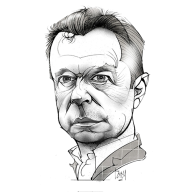


I’m watching my old friend Liam break the caramel on his crème brûlée, in a discreet restaurant in the hills above Nice. Liam is in his mid-fifties now: rugged and well-set, possessed of the affable, intellectual confidence of a man who once played chess at the very highest level. “Liam” is, of course, not his real name. He is a successful but highly private businessman, and he wants to stay that way.
‘Eventually we called it centaur chess, and nobody thought it was cheating. It was accepted’
Our surroundings are impossibly tranquil, yet the world beyond is in turmoil, not least because of AI. And my friend Liam knows all about AI, indeed he thinks his experiences with AI and chess have a lesson for the rest of us. And he has a story to illustrate his thesis.
“I encountered Garry Kasparov a few times,” he says. “Once I actually played him. He wiped me out. Then, a few years later, in 1995, I watched him defend his world title against Viswanathan Anand in the World Trade Center. It was a very close struggle, eight draws, then Anand won a game, and then, in game ten, Kasparov did this incredible sacrifice. Everyone in the crowd went: ah, brilliant! Kasparov swaggered out the room, he knew he’d won.” Liam takes a spoonful of the excellent crème brûlée. “But later the truth emerged. Kasparov’s computers had, with Kasparov’s help, prepared this way to win.”
I look at Liam. “Wasn’t Kasparov ashamed?”
Liam laughs. “Course not. Why would he be? This was the dawn of the era when man plus machine was better than either alone. They worked together. Eventually we called it ‘centaur chess,’ and nobody thought it was cheating. It was accepted.” He picks up his wine. “And this is my point. I think we are entering the age of centaur… everything. As it was with chess, AI and humans working alongside will be the best combination, for a while. We will have centaur accountants, centaur doctors, centaur lawyers, centaur architects.” Liam doesn’t say it, because he doesn’t need to. Centaur writers are also on the way, in truth they are surely here already.
These days when I read even the best newspapers, magazines and journals, I can often tell which pieces have been half or wholly written by AI: there is a certain cadence, a tendency to metaphor, an uncanny smoothness, and things come in threes. And yet, at the same time, the AI prose is getting steadily better, and very soon it will be invisible. After that, Liam believes, it will be superior.
“We had about 15 good years as centaurs,” says Liam. “Then the chess engines got so strong the human half was pointless, deadweight. A grandmaster advising a chess engine today would be like a 90-year-old back-seat driver in a Formula One car.”
For a sobering lesson in what comes after the centaur era, we need only look at mathematicians. Last month OpenAI announced that its machines had cracked Navier-Stokes, one of the seven Millennium Prize maths problems, each worth a million dollars.
How did the mathematicians respond? As academics often do: with entitlement and amour-propre. An advisory group of nine eminent mathematicians asked the labs “to stop testing advanced mathematical problems on proprietary models.” This in turn scandalised people on social media, who compared the maths boffins to whining Luddites, or worse. And with good reason. What would we think of oncologists who asked the machines to stop curing cancer, because it was depriving the medics of purpose?
Either way, the robots did not slow down. A few days ago OpenAI dumped more than 700 new maths papers onto the internet, written by an AI bot the public cannot use. The haul includes major work on three more Millennium problems, along with much else. The Swedish mathematician Olle Häggström suggested it might be “the most earth-shattering event in the entire history of mathematics.” Others have called it “ground zero” for the discipline.
Mathematicians now, arguably, stand in the smoking ruins of their profession, wondering what to do with their careers, their brains, their PhDs. To grasp why they are so unnerved, consider this: some of the problems solved by OpenAI have been puzzling mathematicians for many decades. Yet they were resolved in a few hours by AI, supposedly after one prompt.
Liam is sympathetic to the plight of the professors. “I paid my way through college by analysing chess games. People would post me the games they’d lost, and I’d write back telling them where they went wrong. Then suddenly that work dried up. That’s when I knew everyone now had a chess machine, and the machine was better than me.”
The coffees arrive. The evening has gone softly violet over the Baie des Anges. On behalf of humanity, I point out that despite all this, chess hasn’t actually died. Indeed, it has never been more popular. Magnus Carlsen is a rich man, and millions watch grandmasters online.
“That’s something of a fallacy,” Liam says. “Human chess survives not because it is the best, it isn’t any more, but because it is gladiatorial, a sport, we emotionally invest in the players. The nerves, the clock, the drama. Sport will always survive, and we will always watch it. A robot can kick a ball twice as hard as a human, yet we won’t watch robot football.” He leans forward to emphasize his point. “However, that emotional involvement doesn’t apply to purely cognitive work. Nobody cares if their accountant breaks into a sweat. A moviegoer just wants a great film with great lines. She won’t care if a robot wrote the screenplay.”
I get up to say goodbye; Liam sips the last of his Sauternes, and concludes, “Mine was just the first profession to be robotized. All this time I’ve been waiting for what happened to me, to happen to everyone else. And so it is. That’s why we should make the most of being centaurs, because after that, as I know, we will be superseded completely.”
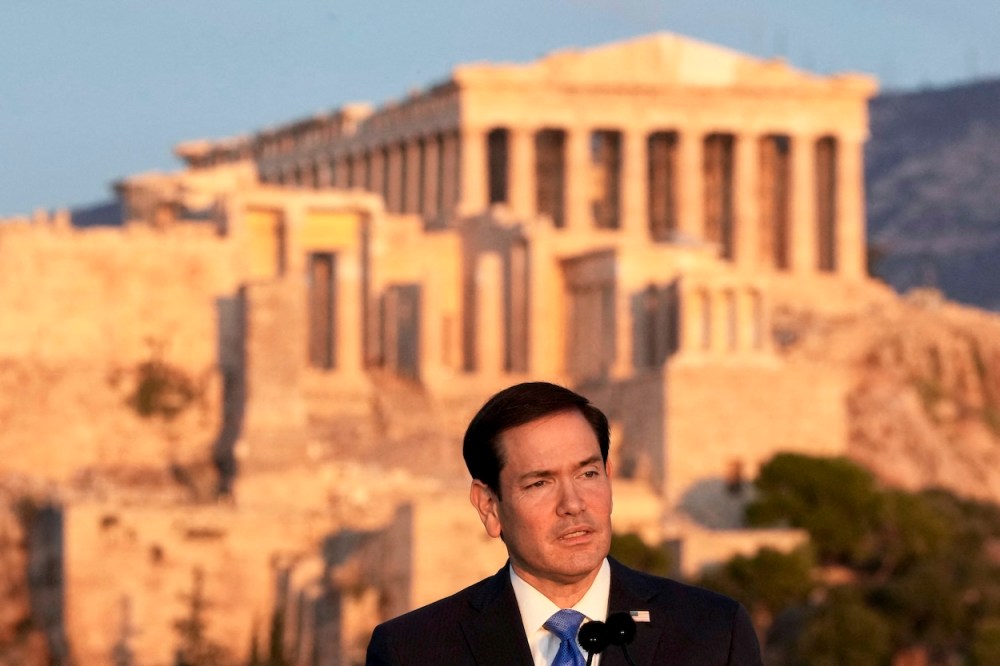
Leaving the restaurant, I step out into the Mediterranean evening. Waiting for my Uber, it occurs to me that the centaurs of myth were not wise, noble creatures. They were violent, chaotic, anarchic. The Ancient Greeks would have seen an age of centaurs as something dangerous.



Comments