In broad daylight, two monuments were smashed in Melbourne’s Flagstaff Gardens last week. One of them was an 1871 memorial to the city’s earliest British settlers; the other commemorated Victoria’s separation from New South Wales in 1850. These monuments not only were sledgehammered, but daubed with the ugly words ‘death to Australia’ and the provocative, hateful triangle symbol of Hamas.
It wouldn’t be Australia’s national day without such acts of vandalism
It wouldn’t be Australia’s national day without such acts of vandalism, meant to deface the anniversary of the day a British convict settlement was proclaimed at Sydney. Last year, it was statues of James Cook, the man who, until the 1970s, was hailed and celebrated as Australia’s discoverer. These acts of destruction against symbols of Australia’s colonial past carry their own symbolism, the perpetrators’ acts of defiance against a nation and society they abhor.
This year, however, such vandalism matters little. What has shaken Australia to the core is the murderous rampage at Bondi Beach a month ago, when two Islamist extremists, an immigrant father and his radicalised, Australian-born, son, killed 15 and wounded dozens more at a joyful Hanukkah celebration. That act of anti-Semitic terror stabbed the heart of an Australian community conditioned to believe how wonderful, harmonious and diverse Australians are.
Instead, many for the first time are realising that Australia is not a single community, nor has it been for a long time. Rather, it is a community of separate communities, a nation of tribes – ethnic, religious and social. Decades of mass immigration, underwritten by a policy of multiculturalism so obsessed with celebrating diversity that to even question it is to be labelled racist, has not only made Australian culture more colourful, our diets more diverse. It has allowed new arrivals to keep to their own and retain their own customs and languages, but, in many cases, never fully integrating into the wider community around them.
Far worse, Australian multiculturalism has tolerated new arrivals bringing their homeland prejudices and hatreds with them. These have been allowed to flourish because of federal and state governments’ reluctance to confront them, for fear of upsetting the new voting blocs that have emerged in an electoral system where voting is compulsory.
It’s one reason why the federal Labor government of prime minister Anthony Albanese, holding significant numbers of western Sydney and Melbourne seats with potentially-decisive Muslim majorities, bent over backwards to criticise Israel’s campaign in Gaza, recognise a Palestinian state, and sat on its hands as incident after incident of anti-Semitism escalated following the Hamas atrocities of 7 October 2023. It explains why, until Bondi forced their hand, Islamist hate preachers were criticised and condemned by Albanese and senior ministers, but little was done to hold these preachers and Islamist organisations to account for the messages of hate they nurtured and spread.
Australians reaped the whirlwind on 14 December. ‘That two people, resident here for more than 20 years, could feel justified in slaughtering 15 innocent people in the name of Islam should shake to the core any complacency that we are “the most successful multicultural nation on earth”’, former prime minister Tony Abbott wrote today.
‘Yes, Australia remains as free, fair and prosperous as any comparable country. Yes, it remains the case that to have the right to live in Australia is to have won the lottery of life. Yet we are changing fast and not always for the better.’
Abbott is right, and even Albanese’s Australia Day message now stresses what unites Australians is greater than what divides them. He told new citizens today, ‘Whether we are Australian by birth or by choice we all share the opportunity, the privilege and also the responsibility of being part of something quite extraordinary, A nation built with hope and hard work with aspiration and determination, a society guided by freedom and fairness, compassion and courage. A democracy where every citizen is equal. A country united and liberated by the Australian covenant, a commitment that every citizen makes to our nation and a promise our people make to each other. To leave behind the burden of old prejudices and hatreds.’
If only such words were used after 9 October 2023, when the first outbreak of ugly and overt anti-Semitism erupted outside the Sydney Opera House. If only Albanese’s government had acted against anti-Semitism then and not after the carnage of Bondi.
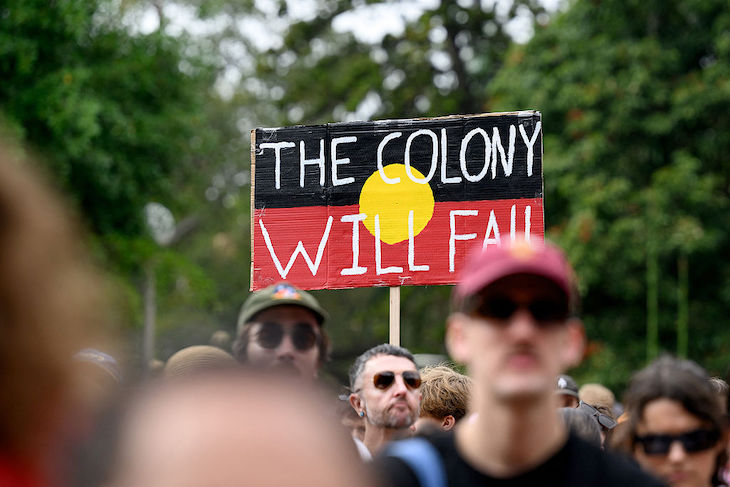
This year, this national realisation that we are not the easy-going and accepting people we thought ourselves has overshadowed even the annual Aboriginal activist and progressive elite protests about 26 January being ‘Invasion Day’. Even many Aboriginal people realise the cancer of racial and religious hate that has infested Australian society needs to be called out, condemned and countered, and that is a cause greater than themselves.
Perhaps that helps explain why, this week, a series of opinion polls found that more than seven out of 10 Australians support keeping 26 January as Australia Day and, more remarkably, support for the day has been rising steadily in both the 18-24 and 24-40 age groups – the first generations to have been educated from infancy to believe the British colonisation was wrong, that the original sin of Aboriginal displacement is their sin, and that Australian multiculturalism is a rejection of all that went before.
In their dismissing the ‘death to Australia’ call on Melbourne’s sledgehammered monuments, there’s a glimmer of hope in those poll numbers. Instead of looking back in anger, more younger Australians are looking forward to making a more confident, happier, tolerant and united Australia where good triumphs over evil, and love over hate.
If some good ever emerges from the awfulness of Bondi, please let it be that.



Comments