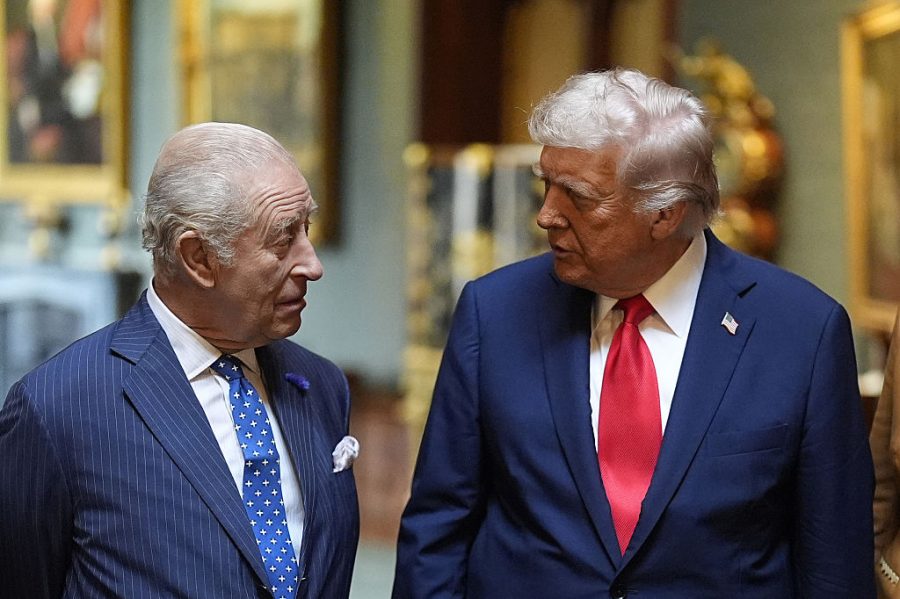
The so-called ‘special relationship’ between Britain and the United States seems to have reached a historically unspecial nadir, in large part because of the tensions between Donald Trump and Sir Keir Starmer over Iran. Amidst this, there remains one particular source of debate: whether King Charles’s state visit to America, scheduled for next month, should still go ahead.
The visit is taking place as part of celebrations intented to mark 250 years since America achieved its independence. It has been suggested on both sides of the Atlantic that despite the President’s clear Anglophilia, manifested most obviously in his sincere love of the royal family, that it is taking place at an inopportune time and should be postponed, if not scrapped altogether.
Charles should continue to represent Britain’s soft power to the greatest of his abilities
Those who feel that the timing of the trip is ill-judged may have a point. But the obvious rejoinder, surely, is that state visits by a monarch should not be constrained by politics but should exist on an altogether higher level. Charles’s personal views on Donald Trump (his polar opposite in most regards) can be surmised. Nevertheless, the King did an excellent job at last year’s state visit, when the President visited Britain, of keeping any hint of distaste for his visitor under wraps and of making the trip a conspicuous success. It was an occasion laden with pageantry and pomp, and the beams of satisfaction on President Trump’s face suggested that he lapped up the red carpet welcome that was duly laid out for him.
A very similar reception will be extended to Charles in America. His state visit has been six careful months in the planning. The King has not made an official visit to the United States since 2018, when he represented his late mother at the funeral of George H.W. Bush. As such, courtiers and diplomats in Britain and America alike have been liaising carefully for months, even years, about what one source told the Times will be ‘a substantive visit from the King for the American people’.
Expectations are firmly being managed. It has been briefed that there will be no policy announcements, no place for Sir Keir Starmer and, above all, no Love Actually moment in which Charles decides to go off script and denounce Trump and Britain’s former colony.
Instead, the relatively brief visit – which will see the King spend only one day in Washington DC before heading to New York and an as yet undisclosed rural location – will be one designed to act as a soft reset of UK-US relations. With Iran very much a live issue, however – and Trump’s criticism of the Prime Minister clearly a sore diplomatic point – it is doubtful that even Charles’s regal presence will do much to mend fences.
But this is not the point of this particular state visit. The relationship between our two countries has not always been the easiest (of which Independence Day remains an annual reminder). There will always be anti-British feeling in the States just as there is anti-American sentiment here. But our shared values and goals transcend party politics and individual leaders. The special relationship might, at times, have been overstated or exaggerated, but it does exist, even in diminished form. Hence the symbolic importance of the King’s trip across the Atlantic.
Ideally, the trip would not be taking place in such eventful circumstances at the court of such a mercurial president. One difficulty that those around the King face is that it is hard to anticipate every eventuality as far as Trump is concerned; few could have foreseen recent events in Iran, for instance. Yet rather than become obsessively concerned with trying to predict whatever his host will do, it is better that Charles should continue to represent Britain’s soft power to the greatest of his, and his country’s, abilities. And, on a personal level, if he feels that his diplomatic skills are not sufficiently appreciated in Washington, there are always other realms left to conquer. I imagine that Montecito, in particular, is very nice at this time of the year.






Comments