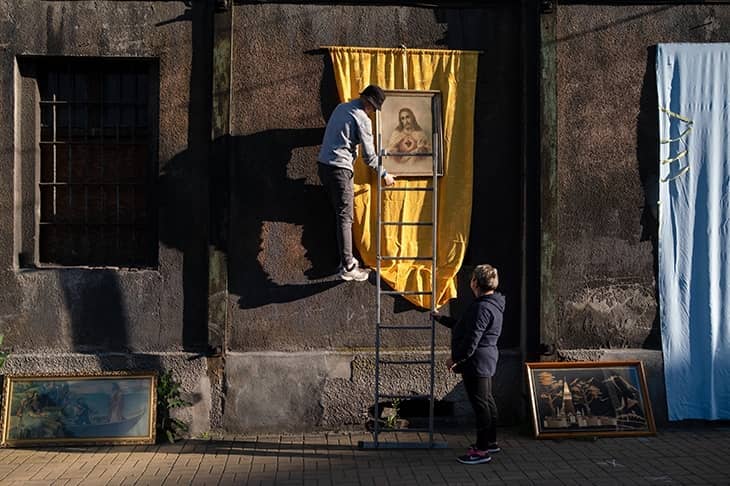
In my wife’s home city of Wroclaw, there’s a luxury hotel named after John Paul II. It has always seemed strange that the Catholic church sanctioned this. Giant chandeliers and glitzy bathrooms weren’t really what St John Paul stood for, and since the hotel opened in 2002 it had seemed as much a monument to the church’s decline as a tribute to a saint. But everything changed with the war in Ukraine. Some 2.5 million Ukrainians have fled to Poland since Russia’s invasion and the hotel is currently home to more than 100 refugees. It’s as if the building has finally discovered its real purpose.
What’s true of the John Paul II hotel is true more widely of the Polish Catholic church. The response of Polish Catholics to the war was immediate, all-out and magnificently unbureaucratic. A vast chain of care was formed that ran from nuns offering cups of tea to exhausted refugees at the Ukrainian border, to counsellors giving psychological support to terrified children, to the archbishop welcoming new arrivals to stay in his cavernous palace. This great humanitarian effort is all the more remarkable because the Polish Catholic church appeared, until very recently, to be demoralised and adrift. Its reinvigoration could hold some lessons for the wider church – not just the Catholic church, but the Church of England too.
For many, the words ‘Polish Catholicism’ evoke images from the 1980s: of dissidents speaking at shipyard gates in front of pictures of the Virgin Mary, vast crowds assembled for the funerals of martyred priests, and John Paul II, dashing in his red cape. But it’s time to update that picture, because the Polish Catholic church has changed greatly.
Following the Pope’s death in 2005, it began to lose its way. The most obvious sign was the abuse crisis. Disturbing disclosures led the Vatican to punish a series of bishops for negligence: a humiliating twist for a church that had enjoyed such moral prestige. Trust vanished, especially among young Poles. One survey found that only 9 per cent viewed it positively. It wasn’t just abuse that troubled them: it was also the hierarchy’s perceived alliance with the polarising Law and Justice party, which has led Poland since 2015.
Anti-church sentiment exploded in 2020 after a further tightening of the country’s strict abortion laws. Young protestors disrupted Sunday masses and daubed Poland’s ubiquitous statues of John Paul II in red paint. These once inconceivable acts suggested a radical shift in Polish society.
The church’s internal weaknesses were becoming ever more apparent. Mass attendance, baptisms and marriages were all falling, while the number of men enrolling in Poland’s seminaries dropped by a fifth last year. Looking at this picture just a couple of months ago, you might have thought that the Polish Catholic church was a spent force. But you would have been wrong.
In their outpouring of charity towards Ukrainian refugees, Polish Catholics have come to embody one of Pope Francis’s most powerful intuitions: that the renewal of the church comes through service. (This is somewhat ironic given the Polish church is often accused of being out of step with Francis.) In his first major interview as Pope, Francis said: ‘I see clearly that the thing the church needs most today is the ability to heal wounds and to warm the hearts of the faithful; it needs nearness, proximity. I see the church as a field hospital after battle. It is useless to ask a seriously injured person if he has high cholesterol and about the level of his blood sugars. You have to heal his wounds. Then we can talk about everything else.’
The response of Polish Catholics was magnificently unbureaucratic
Obviously, the Pope is not the first Christian leader to emphasise service, but there is an unusual urgency to Francis’s message. He believes that we are no longer living in normal times, and the beauty of the ‘field hospital’ idea is that it applies not only to Christianity but all world religions. In Judaism, for example, there is the concept of pikuach nefesh: that the preservation of human life overrides almost any religious rule. So, for example, members of an Orthodox Jewish team worked through the Sabbath to save the injured after the 2010 Haiti earthquake.
Charity is so central to the Muslim faith, meanwhile, that it is one of the Five Pillars of Islam. In Syria today, White Helmet rescuers are consciously putting into practice the words of the Quran: that ‘to save a life is to save all of humanity’. As war, disease, poverty and famine stalk the world again, believers can draw on these principles and give them fresh expression, revitalising themselves in the process.
If this sounds a little abstract, then consider two lives that embodied the priority of service. The first is that of Elizaveta Pilenko, a Russian noblewoman who was so engaged in revolutionary politics in her youth that she plotted to assassinate Leon Trotsky. Forced into exile, she settled in Paris, where she took religious vows. Mother Maria Skobtsova, as she became known, was an unconventional nun. Chain-smoking cigarettes, she turned her convent into a home for refugees. Her habit of leaving communal prayer to answer the doorbell scandalised some of her fellow believers.
Explaining why she put the needy first, she wrote: ‘The way to God lies through love of people. At the Last Judgment, I shall not be asked whether I was successful in my ascetic exercises, nor how many bows and prostrations I made. Instead, I shall be asked: did I feed the hungry, clothe the naked, visit the sick and the prisoners? That is all I shall be asked.’ After the Nazi occupation of France, she offered shelter to Jews, was arrested by the Gestapo and died in a gas chamber at Ravensbrück in 1945. She was recognised as an Orthodox Christian saint in 2004.
Her life had many parallels with that of Dorothy Day. After throwing herself into left-wing politics in 1920s New York, Day became a Catholic. Her faith offered a new outlet for her social activism and she co-founded the Catholic Worker Movement, which offered hospitality to the homeless. She remained clear-eyed about the destitute to whom she dedicated her life: ‘There are two things you should know about the poor: they tend to smell, and they are ungrateful.’ Both Skobtsova and Day sought salvation in radical politics but found it in the unglamorous service of the poor. Perhaps today’s upheavals will produce others like them.
It would surely be naive to think that the glorious philanthropic upsurge in Poland will reverse the decline in church-going. When we hear the word ‘renewal’, we tend to think only of an increase in numbers. Yet it’s possible to conceive it differently: as an internal reinvigoration.
In 1969 – another year of epochal change – Joseph Ratzinger, the future Pope Benedict XVI, devoted a radio address to the topic: ‘What will the future church look like?’ Peering decades ahead, he foresaw an institution that had lost much of its past prestige.
‘She will become small and will have to start afresh more or less from the beginning,’ he said, predicting that the ‘real crisis’ had barely begun. ‘We will have to count on terrific upheavals,’ he went on. ‘But I am equally certain about what will remain at the end: not the church of the political cult, which is dead already, but the church of faith. It may well no longer be the dominant social power to the extent that she was until recently; but it will enjoy a fresh blossoming and be seen as Man’s home, where he will find life and hope beyond death.’
The Christian church is shrinking in the West, as Benedict XVI said, but this doesn’t have to be a disaster. There were just 12 disciples who were convinced that they had witnessed the death and resurrection of their teacher. Somehow this was enough to transform the world.
There are some interesting similarities between the Church of England and the Polish Catholic church. Both are guardians of national identity with unrivalled parish networks. If the refugee crisis has helped Polish Catholics recover their sense of purpose, couldn’t a similar challenge do the same for Anglicans? According to one estimate, 1.3 million Britons will be pushed into absolute poverty by the cost of living crisis. Could the C of E lead an effort to help them? This would tap into a fine British tradition of Christian social engagement that includes the Salvation Army, with its work among Victorian gamblers and drinkers, and Anglo-Catholic ‘slum priests’. This is not an encouragement for the C of E to play politics or grandstand on Twitter – it is about actual service.
While the decline of the Polish church is real, it is also relative. Nine out of ten Poles still describe themselves as Catholics. More than a third of the faithful regularly attend mass. While priestly numbers are falling, one in four Catholic ordinations in Europe still take place in Poland.
In the 20th century, the Polish church was fortunate to be led by two spiritual giants: John Paul II and Cardinal Stefan Wyszyński, a figure less well-known outside Poland. During the Warsaw Uprising, Wyszyński served in an actual field hospital outside the Polish capital. One day, he found a piece of burning paper that had been blown from the charred ruins of Warsaw. On it were the words: ‘You will love.’ He took it as an instruction that he spent the rest of his life fulfilling.
Polish Catholics are responding with the same spirit to today’s war. In doing so, they are challenging the ‘inevitable decline’ mentality that has gripped too many western Christians for too long.
Luke Coppen is Europe editor of the Catholic News Agency. He edited the Catholic Herald from 2004 to 2020.



Comments