
The legacy of the Victorians is everywhere; we depend on them for our sewage disposal, our railway networks, much of our infrastructure and housing stock. Even the hooded eyelids of our Royal Family mark them out as descendants of Victoria herself. The right often dwells on how far we’ve fallen from Victorian greatness – painting modern Britain’s existence amongst the physical debris of Victoriana as akin to living in the ruins of a superior civilisation, like mud-smeared Visigoths prowling around the remains of the Colosseum. Less discussed is how the Victorians are still very much with us.
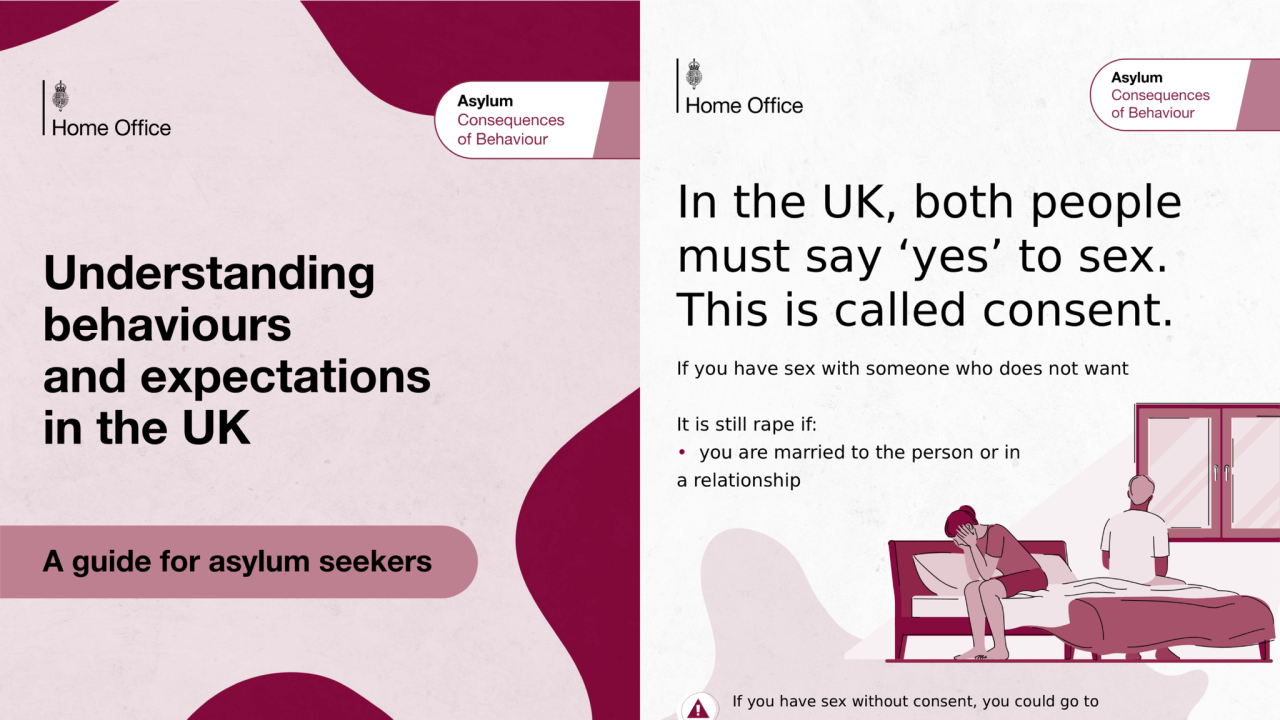
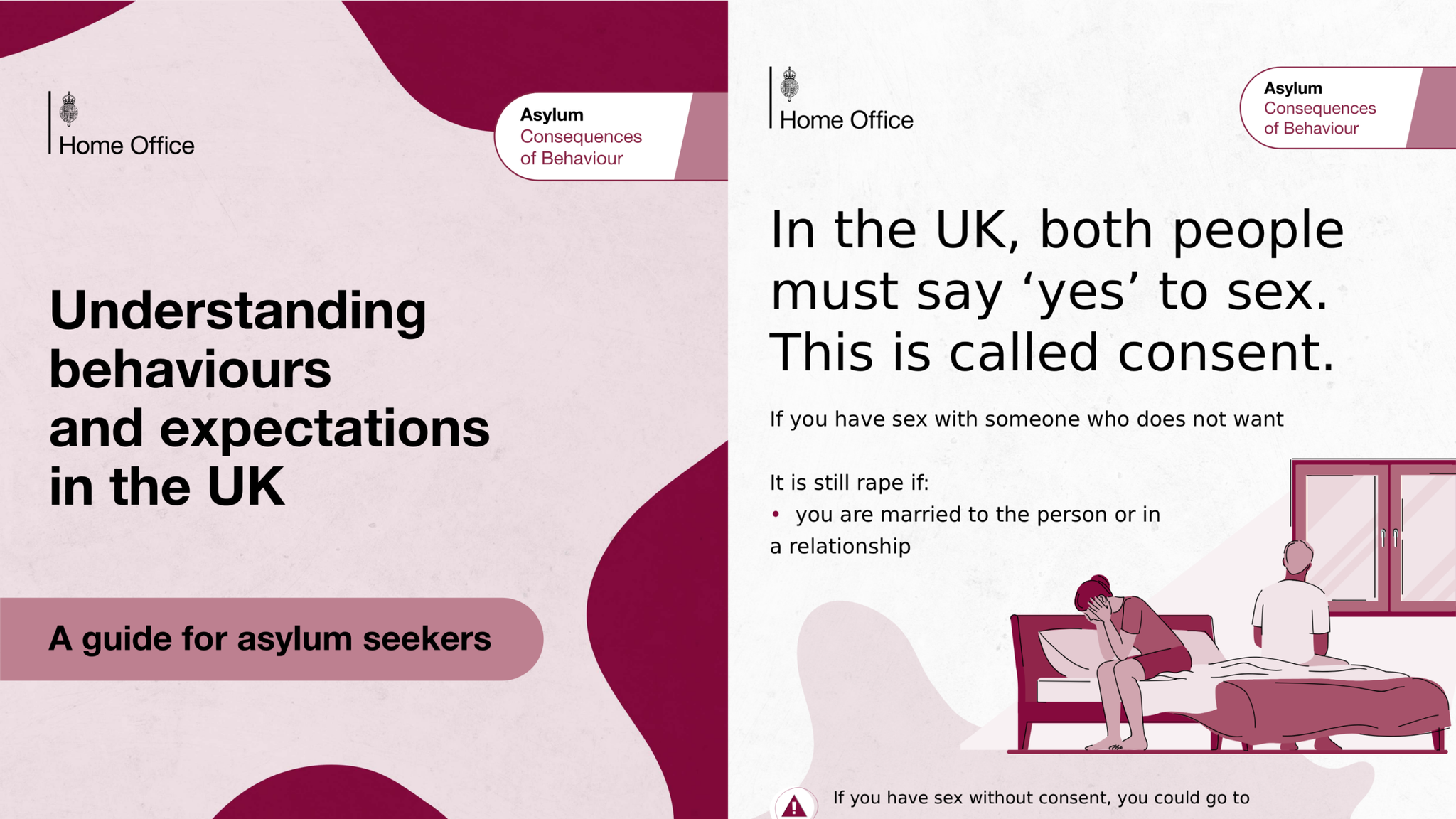
‘In the UK, both people must say “yes” to sex’, scolds one of the posters, which were handed out to asylum seekers. ‘This is called consent’. There’s something unnerving about the combination of Janet and John language with the grim message it contains
We seem to have heartily taken on the characteristics for which the Victorians came to be most despised by succeeding generations; their mawkishness, hypocrisy and above all, their moralising. The Victorian belief that humanity can be finger-wagged into being ‘good’ and that the wholesale improvement in manners and morals was always just one corrective step away pervades our society. The Victorians thought this could be through novels, or sermons, artwork or campaigns of organised lemonade-drinking. And to be fair, they brought about significant declines in a great many social ills.
Now, this intense moralising attitude has been taken up wholeheartedly in Britain, not by nostalgic revanchists on the right but by the progressive, lanyard class who dominate all of our public institutions. However, where they do fall short of their Victorian antecedents is that they seem to believe that full conversion of behaviour, belief and indeed the full inculcation of western civilisational values is achievable through a properly-worded public statement. Nothing illustrates this better than the Home Office’s recent attempts to teach newly arrived migrants the differences between morality in the lands from which they have come, and morality in Britain.

‘In the UK, both people must say “yes” to sex’, scolds one of the posters, which were handed out to asylum seekers. ‘This is called consent’. There’s something unnerving about the combination of Janet and John language with the grim message it contains. It does at least suggest that the Home Office knew all along that the migrant crisis posed a different and specific threat to women, which some organs of the state have been reluctant even to acknowledge. Acknowledging the specificity of this doesn’t mean you are automatically minimising the dreadful reality of sexual assault by native-born men as well, which was the kneejerk defamation of choice thrown at anyone who even tentatively brought it up.
‘If you break these rules, you could be arrested by the police and sent to prison. This could affect your asylum claim’, warns another poster. Note the use of the conditional tense here – if you don’t pay a parking ticket for 30 days you can expect stronger-worded notices than this.
What is bleakly comic about this is that for all of progressivism’s voiced commitment to racial and cultural equality, this is in fact nothing more than a dressed-up version of the intensely racist concept of ‘the white man’s burden’, beloved by the Victorians. The idea that someone with the correct education (in this case, civil service training courses, rather than acing the Cambridge tripos), wearing the right uniform (in this case, a rainbow lanyard rather than a sola topee or pith helmet) can by the simple use of the right formula of words, magically convert those engaging in barbaric practices like child rape, genital mutilation and the beating-up of women, into fully-fledged converts to the religion of the state from whence they came. The idea that people from nations which take a very different view of the sexualisation of children can simply be HR-ed out of their worldview is pure Victorianism, only with the morality completely inverted.
Perhaps we shouldn’t be surprised by the similarities. As with the Victorians, the civil service is at the forefront of these efforts. Were Cecil Rhodes alive today he would probably be an HR manager with painted nails and a passive-aggressive ‘out of office’ email response. That the great ‘civilisers’ of today cannot see, and would be outraged by, the directness of this lineage is amusing. However, the continuation of this – at best, naive, at worst, aggressively deluded – strategy is becoming a serious problem.
The belief that the systematic rape of young women and girls which has occurred in this country can be stopped by an appropriately vigorous verbal chastisement and the very, very loose threat of a change in asylum status is for the birds. That it remains the stubborn stated policy of the people in power poses a continued threat to the poorest, most vulnerable and most marginalised people in our society.
Victorian moralising, for all of its faults, was at least informed on the whole by a sincere conviction and intense Christian belief which knew that obligations to the widow and the orphan trumped the desire to protect the strong and powerful. The moralisers of our age have abandoned even this; or rather, so re-categorised it as to present violent rapists as worthy of our sympathy because of their culture and the colour of their skin and their victims as irrelevant for exactly the same reason. Whatever criticism we could level at the Victorians, they could never be as racist as that.





Comments