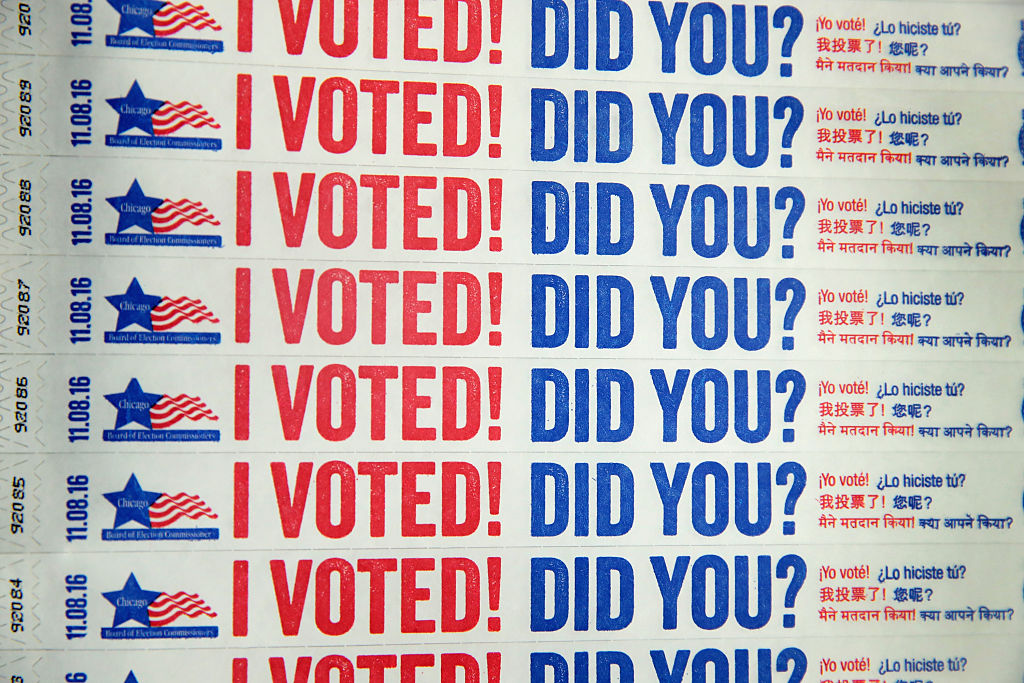
New Jersey officials just admitted that roughly 6,600 non-citizens were illegally registered to vote between 2023 and 2024. More than 400 of them actually cast ballots in one or more elections. Officials blamed a software error at DMV offices that registered non-citizens to vote when they applied for drivers’ licenses even after they admitted they weren’t citizens.
Democratic Governor Mikie Sherrill blasted “the reckless failures that allowed this to happen.” She even pointed a finger at her Democratic predecessor then-Governor Phil Murphy and the “lack of transparency shown by those in charge at the time.”
This should be a wake-up call for states that consistently fail to maintain their vote rolls by removing the dead, duplicate registrations, and voters who have moved out of state. Just last week, President Trump revealed the Department of Homeland Security had used publicly available voter data to identify more than 250,000 non-citizens registered to vote in New Jersey, Pennsylvania, California and Nevada.
Any non-citizen who votes effectively disenfranchises legitimate voters by diluting their votes
The DHS claims that “reviews of the four states’ records” found 190,832 non-citizens registered in California; 35,152 in New Jersey; 15,903 in Nevada; and 14,576 in Pennsylvania. It did not mention if it found evidence that any of those non-citizens cast ballots.
The Trump Justice Department has sued more than two dozen states across the US for copies of their more detailed non-public voter rolls. All of these blue states have refused to cooperate with the DoJ in sharing their most up-to-date lists. Several states claim that the citizenship database created by DHS mistakenly listed some US citizens as ineligible voters.
The watchdog Public Interest Legal Foundation (PILF) says the dispute makes it all the more important that someone conduct a full review of every state’s voter registration roll – subject, of course, to judicial review.
Its own research indicates that several states need to address their bloated and inaccurate voter rolls. In Pennsylvania, the quintessential swing state which Joe Biden won by only one percentage point in 2020, PILF found that the state had allowed up to 100,000 aliens to register to vote due to the same software “glitch” just uncovered in New Jersey.
Pennsylvania’s Secretary of State was forced to resign, but officials stonewalled inquiries from Republican state legislators and refused to identify the aliens on the voter rolls, their voting histories or exactly how many non-citizens were involved. A federal court denied PILF’s lawsuit for the records on the grounds it lacked standing to sue. The cover-up worked.

PILF has uncovered problems in other states. New Jersey’s voter rolls include duplicate registrations, deceased voters and even registrants born in the future. Its research uncovered one person with six voter registrations, a situation that offered ample opportunity for mischief.
In red states, the story on voter roll maintenance is different. In 2024, Virginia’s GOP Governor Glenn Youngkin removed 6,303 non-citizens from the voter rolls who had “accidentally or maliciously attempted to register” to vote. In Texas, Governor Greg Abbott round 6,500 potential non-citizens were registered, including 1,930 who had a history of voting.
Despite such findings, the mainstream media seem intent on dismissing or explaining away evidence that doesn’t fit their pre-approved “move along, nothing to see here” narrative. They falsely insist that there are no vulnerabilities in our election process.
But polls show the public is worried. A 2024 Gallup poll found 74 percent of Republicans, 47 percent of independents, and 21 percent of Democrats thought “people using illegal or fraudulent means to cast invalid votes” was a problem.
Many Americans worry about non-citizens casting ballots, especially given efforts in cities such as Los Angeles and San Francisco to make it legal for non-citizens to vote in local elections. In 2022, New York City enacted such a law but it was later struck down by a state judge.
In practice, nothing prevents a non-citizen from registering to vote and actually voting other than a box on a form that asks for citizenship status but is never verified. That’s why voters in five states – Arizona, Colorado, Florida, Alabama, and North Dakota – have passed laws to require proof of citizenship when registering to vote. The issue of non-citizen voting is before voters in six states this November – Alaska, Arkansas, Kansas, South Dakota, West Virginia and an attempt to clarify Arizona’s existing ban.
Any non-citizen who votes effectively disenfranchises legitimate voters by diluting their votes. “It’s time for liberal groups to admit there is a breakdown and be involved in the solution,” J. Christian Adams of PILF told us.
Don’t hold your breath. That’s why voter integrity proponents says it’s important the GOP Congress overcome the united Democratic opposition to the SAVE Act – which would place limits on mail-in voting and require proof of citizenship for new voters – and send it to President Trump’s desk. It’s passed the House, but it’s been stalled in the Senate where it is blocked by the requirement that 60 Senators must vote to end a Democratic filibuster against it.
Last week, Trump delivered a primetime address on election security during which he underscored the need for Congress to advance the SAVE Act. His speech was typically disjointed and short on details, but the new revelations about non-citizen voting in New Jersey and other states cannot be swept aside.
Republicans now are seeking to attach the SAVE Act to a spending bill which would exempt the legislation from the filibuster threshold and allow its passage with a simple majority.

Comments