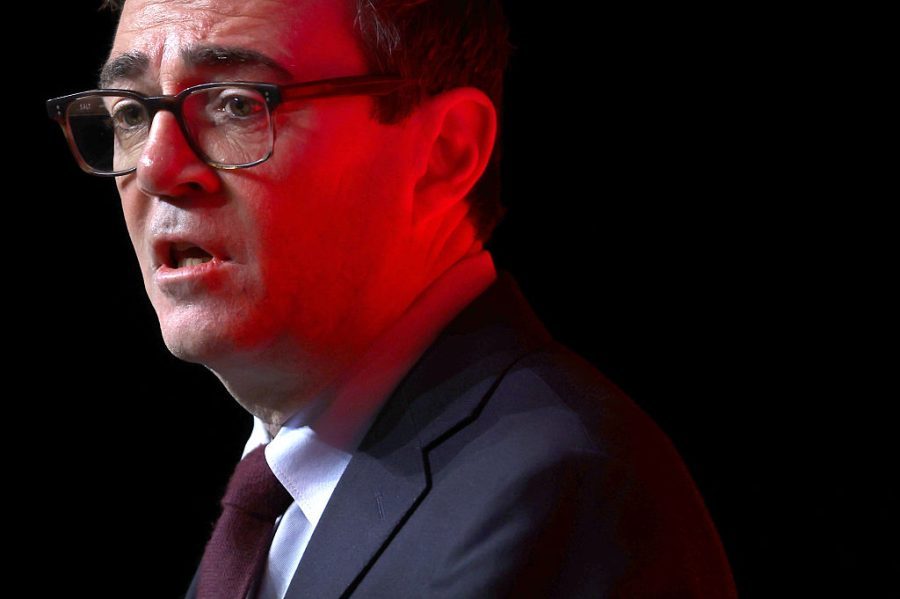
On the surface, last week’s spat between Andy Burnham and David Cameron about the EU was a pretty dry affair. ‘Was the decline in the UK’s economic performance since 2021 due to Brexit?’ is something you’d expect to hear in a university economic history seminar rather than in an argument between a prime minister and an elder statesman. But, as usual in politics, there is a good deal more to this than meets the eye.
All this takes place against a background of a PM who knows he is in much more difficulty than might appear. Any lead Burnham has in the polls is egg-fragile. The country faces very deep financial and social trouble. His cabinet, a group of uninspiring duds with a few exceptions such as Shabana Mahmood, have no useful ideas on what to do about it, and, truth to tell, neither does he. The obvious answers – kicking out net zero, cutting a welfare system now both unaffordable and rabidly dysfunctional, enforcing immigration laws properly, encouraging wealth creation by loosening sclerotic employment protections and reducing punitive tax rates on wealth that stays here – his backbenchers wouldn’t tolerate even if he was willing.
And we also have to look at Burnham himself. By temperament he is a showman and not an ideas man. So far he has got by with a number of small but eye-catching irrelevancies: think No. 10 North and the invention of a mythical Manchesterism, attacks on the supposed evils of Big Tech, a few more tenants’ rights here, a few more workers’ rights there, and so forth. But this can’t go on.
It’s clear that Burnham desperately needs a deal to shore up his position
This is what really explains his much-trumpeted move towards an EU rapprochement. Burnham isn’t cosying up to Brussels and making noises about rejoining the bloc because of any sudden Damascene conversion to economic pan-Europeanism, or even any serious conviction that not being in the EU is making the UK poorer. It is very noticeable that while he mentions a Treasury analysis that supposedly supports the conclusion that we need to move economically closer to Europe, he does not give any details. If hard figures and arguments had indeed been available from the mandarins at 1 Horse Guards Road, it seems almost a racing certainty that he would have produced them.

By contrast, as a sales ploy, the move towards Europe makes much sense for Burnham. The left-leaning establishment that provides his intellectual backing continues to hate Brexit and will instinctively support anything that works against it. And as regards voters in general, a grand project like this has the useful potential to distract attention away from present problems, to allow ministers to say they are too busy to deal with day-to-day matters, and explain away the lack of any obvious benefit by promising fairly unspecific long-term gains.
There is one difficulty. Politically, subservience to Europe in matters such as foreign policy, the ability to decide on our own laws, the standards of the goods we buy, or our ability to trade with whom we wish on what terms we wish, remains something hard to sell. Much of the support for exit in 2016, and a great deal of the continuing support in 2026, was and is on this ground. But if arguments like this can be sidelined by a deft insistence that the government has looked at the figures and is merely trying to make economic life easier for everyone, at least some of these difficulties disappear.
Having said this, we need to be very sceptical indeed about the substance of the government’s approach to Brussels, and very carefully take apart any plan for a deal that emerges. The omens are not good. Micro-regulation from Brussels has enormously increased since we left, giving us something of an advantage: it is a racing certainty that we will be asked to give all that up. Again, it’s worth remembering that Brussels seriously wants our money. Brexit badly dented Euro finances in 2021; since then the German economy, which previously had funded many of Brussels’s ambitions, has sputtered. It is another certainty that UK taxpayers will be asked to pay handsomely for any advantages we get.
Furthermore, it’s worth remembering that if you want an advantageous deal with someone, it’s politic to play at least slightly hard to get. Burnham hasn’t done this. Despite a few formulaic suggestions from Euro-leaders that we would be welcomed back in, or at least nearer to, the EU fold, it is abundantly clear that all the initiative here has come from our side. It’s also clear that the PM desperately needs a deal to shore up his position. The EU negotiators are not stupid. They will know that the civil servants sent to Brussels will have been told to get an agreement at all costs and will act accordingly. The losers, as usual, will almost certainly be the British people.



Comments