
Before the 1980s, our broadcasters had a terrible habit of throwing their own recordings away to save storage space. Videotapes were simply wiped and reused.
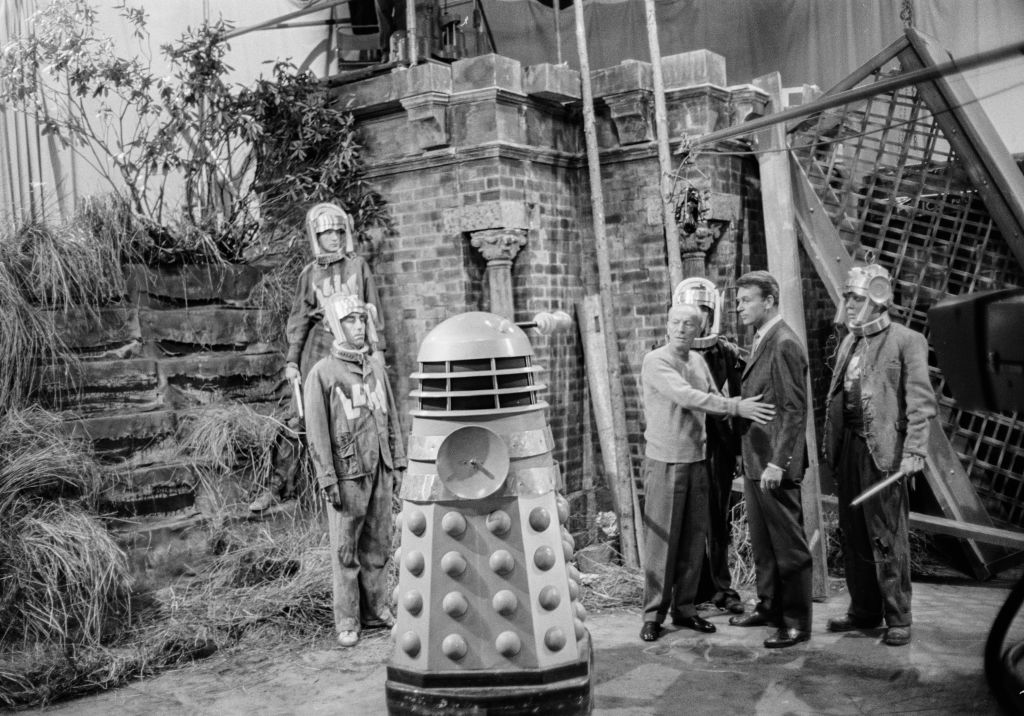
Every single episode of Doctor Who from the 1960s met this fate, but because the BBC sold the series around the world on film copies about two thirds have survived. Now, two more lost episodes from November 1965 – ‘The Nightmare Begins’ and ‘Devil’s Planet’, from an epic story featuring the Daleks – have been found in a private film collection, spruced up, and are available to watch on the iPlayer, 60 years on.
Writer Terry Nation and director Douglas Camfield were both unusually politically conservative, even for the BBC of the day
As nothing exists in a vacuum, even this amiable children’s teatime entertainment has some interesting undertows. Writer Terry Nation and director Douglas Camfield were both unusually politically conservative, even for the BBC of that day.
Nation, who created the Daleks, had a bracing attitude to war and peace. His writing is often of the two-fisted war story kind, often featuring – as here – desperate commando missions in jungle terrain. There is absolutely no moral or cultural relativism in his work. This is one of the reasons it connected so well with children, who have an unsophisticated attitude to justice and fairness because they have only just learnt these rules and are outraged when adults bend them. But Nation’s writing is also never gung-ho or tediously macho.
The most interesting scene in these episodes occurs not in the space jungle on the planet Kembel, but back home in Earth in the year 4000. Nation shows us a complacent, affluent society where the people running the state’s security apparatus are consumed by trivia. In the futuristic Pentagon, a warning light – presumably red, but this is black and white so we can’t tell for sure – is flashing insistently, carrying a vital message about an imminent Dalek invasion. But the two admin bods on duty, Lizan and Roald, don’t notice; instead, they are discussing which of the hundreds of TV channels to watch on their security screen, and bickering amiably about which is the coolest model of luxury space yacht. Lizan is smitten by hero worship for Mavic Chen, the smooth politician who has brought peace and prosperity to their lives; her fervour reminds me of the way people used to moon about Obama.

Chen is a peculiar figure – he is almost comically racially mixed, with characteristics of every human ethnicity. This is presumably supposed to signify the far future, but the ‘oriental’ eye makeup and trimmed white curly wig on Caucasian actor Kevin Stoney have, strangely, elicited less comment in 2026 that you might have expected. On the big TV in the War Room nerve centre, we see the end of Chen’s media round as he sets off on a space holiday – ‘I hope to get away from all interviewers’ he gently ribs the 41st century’s answer to Laura Kuenssberg. He’s very obviously a galactic-level wrong ‘un. It will hardly come as a great shock to even the youngest viewer that he is in fact heading off to join the Daleks’ battle against humanity.
The dangerous complacency of peace and affluence was felt acutely by the older generations during the 60s. Nation’s concerns here mirror those in Tolkien’s abandoned Rings sequel The New Shadow, which is similarly anxious about younger people forgetting to bother with the eternal vigilance side of the price of freedom.
Somebody else who apparently felt this very acutely was the director of these episodes, Douglas Camfield.
Camfield was destined for a military career but was unable to stay in the army because of the congenital heart condition that eventually killed him, tragically young, in 1984. But he conducted his TV work with incredibly precise and indeed military levels of planning. In her autobiography, later Doctor Who assistant Elisabeth Sladen recalled that ‘he was a military man through and through. He had an air-raid shelter at the bottom of his garden, stocked with bully beef. Everything was set for the bomb to go off. He used to say, “The invasion is coming and I’m ready.”’ Camfield was also a friend and admirer of George Shipway, author of the 1971 thriller The Chilian Club – the story of a right-wing coup that has the eye-popping blurb line: ‘Don’t YOU ever feel like shooting a Union leader?’
Camfield’s full-blooded conservatism was unusual in television then, and unthinkable now. But he was not a tough guy hothead; he was across all the qualities of a script, squeezing out every last drop of dramatic juice. In ‘Devil’s Planet’ he emphasises the tragedy of an innocent character with a serious sensitivity that is quite moving.
Terry Nation returned to the theme of the complacency of affluence in his later work, most notably in his 1975 series Survivors, an adult show about a plague that wipes out most of humanity. He was acutely conscious of the precariousness of civilised life. Survivors begins with its heroine – a comfortable Home Counties trophy wife – playing tennis against a practice machine. Fifty minutes later she shaves her hair down to a buzz cut, sets fire to her house with her dead husband’s body inside, and starts out into a new life in a brutal new world.
These are the kinds of conservative considerations that don’t even register in our popular culture today, even in the perennially popular post-apocalypse genre. With another 60 years on the clock of peace and luxury since ‘The Nightmare Begins’, we’ve all forgotten the warning lights flashing in the corner of our vision.






Comments