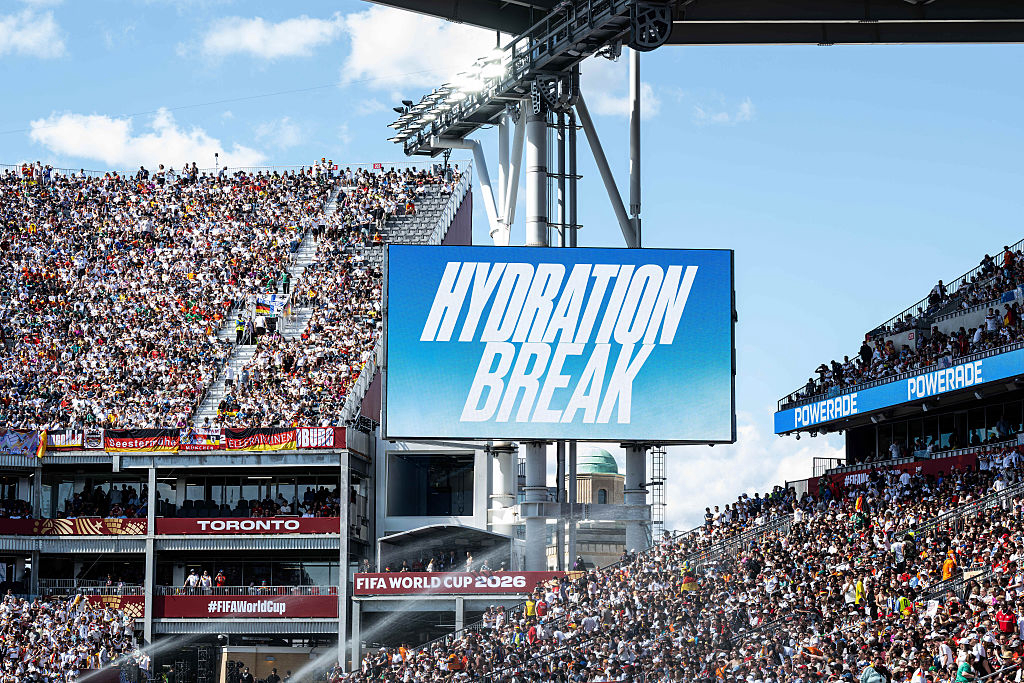
More often than not, controversy over liquid refreshment at a football World Cup focuses on the unsavoury antics of England’s travelling support. But, in the US these past two weeks, the focus has been less on the booze and more on the boos that have greeted that dreaded moment, roughly at the midpoint of each half, when play must stop for a ‘hydration break’.
These hiatuses were introduced, as so many Fifa initiatives are, with all the good will in the world. The idea was that when the temperature tops 32°C, the players should get a chance to take a short break to get extra fluids on board for fear of dehydration. They were used extensively in last summer’s Fifa Club World Cup in America, at which point US TV advertising execs, for whom 45 minutes of break-less sporting action are anathema, may have taken note.
In a move that may not be unconnected to this new window of advertising opportunity, Gianni Infantino, the Fifa president, had the brainwave of implementing a hydration break 22 minutes into each half of all 104 matches at the Fifa World Cup currently taking place in the US. No matter the conditions, and no matter the fact they ruin the flow of a game (hence not being welcomed by the boo boys in the stands), play would be stopped for three minutes.
The move was attributed to ‘fairness’, which on the face of it kind of makes sense – until you realise that no amount of hydration breaks will compensate for playing in the 40°C heat of Santa Clara versus the 20°C climate-controlled environs of the Dallas Stadium. But ‘player welfare’ is the shibboleth of modern football, so no one dared question the reasoning.
But then, as so often, Infantino invoked that old witticism about being thought an idiot, and opened his mouth. According to him the ‘fairness’ wasn’t actually about the effect on the players’ health – no, the issue was that it would not be fair that coaches in some games get an extra break to talk to their players while in others they wouldn’t.
In one fell swoop the head of Fifa kindly disabused us of the notion that a hydration break was actually anything to do with, well, hydration. If it was, there would be a 45-second pause at a suitable stoppage in play where a waterboy could jog on with 11 bottles of some kind of water-based refreshment, players could have a swig, catch their breath and the game could crack on with minimal disruption.
No amount of hydration breaks will compensate for playing in the 40°C heat of Santa Clara versus the 20°C climate-controlled environs of the Dallas Stadium
But, no, Infantino sees these three-minute breaks as a chance for managers to make tactical tweaks, issue instructions and rally the side in a far more meaningful way than shouting into the void from the touchline. One might even call it a ‘mini half-time’ in each half, giving us – yes, you’ve got it – a game of four quarters. When in Rome, hey Gianni? It seems that the welfare of the players is actually not as great a consideration as that of the US TV advertisers. Infantino – a man who is either not as clever as he thinks he is, or who thinks everyone else is dumber than they are – will deny this till the cash cows come home, but it is hard to see it as anything else.
Could this be the future of football? If the current UK heatwave is replicated at the end of August, will there be Premier League hydration breaks? If so, will the integrity of the competition be maintained only if every game then has them? Infantino would probably think so.
But then, as with most controversial new measures in football, there arises a bonus backlash around its implementation. England’s game against Ghana – played on a rain-drenched, 20°C kind of evening – was stopped at the 20-minute mark because of an injury. It was more than two minutes before the game began again, only to be stopped shortly after for the hydration break. Why did the break in play not afford a natural opportunity for the hydration break? As the BBC’s man suggested, perhaps the adverts weren’t ready to roll. When even less common sense goes into a rule’s implementation than into its conception, you know you’re in trouble.
Still, as we watched Harry Kane et al huddled on the touchline to be berated by Thomas Tuchel even as the rain fell upon them, one was reminded of the words of S.T. Coleridge: ‘Water, water everywhere, and still a stop for drinks.’


Comments