I’ve been a member of the National Union of Journalists for decades. Every month, as the £32 direct debit slips out of my bank account, I wonder why on earth I am paying to support an organisation that, as well as backing every hard left cause around, seems more concerned with restricting the ability of journalists to do their job than protecting it. The NUJ has long backed de facto state regulation and in February 2017 supported a parliamentary plan for Leveson-style regulation.
But for reasons which, I shamefully admit, have been based mainly on inertia I’ve carried on as a member. Today that inertia – and my membership – ends.
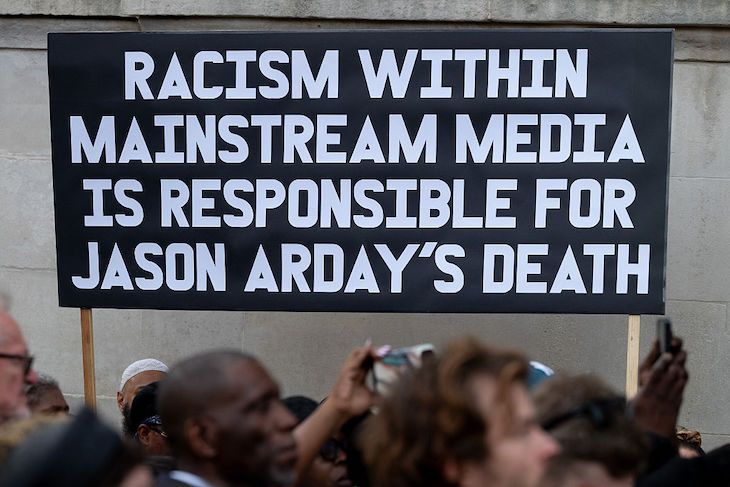
The NUJ’s response to Jason Arday’s death and to the media coverage of his plagiarism and Walter Mitty fantasies is so grotesque
The NUJ’s response to Jason Arday’s death and to the media coverage of his plagiarism and Walter Mitty fantasies is so grotesque – and so inimical to even the most basic idea of what journalism and a free press should mean – that I can no longer in good conscience remain a member of the union.
On Tuesday, the NUJ published a statement effectively accusing those news organisations and journalists who covered the Jason Arday story of racism: “The NUJ Code of Conduct is an ethical framework for journalists carrying out their work. The Code states that journalists should not produce ‘material likely to lead to hatred or discrimination on the grounds of a person’s age, gender, race, colour, creed, legal status, disability, marital status, or sexual orientation.’
“…Racism, ableism and pernicious rhetoric against diversity, equity and inclusion has become increasingly normalised in our society…The union will continue its long-running campaigns for ethical journalism – including strengthened independent regulation, better access to the industry, greater diversity in newsrooms, and reform of media ownership. Individual journalists must also have the power to object to unethical industry practices. Central to this is trade union recognition and the protection offered by collective agreements as well as the introduction of conscience clauses in staff and freelance contracts.”
Such a statement shames the union. When coverage of Arday’s fantasies was false, it should – of course – be pointed out. But for all the many words devoted to a story that was without even a hint of doubt in the public interest – Arday’s story was key to understanding and highlighting what is happening in academia and beyond – I have yet to see any evidence that the revelations about the fictions he pushed about his own life were incorrect. Quite the opposite: every day seemed to bring more astonishing lies or exaggerations of his.
The implication behind the NUJ’s statement is not only that the fact Arday’s fictions became a news story shows that journalism needs more controls limiting its scope – an astonishing stance for a national union of JOURNALISM to take – but that the fact that Arday was black meant he should have been treated differently. If that is not racism – direct, unambiguous and despicable in the notion that black people should be treated with kid gloves – then what is?
The NUJ is a fringe organisation. Its membership is in free fall, having collapsed from 31,019 in 2012 to 24,528 in 2022, down 21 per cent in a decade, and stands at roughly a third below the 2004 level. But it does matter, given that while it supposedly seeks to protect the rights of journalists, in reality it seems to actively campaign to shackle them – a stance which it shares with another organisation that presents itself as being on the side of freedom.
Also on Tuesday, Amnesty International issued its own statement, asserting that “Professor Arday was a victim of a brutal, racist witch hunt…Professor Arday is not the first victim of our toxic, unregulated media culture and unless there is systemic legislative change, he won’t be the last, as networks we therefore support the creation of Arday’s Law.”
There is of course no evidence that Arday was the “victim of a brutal, racist witch hunt”. He was the subject of a series of news stories who was also black. On Amnesty’s logic – and that of the NUJ – no damaging story could ever be published about a black man or woman because that would be racist.
In pushing for ‘Arday’s Law’, Amnesty is explicitly demanding legislation to shackle journalists from doing their work. The proposal for ‘Arday’s Law’ calls for “legislative action to impose limitations on the number of news articles published about a single individual within a defined time frame…The government must hold media outlets accountable for their role in amplifying potentially damaging narratives.”
The NUJ and Amnesty may be caricature hard left groups and as such easy to dismiss. But their attack on journalism comes at a time when others who cannot be so dismissed are no less vocal in their attacks.
Nigel Farage, for example, has in the past few months lambasted the media over its entirely proper reporting of his finances and those of his party, as has Zia Yusuf. John Sweeney has attacked reporting of the SNP. Many Labour MPs support the Hacked Off agenda and there is growing noise over the possible resurrection of ‘Leveson 2’ – the second part of the Leveson inquiry that was rightly ditched by the last government.
Authoritarian attacks on the media are par for the course across the world, but at a time when British values are often discussed, there is nothing less British than the idea that the media should discriminate against black people because of the left’s racism.


Comments