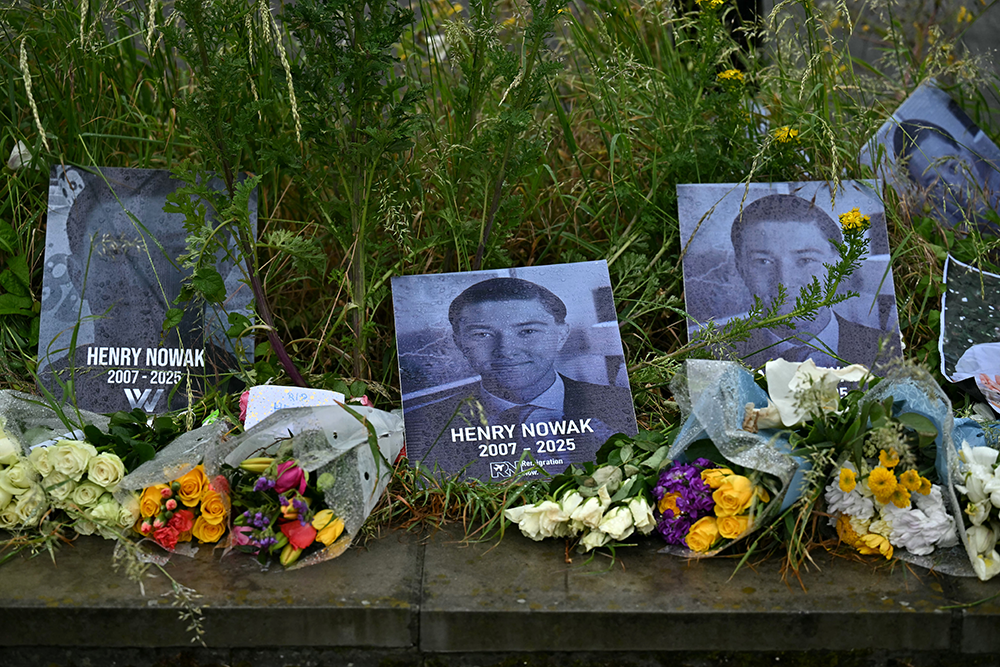

Last month’s headline in the New York Times was obfuscating: “In the UK, a Violent Cycle: Hateful Attacks, Right-Wing Agitation and Riots.” Because hatred is now irrevocably associated with the “right-wing,” innocent American newspaper readers will have presumed that these agitating, rioting reactionaries were also the authors of the “hateful attacks.”
The New York Times and the PBS News Hour delivered such twisted, incomplete and minimized versions of recent incendiary events in the UK that I was obliged to tell the stories of Henry Nowak and Stephen Ogilvie to more than one ordinarily up-to-date American friend, because the salient details had been omitted from left-leaning reports. My friends’ news sources had left the hazy impression that ructions on the streets of Southampton and Belfast were simply the “right-wing” creating mayhem for the sake of it, because that’s what the “right-wing” do. This was merely more Brexity hatefulness.
Under the misleadingly neutral-sounding heading “News Analysis,” which routinely allows opinion pieces to masquerade as straight reporting, this NYT journalist glossed over the particulars of both stories that had roused such British consternation.
The article presented Nigel Farage’s accusation of ‘anti-white prejudice’ as preposterous
The snidely dismissive police response to Nowak’s entreaty that he’d been stabbed – “I don’t think you have, mate” – conspicuously fails to feature in this recap. The way the Sikh murderer connivingly played the race card, convincing police that he was the one who’d been set upon and pointing to a flagrantly nonexistent wound on his forehead as evidence, was collapsed into vague summary. Decrying the “malign, distorted narrative” that takes off online in Britain “when[ever] the attacker is an immigrant or a person of color,” the article claims that “right-wing political groups are amplifying the frustration and anger that people feel in the wake of a scary episode.” Really. Nowak and Ogilvie merely experienced a scary episode, as if someone jumped out of a closet and said “Boo!” and then everyone laughed about it later.
In the original NYT report on the Nowak bodycam footage, police merely handcuffed the young man “for about a minute before they realized he was severely injured and began administering first aid.” The article presented Nigel Farage’s accusation of “anti-white prejudice” in the police as transparently preposterous. It signally neglected to note that rejection of “colorblind” enforcement and an exhortation to abjure “treating everyone the same” occur clearly in black and white in the UK’s Police Anti-Racism Commitment.
The NYT took pains to explain the results of Nowak’s pathology report, to the effect that, big deal, the guy would have died anyway. As for Ogilvie’s gruesome encounter in Belfast, which led to a Sudanese refugee being charged with attempted murder, another article alludes merely to an “attack.”
The consequence of giving the reasons for civil unrest such short shrift is to make these stories incomprehensible. Made likewise deliberately incomprehensible is the connection between such grisly incidents and mass immigration: “Mr. Farage linked the [Nowak] stabbing to Britain’s migration policies, even though neither the victim nor the attacker were immigrants.” In response to J.D. Vance’s charge that this tragedy was due to the “politics of self-hatred and the mass invasion of migrants,” David Lammy asserted on the BBC: “I told him he was wrong: this has got nothing to do with mass migration. The young man who perpetrated this crime was a Brit, born and raised in this country.”

Look, this keeps coming up. I don’t want to get into the whole tortuous debate over what it does and doesn’t mean to be “British.” Let’s simply agree that citizenship may be a legal absolute, but nationality needn’t be a cultural absolute. You can have degrees of Britishness. Kemi Badenoch, for example, strikes me as quite culturally British, even if she hasn’t the ancestral lineage to match. At first glance, in this cultural sense, Vickrum Digwa strikes me as somewhat less British. (If you don’t mind my saying so, he also looks stupid.)
Strictly speaking, the UK does not grant birthright citizenship – though its naturalization rules are generous. One naturalized parent or even one parent with leave to remain makes British citizenship automatic. Any children who live their first ten years in the UK also qualify. But no amount of paperwork magically turns a foreigner “British” in a meaningful sense. I should know. My 36 years in the UK never altered my neighbors’ perceptions of me as American, and I guarantee that even if I’d gone to the trouble of obtaining a British passport they would still regard me as American.
To say that the Nowak murder has nothing to do with immigration is ludicrous. Digwa is a second-generation immigrant, and absent immigration he wouldn’t have been born in Britain and thus wouldn’t have stabbed a British university student. Anti-terrorism authorities often observe that second-generation immigrants are more likely to succumb to violent radicalization than their parents. Yet we’re meant to pretend that just because these young men were born in the UK they are as “British” as Paddington Bear. We went through the same farce with Axel Rudakubana – whom police notoriously identified as “originally from Cardiff.” Out of his tiny mind, Rudakubana also wouldn’t have been in Britain to viciously murder three little girls if his Rwandan parents hadn’t immigrated to the UK in 2002, and he was obsessed with the Rwandan genocide. So maybe he’s a teeny bit Rwandan and ever so slightly less British.
Vickrum Digwa’s mother, a first-generation immigrant, was complicit in clumsily covering up her son’s inexplicable stabbing frenzy by hiding the knife back home – so this case does have something to do with immigration. That said, let’s give our friend Vickrum credit for having sussed out the weak points of his family’s adoptive country. In today’s Britain, trying to weasel out of arrest for murder by crying racism is what I call proper assimilation.






Comments