

What is the limit of Ukrainian civilians’ endurance? In nearly four years of relentless war, Ukraine’s people have faced summary executions, ‘drone safaris’ where unmanned aerial vehicles hunt people down city streets and constant bombardment of cities by swarms of drones and missiles. This winter their remarkable resilience faces its severest test yet as Russian forces reach a tipping point in their systematic attempt to knock out the country’s energy infrastructure.
In each of the past three winters, Vladimir Putin has attempted to render Ukraine’s cities uninhabitable by plunging them into darkness and cold, without success. But this time it looks like the Kremlin’s campaign to weaponise winter may be succeeding. With temperatures in Ukraine falling to -16°C, Russian forces are trying to knock out as many citywide heating systems as possible. Over the past week, Russia hit Ukraine with an unheard-of bombardment of nearly 1,100 drones, 890 guided bombs and more than 50 missiles, including the Oreshnik hypersonic missile, targeting power plants and homes during brutal cold. Volodymyr Zelensky called the attacks ‘cynical terror’ aimed at civilian suffering, with more than 1,000 buildings losing heat. Since Christmas, Russian attacks have blacked out the cities of Odesa, Sumy, Dnipro, Kharkiv, Zhitomir and Zaporizhia for more than a day, along with swaths of Kyiv and its suburbs.

The reason Putin’s latest attacks are particularly effective is a basic but inexorable law of physics – water expands by about 10 per cent when it freezes, cracking pipes and heating systems that cannot then be repaired until spring. In an attempt to pre-empt irreparable damage to Kyiv’s infrastructure, the city’s mayor, Vitali Klitschko, announced last week that the plumbing and heating systems of many of the city’s apartment buildings would be drained of water. He advised affected residents to ‘temporarily’ evacuate the city while their homes were uninhabitable. ‘The Ukrainian people continue to demonstrate that willpower becomes resilience, even in the darkest moments,’ was Klitschko’s defiant message. ‘Together, we are unbreakable.’
But the hardest January weather will test Ukrainians’ willpower to the utmost. Unlike the previous three unusually mild winters, this one is polar. ‘I just stepped outside and it’s insanely cold,’ reports the blogger Angelica Shalagina. ‘I honestly don’t remember winters like this in Kyiv.’
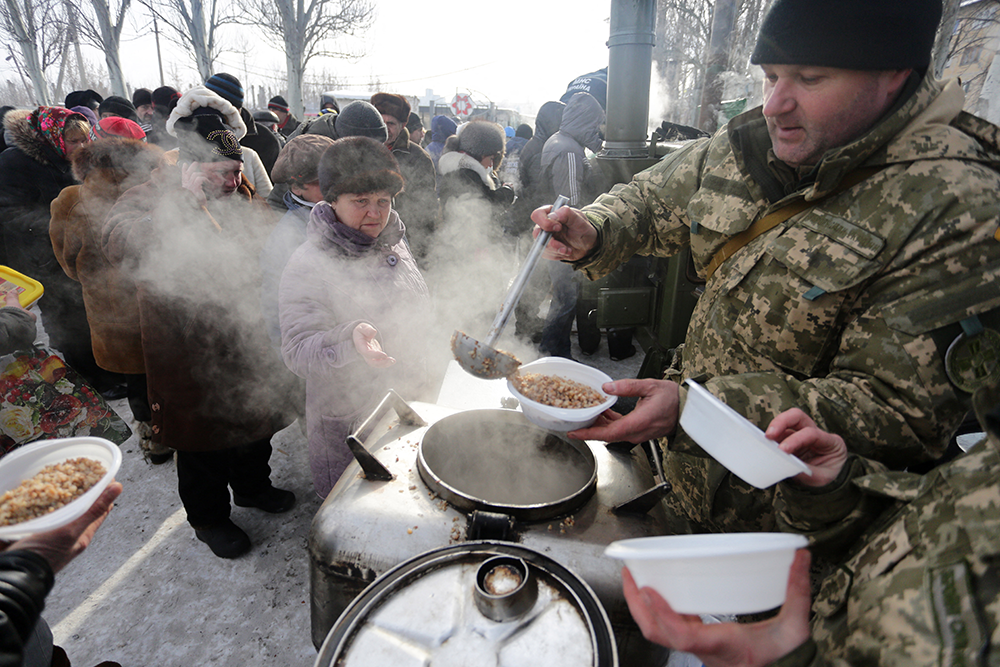
Ukraine’s government has organised a network of heated insulated tents in city parks and boulevards known as ‘Points of Invincibility’, where people can warm up, charge their phones, drink hot soup and receive support from trained psychologists. But there is a point where cities cease to be practically liveable, as Russian attacks shut down water and electricity supply, heating systems and public transport. ‘From early morning, I’m calling my friends to ask how they are after a terrible night,’ says Iuliia Mendel, Zelensky’s former press secretary. ‘Russian drones and missiles hit the population harder with every strike – something Ukraine isn’t able to cope with.’
Almost every European country now has a major political party that opposes more aid to Ukraine
Many Ukrainians are facing an agonising choice over whether a flight into exile could be a more bearable proposition than remaining. As early as September, senior German foreign ministry officials were warning the federal government in Berlin to brace for a fresh influx of Ukrainian refugees, pushed out of their homes by Putin’s ruthless winter war strategy. Poland and the Czech Republic have made contingency plans and adapted their support systems in case of a new large influx of refugees. The EU has also extended the Temporary Protection Directive for Ukrainians until March next year. As of the first week of this year, passenger traffic across the Ukrainian border had grown by approximately 27 per cent, according to the State Border Guard Service of Ukraine.
Generating a new wave of Ukrainian refugees is the Kremlin’s aim. Allied military planners during the second world war used the term ‘de-housing the enemy population’ as a justification for the area bombing of German cities – a strategy that remains one of the most controversial of the war. Putin, it seems, is attempting to produce the same effect. His agenda is political, intended to put pressure on European capitals and force them to agree to ending the war on his terms.

The problem for the EU is that there is already a growing backlash against Ukrainian refugees. Germany, which hosts 1.24 million Ukrainians, the most of any European country, introduced significant benefit cuts last year. Poland’s President Karol Nawrocki vetoed an amendment that would have extended protection for Ukrainian citizens into this year, while Warsaw’s mayor, Rafal Trzaskowski, proposed cutting child benefits for Ukrainian families where parents do not work in Poland, citing ‘common sense [and] simple economics’ as well as pressure from ‘ordinary Poles on the street’. And the Dutch government has stated that it is planning to help refugees ‘move back to Ukraine’.
Europe’s extraordinary welcome of the estimated 4.3 million Ukrainians who fled in the early months of the war was an epochal lesson in generosity and solidarity, human and political. Thousands of ordinary Britons opened their homes to displaced Ukrainians with remarkably little pushback from parts of the political spectrum otherwise hostile to mass immigration. But four years on, almost every European country (with the notable exception of Britain) now has a major political party that opposes more aid to Ukraine and advocates compromise in order to bring a swift end to the war. In Hungary, Czechia, Slovakia and Croatia, these Zelensky-sceptic parties are in power – while the governments of Poland, Belgium, Italy and Austria have all in different ways expressed opposition to continued support for Kyiv’s war effort and confiscating Russian state assets.
A new wave of Ukrainian refugees is likely to stretch already tight European budgets and tolerance, as well as cause new political pressures. Putin’s strategy of de-housing Ukraine’s population is fiendishly cynical. But it is a strategy that could prove devastatingly effective in focusing European minds on the human cost of this war – and on how to end it as soon as possible.



Comments