


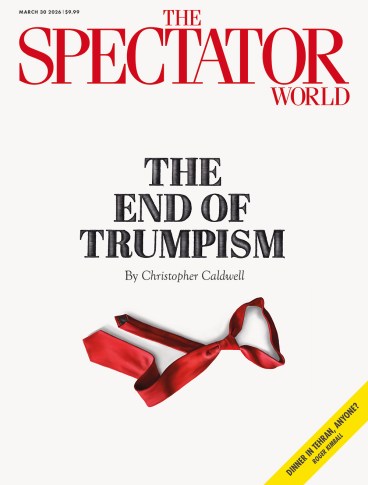
Having Donald Trump as President probably resembles being a heroin addict: you undergo regular episodes of sweating terror and mortal danger, the end result of which is to get you – at best – back to normal. A year ago, the Liberation Day tariffs nearly caused the American economy to seize up, before China mercifully let the matter drop. Then came the even more reckless decision to join Israel in bombing Iran’s Fordow nuclear installation; Iran agreed to halt hostilities just as it was figuring out how to penetrate Israeli airspace with its missiles.
But now the President has pressed his luck. He has joined Israel in a campaign of aerial assassination and bombardment against Iran – this time of an almost incredible violence – and has wound up trapped. American air power proved sufficient to kill Iran’s 86-year-old leader and dozens of schoolgirls, flatten residential apartment blocks and blow up much of the country’s navy, but not to neutralize Iran’s missiles, which have been able to rain destruction on America’s bases and Tel Aviv’s neighborhoods.
Trump has escaped other predicaments of his own making, but there is something different about this one
Iran has closed the Strait of Hormuz, through which 20 percent of the world’s oil passes. The reversal has not brought out the President’s dignified side. He now boasts about the comprehensiveness of his glorious victory, while imploring America’s hitherto unconsulted allies to join him in a naval campaign to get the strait back open. The message seems to be: “Help! Help! We’re kicking ass!”
Trump has escaped other predicaments of his own making, but there is something different about this one. The attack on Iran is so wildly inconsistent with the wishes of his own base, so diametrically opposed to their reading of the national interest, that it is likely to mark the end of Trumpism as a project. Those with claims to speak for Trumpism – Joe Rogan, Tucker Carlson, Megyn Kelly – have reacted to the invasion with incredulity. Trump may entertain himself with the presidency for the next three years (barring impeachment), but the mutual respect between him and his movement has been ruptured, and his revolution is essentially over.
Contrary to its portrayal in the newspapers, Trumpism was a movement of democratic restoration. At its center was the idea of the deep state. In recent decades, selective universities created a credentialocracy, civil-rights law endowed it with a system of ideological enforcement, the tax code entrenched a class of would-be philosopher-kings in the nonprofit sector, and civil-service protections armed government bureaucrats to fight back against any effort at democratic reform.
The Trump movement is what happened when Americans discovered the system could not be reformed democratically, only dismantled. It was not a move against democracy, or even liberalism. In fact it was a return to the original constitutional understanding that Alexander Hamilton laid out in Federalist No. 70: Americans are led not by a class-based bureaucracy but by an executive they choose.
Unfortunately, this democratic idea is dangerous. That is why no one ever dared try an American-style presidential system before 1788, and it is why progressives hemmed the presidency in with the deep state. Without it, there are really only two safeguards against a rogue executive: first, the public must elect a public-spirited person of unimpeachable character, and, second, that person must honor the constitution. The Iran assault shows neither condition to be operative.
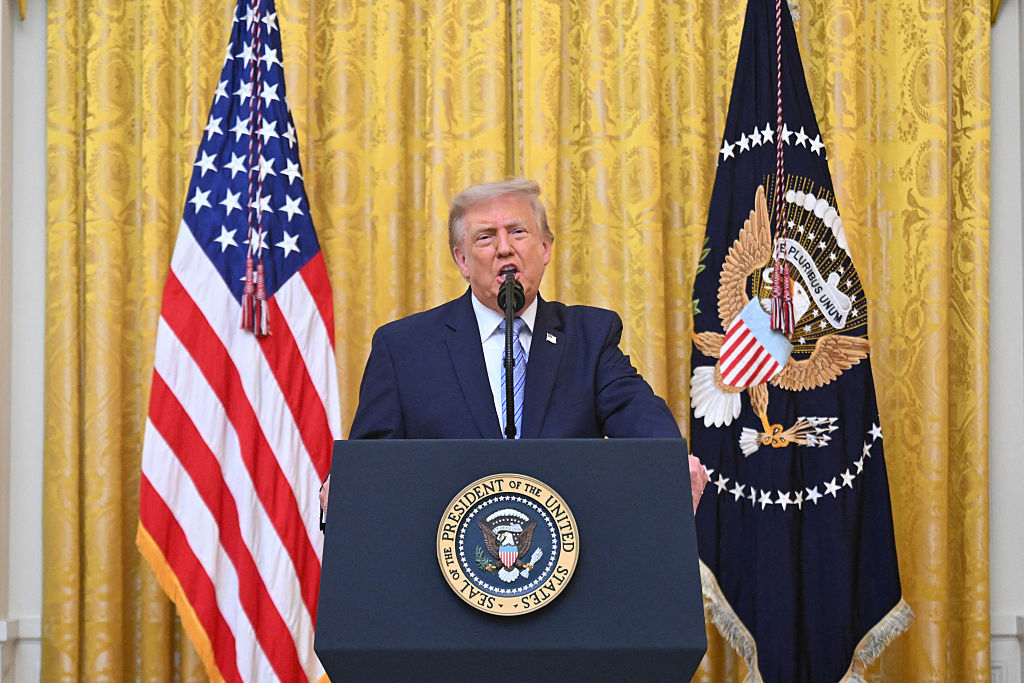
No one who witnessed Trump’s bravery after being hit with a would-be assassin’s bullet in Pennsylvania in 2024 will doubt he has character. But his virtues are not the ones you need to run a free country. Never has a president so availed himself of the public trust to line his own pockets. Trump welcomed Qatar’s offer of a new presidential airplane intended as a personal gift; he established a personal memecoin into which petitioners for presidential favor could drop multimillion-dollar contributions. We could go on.
Trump has indeed made progress in fixing the deep state. His supporters like to think of him as a rough-hewn, corner-cutting, hard-bargainer of the Andrew Jackson sort, with the fortitude to ignore pleas from special interests.
But there has always been a red line: Americans did not expect Trump’s character flaws to endanger them in the realm of foreign policy. America’s Iran policy has been made over the past year by Trump’s son-in-law Jared Kushner and Trump’s real-estate crony Steve Witkoff, working in consultation with Israeli Prime Minister Benjamin Netanyahu. Both Kushner and Witkoff carry the title “special envoy for peace,” but neither of them has been confirmed by the Senate, as top diplomats and cabinet members must be. Kushner did not even release a financial-disclosure statement. So these two go to the Middle East to discuss with Netanyahu what to do about Iran. Netanyahu lays out Israel’s priorities, which involve, at the very least, disarming Iran. What American priorities are Kushner and Witkoff advancing?
It would be an understatement to say Kushner is close to the Israeli government. On visits to the Kushner family when Jared was growing up, Netanyahu literally stayed in his bedroom. Kushner is also close to Crown Prince Mohammed bin Salman of Saudi Arabia, who overruled Saudi regulators to invest $2 billion of the Saudi sovereign wealth fund in Kushner’s investment fund, Affinity. Two weeks into Trump’s war, the New York Times alleged that Kushner has continued to raise money for his firm in the Middle East while working as an envoy.
Witkoff’s family joined Trump’s to found World Liberty Financial, a crypto company. Last year, the United Arab Emirates put $2 billion into the firm, and shortly thereafter received clearance to import hundreds of thousands of state-of-the-art Nvidia chips, despite the country’s ties to China.
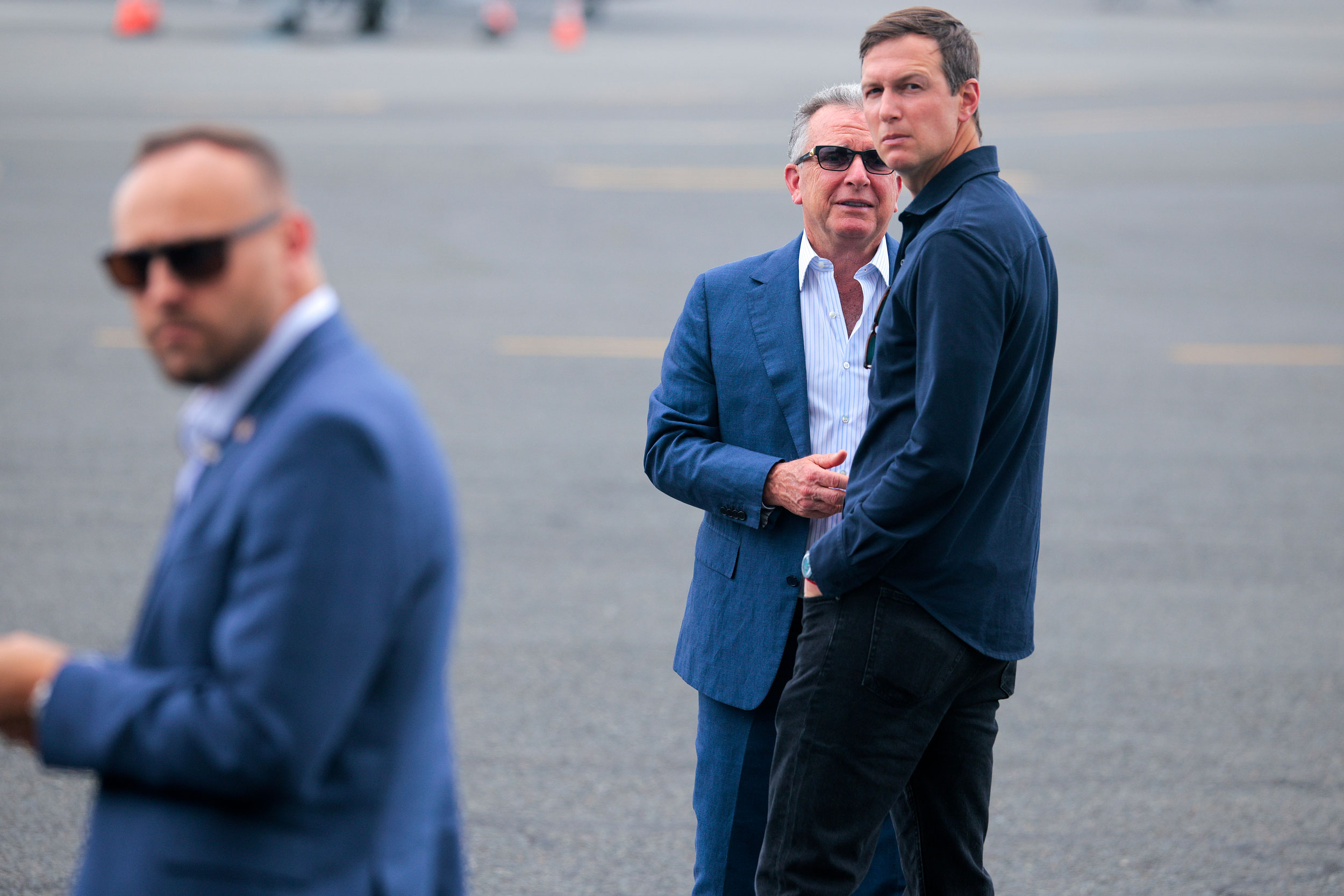
Kushner and Witkoff are neither financiers nor diplomats by trade, but real-estate moguls. At the World Economic Forum in Davos in January, with President Trump in attendance, the pair unveiled an artist’s rendition of a gigantic, Dubai-esque oceanfront development called “New Gaza,” complete with a timeline for its construction. Of course, ground couldn’t be broken until the property had been purchased by whoever planned to develop it, unless Israel planned to neutralize the place by force of arms in the meantime.
By law, Senate and House leaders must be informed of impending military operations – but no one informed them about Iran. They would have been curious to know that the United States had volunteered its military to take on the regional rival of Israel, Saudi Arabia and the United Arab Emirates on the say-so of two irregular “diplomats” with interests in those countries.
You cannot blame Netanyahu for taking advantage. Probably never again would his country get to deal with a president so gullible. But as soon as the attacks began on Iran, the news brought talk of tactical “divergences” between Israel and the United States. Israel wanted Iran wrecked and weak, and was hitting oil infrastructure that the United States had warned it not to. The United States wanted the oil industry up and running: first to lay claim to the oil for Trump, as happened in Venezuela; later to prevent the tit-for-tat strikes on Middle Eastern oil that could cause a global depression.
Incredible as it sounds, Trump may already be one of the half-dozen most important Americans who ever lived
In fact, the only divergence between Israel and the United States, when it comes to war aims, is that Israel has them and the United States does not. That, of course, could be problem enough. For Europeans now marching against the war, Israel’s invasion of Lebanon is evidence the US is abetting an escalation of Israel’s unpopular Gaza war. For a growing part of Trump’s own base, while Iran remains the bigger threat to America’s global position, Israel is the bigger threat to America’s democracy. As the war entered its third week, Joe Kent, head of Trump’s National Counterterrorism Center and a top aide to National Intelligence Director Tulsi Gabbard, resigned in protest, alleging: “It is clear that we started this war due to pressure from Israel and its powerful American lobby.”
President Trump’s case for going to war in the Middle East is a lot like George W. Bush’s back in 2003. We hear a collection of stirring phrases about weapons of mass destruction, terrorists (“tairsts,” as Bush called them), countdowns to this and that and how many times some politician said “Death to America” in 1985. But now, as then, having many arguments does not add up to having a good argument. Like Bush, the President and his aides treat America’s superior weaponry as the whole solution. Given its tendency to lure the United States into unaffordable but inescapable wars, it can sometimes look more like the whole problem.
Again, Trump has a gift for escaping seemingly impossible situations of his own making. It’s easy to underestimate him. His flaws – his ignorance, his incuriosity – are in plain sight. He really does seem to have gone to war thinking his abduction of the President of Venezuela augured a similar success in Iran. Trump’s strengths, by contrast, are often hidden. As John Judis writes in a profound recent essay on Trump and Hegel, Trump is somehow a world-historical catalyst. He may already be – incredible though it sounds – one of the half-dozen most important Americans who ever lived.
That will not keep his movement alive. Trumpism is about democracy or it’s about nothing. For Trump’s base, the sense of betrayal is acute. The international relations professor John Mearsheimer recently remarked of Trump: “He treats allies worse than he treats adversaries.” He does the same in domestic politics. Trump is now carrying out the policy of the very think-tankers and democracy-spreaders he rose to power by promising to fight. And it has apparently been many months since the people in whose name he campaigned have even flitted across his mind.



Comments