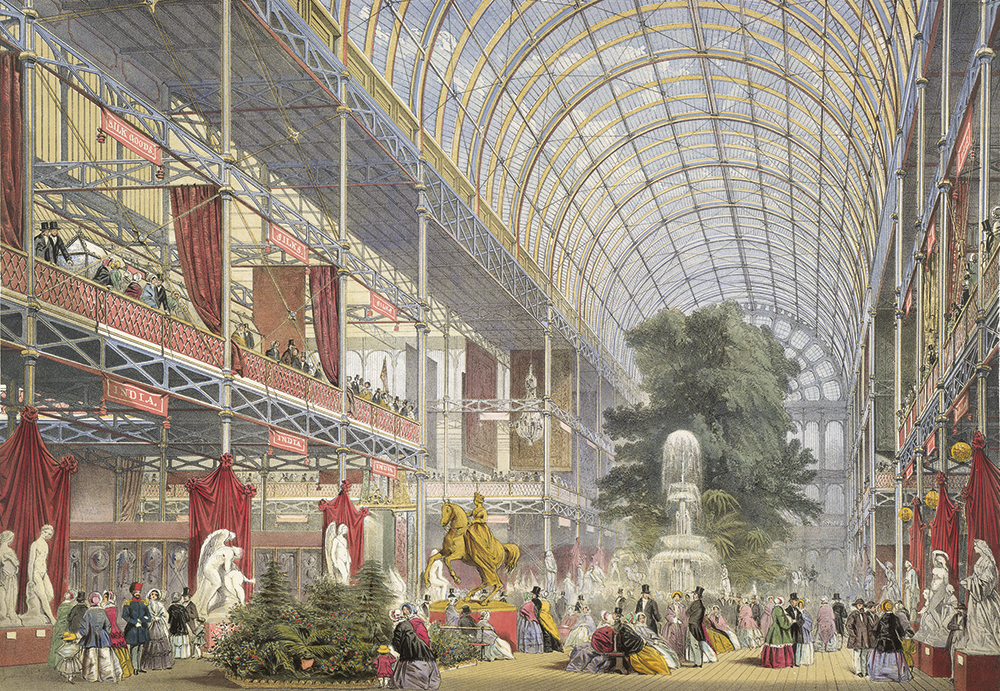
If you want to understand Victorian Britain, look to the Great Exhibition of 1851. At a time of unprecedented technological change and international rivalries, this event gathered the finest art and the latest manufactured goods from around the globe and displayed them for almost six months to more than six million visitors in the magnificent Crystal Palace on the southern perimeter of London’s Hyde Park.
Its success generated a profit of £186,000, or around £20 million today. The aim was not simply spectacle; in the spirit of the age it was also pedagogic. So this sum was used to buy 86 acres of fields and market gardens in the adjacent suburb of Brompton, where new institutions could be built to further the broad objectives of the Royal Commission behind the exercise. According to its charter, these were ‘to increase the means of industrial education and to extend the influence of science and art upon productive industry’.
Visitors could marvel at gold ingots, railway engines, fabrics, sculptures and Heath Robinson-type gadgets
Over the next half century, a cluster of galleries and educational establishments sprang up there – among them, the Victoria and Albert, Science, and Natural History Museums, the Royal Albert Hall, Imperial College and the Royal Colleges of both Music and Art. Brompton was renamed South Kensington, in deference to Queen Victoria’s birth in nearby Kensington Palace, and, as the grand institutions grew, the area became known as Albertopolis, after the queen’s beloved consort Prince Albert of Saxe-Coburg and Gotha, who died prematurely in 1862, aged just 42.
The high-minded prince is one of the two heroes of A.N. Wilson’s comprehensive account of the Exhibition and its legacy. As a young man in Germany he had noticed the success of regular fairs promoting art and commerce in Paris and other European cities. Once in London and married to Victoria, he founded the Society of Arts (yet to receive its royal badge), striving to emulate this continental practice. As its president, he harnessed British inventiveness to rampant capitalism. His patronage helped smooth over differences of opinion, taking controversial matters out of the political arena with the setting up of a Royal Commission to oversee the 1851 Exhibition.
The other champion was Henry Cole, the dynamic son of an impoverished army officer, who served as the society’s secretary. Using the upbeat pseudonym Felix Summerly, he had won a prize competition for a tea service which later went into factory production. He worked with Rowland Hill to develop postal services and is credited with making the first Christmas card. A passionate free trader, he argued confidently that an exhibition would enhance global understanding and boost general prosperity.
Wilson tracks how, after a false start with a brick design by Isambard Kingdom Brunel, the Duke of Devonshire’s resourceful head gardener Joseph Paxton hit upon his crystal palace, a structure made of cast iron and plate glass, with vast halls divided into sections to show off minerals and raw materials, machinery, manufactured goods and fine arts. Visitors could marvel at gold ingots from Cornwall, railway engines, scientific instruments, including a prototype fax machine, fabrics, pottery, sculptures and Heath Robinson-type gadgets, including the first slot machine for postage stamps. Contributions from abroad ranged from American firearms to Gobelins carpets. A centrepiece was the Koh-i-Noor diamond, which Prince Albert subsequently had recut because there were complaints that it was not brilliant enough.
However, displaying artefacts was only part of the Exhibition’s remit. As soon as it closed, the palace was dismantled and moved to Sydenham. Work then promptly began on its institutional legacy, which was geared more than ever to promoting good design to give Britain an edge in increasingly competitive global markets.
Once land for Albertopolis had been purchased, it was mooted that the National Gallery should transfer there from Trafalgar Square where pollution was said to be damaging the paintings. Nothing came of this, but other collections moved across town, among them the contents of the Patents Museum which ended in the Science Museum.
The South Kensington Museum, later the V&A, became the depository for items most obviously linking industry and the arts. Its exhibits were initially housed in ugly iron structures known disparagingly as the Brompton Boilers. Hit by rising expenses, Cole arranged for this new museum’s operations to be taken over by the Board of Trade’s department of practical art and therefore financed by the public purse rather than that of the Commission, which was left free to concentrate on other projects on the Albert-opolis site.
Wilson is good at observing the wider cultural implications of these developments, such as how the vast, cathedral-like halls of the architect Alfred Waterhouse’s Romanesque Natural History Museum proved ideal for displaying dinosaurs and carrying on the ‘quintessentially Victorian debate between religion and science’.
By the time Imperial College opened in 1907, merging the Royal College of Chemistry and Royal School of Mines, the original players were long gone. But the Royal Commission for the Exhibition of 1851 has continued to thrive. While retaining ownership of Albertopolis (the estate boasts assets worth £169 million) it now distributes its income largely in grants to budding scientists. Twelve Nobel Prize laureates, including Ernest Rutherford and Peter Higgs, have benefited.
Wilson’s book marks the Exhibition’s 175th anniversary. It’s ambitious in conception and full of absorbing details, with fine colour illustrations. But it lacks an index, bibliography or even a useful map, and there’s a curious mistake in the first line. This quotes from the start of Thomas Hardy’s 1893 story ‘The Fiddler of the Reels’, in which an old Wessex gentleman recalls the Great Exhibition. Wilson manages, with an unexpected nod to Topol, to mistitle the story ‘The Fiddler on the Reels’. He doesn’t date it or give its wider context by pointing out that it was part of a collection commissioned from prominent authors by the American magazine Scribners to commemorate the 1893 Chicago World’s Fair. The old codger was bemoaning the proliferation of such fairs in his day. But he acknowledged that 1851 had been like a geological fault, bringing ancient and modern into ‘absolute contiguity’ as never before. The Great Exhibition was vital to that process.




Comments