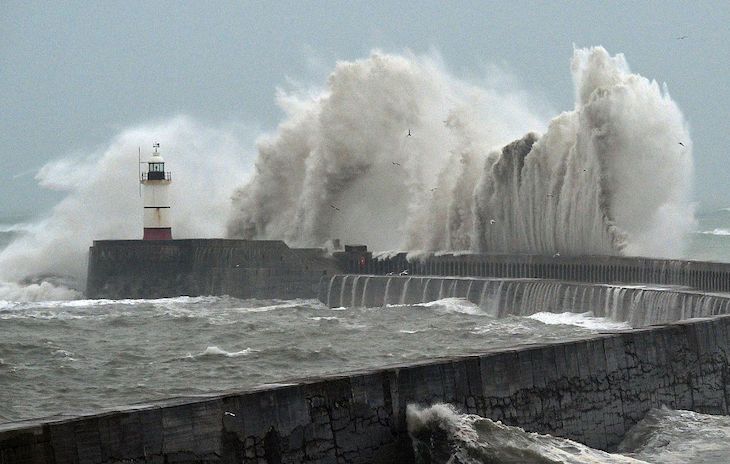
By and large, the British Isles are a decent place to choose to live. While it is true that one reason for this is the quality of the institutions in the UK, the rule of law, the outstanding universities (and more), the more basic starting point is that the ecological lottery has been kind to this part of the North Atlantic: nice, long temperate summers and winters that do not give too much to complain about, other than short daylight hours. Most of the time, we live in a “Goldilocks zone” – not too hot, not too cold, not too dry, not too wet.
So powerful is the developing El Niño, that it is not being referred to as a mega-Niño, but a “Godzilla Niño”
That balance has started to change in recent years. One reason comes from the natural rhythms of the planetary cycle; another, though, stems from the way we live and in particular from the way we generate energy. Last year, the oceans absorbed an estimated 23 zettajoules of additional heat – the equivalent of roughly twelve Hiroshima detonations every second throughout the year. This is in addition to greenhouse gases, including those released by burning hydrocarbons, which trap heat in the atmosphere. The result is a rapidly warming planet.
Over the last few months, scientists have been tracking sea surface temperatures in the Pacific – as they usually do – in order to make better predictions about the El Niño–Southern Oscillation (ENSO), which describes the relationship between the atmospheric and oceanic conditions in the equatorial Pacific – including the direction and strength of trade winds, surface water temperature and air pressure. The ENSO cycle of alternating warm El Niño and cold La Niña events is the dominant year-to-year climate signal on Earth.
El Niño occurs every two to seven years, when sea surface temperatures across the central and eastern tropical Pacific Ocean become unusually warm. Typically lasting between nine and 12 months, El Niño disrupts prevailing trade winds and alters atmospheric circulation, influencing weather patterns across much of the world. It often brings lower than average rainfall in Australia, Indonesia and parts of Southeast Asia, as well as weaker summer monsoons and an increased risk of drought in India. Although difficult to predict, it can also result in flooding along the Pacific coast of South America, while in China it increases rainfall in some locations while dramatically reducing it in others. The consequences can extend thousands of miles beyond the Pacific, including the British Isles because of the disruptive effects El Niño can have on the Atlantic jet stream – meaning stronger winds, worse storms and more rain.
Because of the way we teach (and sometimes write) history, the natural world is often put to one side when we think about the past: most can name the greatest – or most evil – leaders in history, or the most vibrant and successful cities or the great empires of the past; climate and the environment, on the other hand, are usually passed over in silence. This is a shame, as climatic anomalies have played important parts in topics as diverse as the fall of Queen Cleopatra to the writing of The Tempest and Macbeth, from the rise of the Vikings to the spread of disease not only in the Middle Ages but more recently too.
That is one reason why writing more expansive and inclusive books is important – and why this month sees the publication of a new illustrated version of my book The Earth Transformed, which is aimed not only at younger readers but also at those wanting to understand the way that the natural world fits both into the grand sweep of history and into specific episodes too.
That matters at the moment, because the coming year will be a difficult one. Sea surface temperatures in recent months in the central and eastern Pacific are not just high, but in ranges scientists have never seen before. So powerful is the developing El Niño, that it is not being referred to as a mega-Niño, but a “Godzilla Niño”.
It comes at a particularly bad time for the UK, which is struggling with sluggish growth, high national debt, inflationary pressures and the fallout from war in Ukraine and conflict in the Gulf. The first warning signs of the coming storm have already arrived. Over the weeks ahead, El Niño will increase the likelihood of wetter, windier conditions as Atlantic storms sweep across the country, bringing heavy rainfall and an increased risk of flooding, particularly in western Britain. For farmers already struggling with the consequences of an exceptionally dry summer, the prospect of waterlogged fields presents another challenge, while homes, businesses and transport infrastructure face the risk of costly damage and disruption.
Predictions can be tricky, since no two El Niños behave in precisely the same way. Nevertheless, strong episodes can increase the risks of colder conditions later in the winter as changes in atmospheric circulation interrupt the usual flow of relatively mild Atlantic air and allowing freezing conditions to spread southwards from the Arctic or westwards from continental Europe and Siberia. It scarcely needs saying that this will come at a difficult time given high energy prices and the pressures already facing household budgets. Emergency response planning should therefore be high on the government’s agenda, alongside measures to mitigate the impact on the most vulnerable.
The effects may not end with the arrival of spring. El Niño tends to raise global temperatures, often with a delay of several months, as heat accumulated in the Pacific is released into the atmosphere. That means 2027 could challenge existing global temperature records which have been broken repeatedly in recent years – although precisely which parts of the world will be most affected and how remains uncertain. What seems more predictable, however, is the pressures on global food supplies and prices, compounded by fertiliser shortages resulting from disruption to shipping through the Strait of Hormuz.
It is little consolation that others might have it worse. But this is the moment to be fastening seatbelts and preparing for Mother Nature to remind us that for all our ingenuity, scientific breakthroughs and exciting new technologies, it is the natural world that has shaped human history – and will continue to shape our future.
Peter Frankopan is Professor of Global History at the University of Oxford. The Earth Transformed – Illustrated Edition: How Natural Forces Shaped Our History and the World was published by Bloomsbury on 22 October, with illustrations by Rômolo D’Hipólito





Comments