
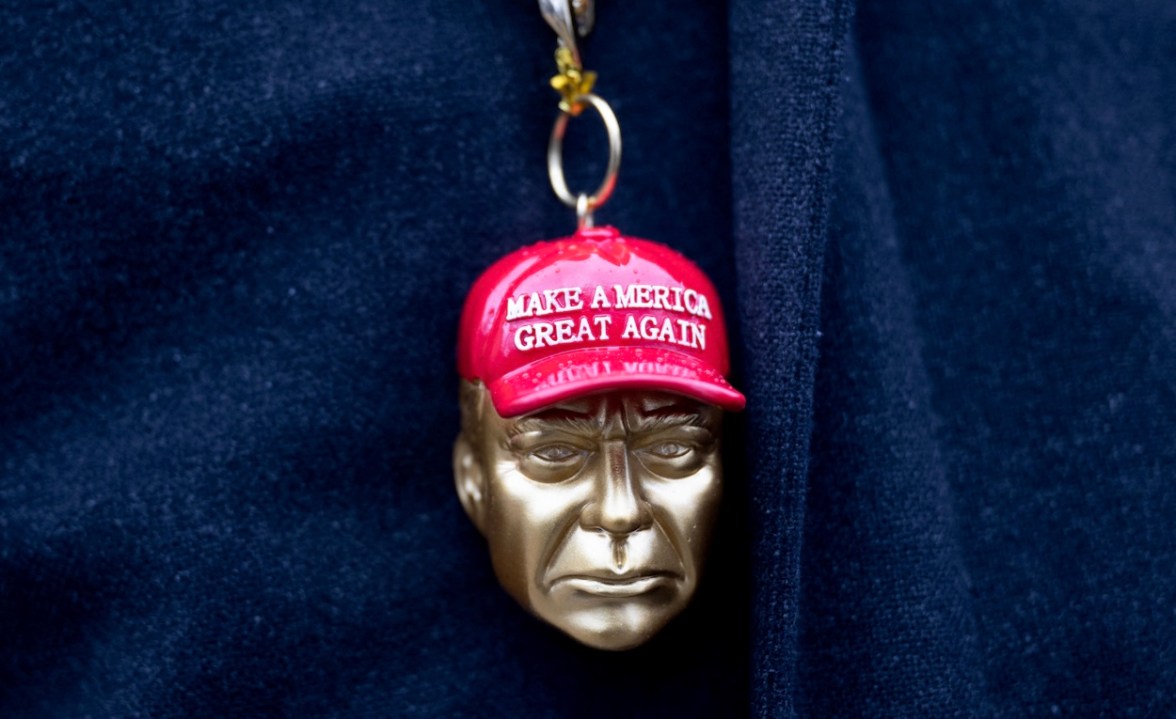
With the death of Lindsey Graham and the disappearance of Mitch McConnell, a link to the past seems to have broken. The two United States senators had been the symbols of a conservatism that Trump destroyed in 2015. They were the last holdouts of a dying Republican tradition, we were told. Through McConnell and Graham’s influence, Trump was persuaded to arm Ukraine, delay the withdrawal from Afghanistan, reform and rename NAFTA rather than scrap it, and attack Iran.
Graham and McConnell had given this Republicanism a strange posthumous existence throughout Trump’s two administrations by various acts of bartering and maneuver. But their battle was supposed to be a losing one. By the end of 2015 Trumpian nationalism had already conquered the Republican base. It would now go on to conquer the next generation of party advisers, and, in the fullness of time, the congressional GOP.
The whole point of Trump’s political project was that this conservative populism was not enough
The tech-demagogue alliance that came into being in 2024 promised a new kind of politics, one that would exclude the old conservatism forever. The remnants of the old GOP had been able to hold their own against MAGA during the first administration, but now they would have the full might of Silicon Valley bearing down on them as well. McConnell and Graham had been able to deal with Trump, but the risk now was that the traditional conservative demands would simply baffle these new forces. What did constitutional originalism and the moral majority mean in the age of mass deportations, transhumanism, and $400 million Qatari air palaces?
Quite a lot, as it turned out. A year and a half into the second Trump administration, pre-2015 conservatism has not only clung on but asserted itself as the dominant strain in the American right. Legislatively, judicially, 2025-6 has been a tour de force for old style conservatism. In the Senate, the bulk of Trump’s legislation is being held back by John Thune’s constitutional scruples. His reluctance to get rid of the Senate’s old right to talk out a bill has caused the SAVE Act, now MAGA’s flagship bill, to stall with no clear way forward. A lot of time is spent trying to parse the motives of Trump voters but preserving the 60-vote requirement for a cloture motion is probably not among them. Right-wing politics was no longer meant to turn on such things.
It has been much the same with the Roberts court, which has been a triumph for conservatism if not for MAGA. The Supreme Court has ruled that transgenders can be banned from women’s sports teams, but it relieved Trump of his command of the National Guard and upheld birthright citizenship. Taken together, this is more or less the editorial line of the National Review: social and religious conservatism, while defending the traditional “balance” of the constitution against the executive’s encroachments – which really means defending the post-Watergate arrangement under which the presidency is largely decorative.
How did this all come about? Inertia is one reason. No one ever bothered to replace these people. Elon Musk regularly denounces Thune on X but there has been no real effort from him or his Silicon Valley friends, with all their billions, to oust them in favor of their own cronies. Most of the primarying efforts – against Liz Cheney and John Cornyn – had to be masterminded by Trump himself. Nor has anything been done to break the Federalist Society’s monopoly on judicial appointments.
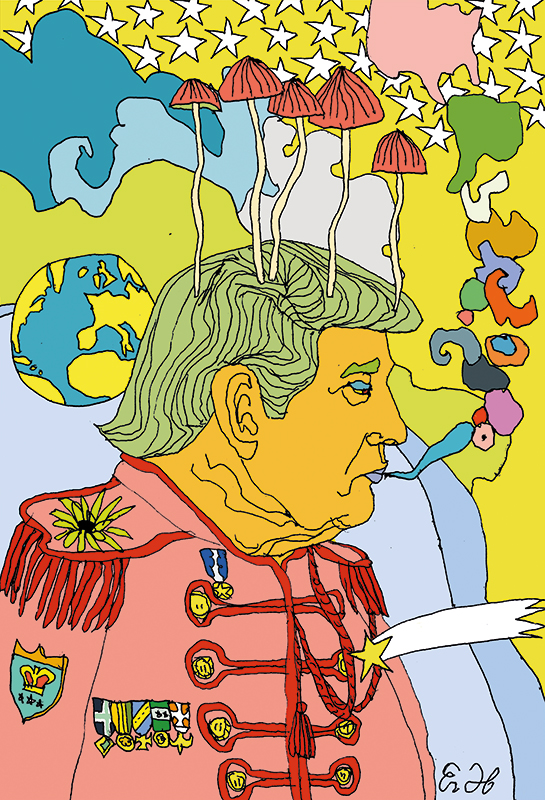
There is a deeper reason: the “new forces” on the American right are converging on these pre-2015 ideas anyway. What was the GOP before Trump? It was a socially conservative and pro-migration party which maintained two popular wings. One, the libertarian Tea Party, whose only policy was a restoration of the old Constitution; the other, a family values Christian right that warned of demonic possession, porn, video games. Is the supposed New Right really so different from any of this?
Elon Musk worries that Americans aren’t having enough babies and vowed to go to war to defend the H1B visa system – this is almost the exact platform of Marco Rubio and his infamous Gang of Eight circa 2013. Podcasters such as Joe Rogan and Theo Von, meanwhile, often imply that all would be well if we could just return to the vision of the Founders, and have joined hands with the same Tea Party constitutional conservatives that Trump warred with long ago.
There is little novel or eccentric in Tucker Carlson and Candace Owens’s tall tales about demons; these were the phrases of Pat Roberston and Rick Santorum, who in his 2012 presidential campaign maintained that the devil himself was waging war on the United States. Much is made of the two’s spats with pro-Israel voices such as Ted Cruz and Mike Huckabee, but there has always been something unreal about the conflict. Foreign affairs are the least important issue in national life. A continent-sized country with unlimited resources surrounded by two vast oceans does not need a foreign policy. In all other areas the story is one of convergence: both sides agree that the ends of politics are religion and family values. If not for the Israel issue, Huckabee would be a fairly standard “crunchy” guest on Carlson’s show.
Silicon Valley, meanwhile, is full of praise for what is called agency – an individual’s executive function. Injustices in society do not really matter, it is said, because the best will always be able to find a way to route around them; this is the same witless prosperity gospel that the old GOP used to traffic in. One might say that a core premise of Trumpism is that American society really is rigged, and that those who are failing under the current system are not to blame.
Rogan, Von, and Musk would not identify with the traditional GOP but none of them grasp why Trump opposed it in the first place. In 2015 there were plenty of moral and constitutional conservatives in the GOP primary; two of them, Rand Paul and Cruz, styled themselves as populists. The whole point of Trump’s political project was that this conservative populism was not enough – that the competitive pharisaism over the constitution and social questions was a way to distract from the real issues: immigration and the destruction of people’s livelihoods, “American carnage.” Conservatism is the defense of historic institutions, but the only historic institution Trump seems to respect is the House of Windsor. For the great bulk of the New Right, the only effect of the Trump saga seems to have been to convert them to these pre-2015 ideas.
Which leaves only Trump the man. Eleven years into the MAGA movement, Donald Trump remains the only figure who sees the state as a civil instrument for solving problems in the here-and-now. Trumpism’s place in the history books will be as a secular reformist movement, like Kemalism or Ba’athism. And like Ba’athism, it has no apparent heirs.




Comments