
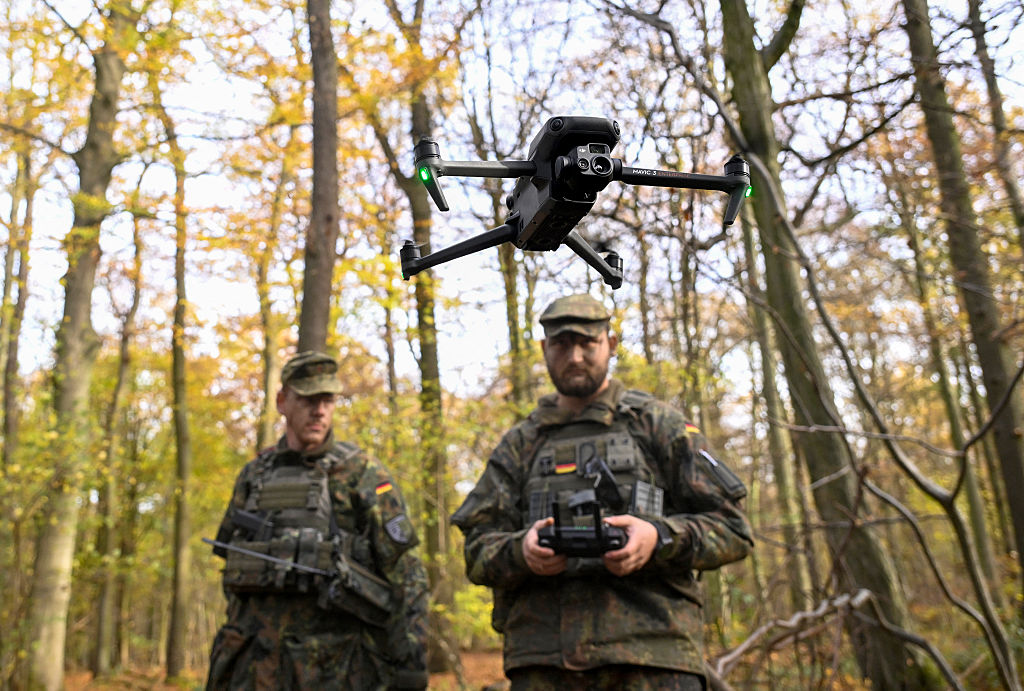
German politicians like to talk about Zeitenwende – the country’s great turning point in its defence policy since the invasion of Ukraine. And it has certainly turned: towards spending billions of taxpayer euros on drones that cannot fly in frontline situations, seemingly cannot hit their targets, and whose largest investors sit not in Berlin or Brussels, but in Silicon Valley boardrooms with direct lines to the White House and CIA. If this is European defence sovereignty, one could wonder what this dependency actually looks like. And if Europe really is serious about this change.
Last week, Reuters confirmed that the German government plans to award contracts worth €536 million to two drone startups – Stark Defence and Helsing – for loitering munitions destined for Germany’s 45th Tank Brigade in Lithuania. The contracts are part of a framework deal potentially worth €4.3 billion. It seems a good deal: homegrown European technology, built by European entrepreneurs, defending Nato’s eastern flank against Russia. The reality is rather less inspiring.
Let’s start with the technology. In October 2025, Stark’s flagship Virtus drone was put through its paces in trials with British and German armed forces. It missed every single target across four attempts. One drone lost control before crashing into nearby woodland. Another’s battery caught fire on impact. Stark’s official response was bracing: ‘We did not crash once or twice, we have crashed a hundred times. That is how we test, develop, and ultimately continue to deliver defence technology like Virtus to the front lines in Ukraine.’ Reassuring words, no doubt, for the German taxpayer about to underwrite a contract worth up to €2.86 billion.

Helsing’s record is scarcely better. Its HX-2 strike drone – billed as Europe’s answer to the Russian Lancet – managed a 36 per cent hit rate during combat deployment in Ukraine. Only a quarter of its drones successfully launched in frontline tests. AI features that were supposed to enable autonomous navigation were missing, while the electronic warfare resilience was limited (Helsing rejected these findings and denied that only a quarter of the HX-2s successfully launched in tests.) Ukraine, the intended customer, has now suspended further orders. Germany will not place a follow-up order until Kyiv expresses renewed interest. One imagines the wait may be long.
None of this seems to have dampened Berlin’s enthusiasm. The contracts – €260 million apiece for Helsing and Stark, with potential expansion into the billions – will equip Germany’s 45th Tank Brigade, currently deployed in Lithuania. Both contain ‘innovation clauses’ requiring the companies to deliver continuously upgraded technology, which is a polite way of saying the Bundeswehr knows it is buying products that do not yet work and it hopes will improve with time and taxpayer money.
What makes this more than a standard procurement scandal is the question of who is actually paying for, and profiting from, Europe’s supposed march towards defence autonomy. Stark’s principal backers include Peter Thiel’s Founders Fund, Sequoia Capital, and In-Q-Tel – the venture capital arm of the CIA. The company crossed a €1 billion valuation just last week, with Thiel’s fund contributing another ‘double-digit million’ amount. Helsing counts several American venture firms among its investors.
European politicians have spent three years insisting that the continent must build its own defence industrial base, independent of Washington. They are now handing billions to companies bankrolled by American intelligence-adjacent capital. You don’t have to be a conspiracy theorist to wonder whose strategic interests a Thiel-funded drone company ultimately serves – particularly when Thiel’s relationship with the current occupant of the White House is a matter of public record.
And then there is what one might delicately call the testing methodology. Both Stark and Helsing are using the Ukrainian battlefield as their laboratory. Stark openly describes its Ukraine operations as ‘testing and evaluating systems under real operational conditions’. Helsing shipped thousands of HF-1 drones to the front – built partly from plywood, criticised by Ukrainian forces as overpriced and ineffective – before pivoting to the HX-2, which has failed to launch. The Ukrainian soldiers operating these systems are not so much customers as unwitting test subjects – trying to fight a war with equipment that has not finished being developed, while the companies work out the kinks at their expense.
Meanwhile, Rheinmetall – Germany’s largest defence contractor, the company that actually builds the anti-aircraft systems and ammunition that Ukraine depends on – has been passed over for these contracts entirely. Its CEO, Armin Papperger, warned last September that military drones risked becoming the industry’s ‘biggest bubble’. He has a commercial interest in saying so, of course. But he also has a point when a company valued at a billion euros cannot hit a stationary target, and another’s drones launch successfully only a quarter of the time.
The Zeitenwende was supposed to be the moment Germany – and by extension Europe – got serious about defence. Three years on, Berlin is channelling historic sums into startups with American investors and catastrophic trial results, while the companies that have spent decades learning how to make weapons that actually work watch from the sidelines. So much for strategic autonomy. Someone in the Bundestag might want to check who is signing the cheques before they clear the next billion euros that won’t go into German technology.



Comments