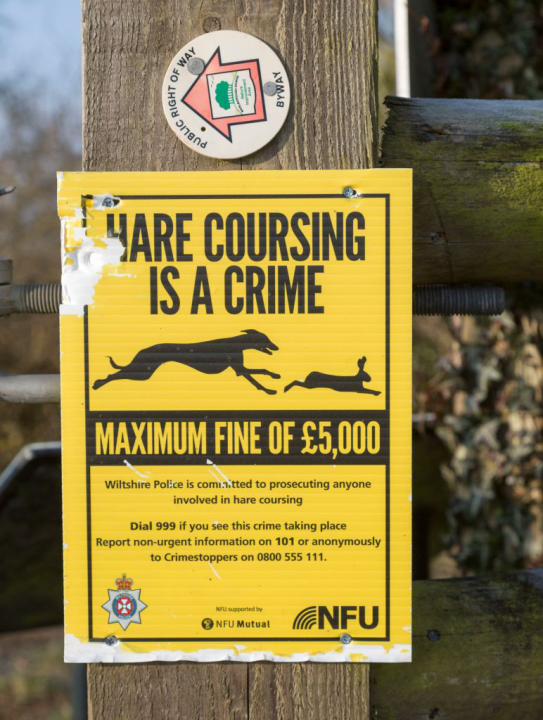


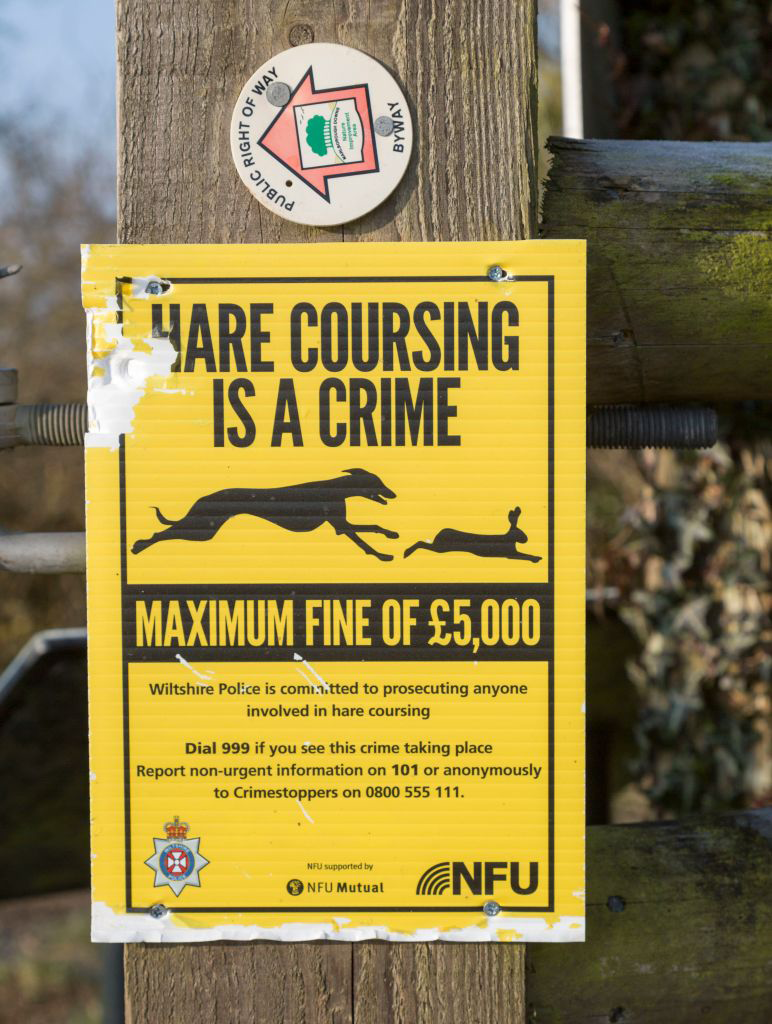
Sergeant Rob Goacher was on patrol recently when the radio crackled with a tip-off. Two men were hare coursing – chasing and killing hares with greyhounds or lurchers – in the fields near Winterbourne Monkton, a small village in Wiltshire. When Goacher arrived, a silver Subaru with the exhaust hanging off edged out of a field and accelerated through the country lanes, hitting 60mph before reaching the M4.
‘The driver then suddenly decided to exit the motorway,’ says Goacher. ‘Over a verge, through a fence, and out through the farm. The field was full of cattle, which could have easily escaped onto the motorway. Then we’d be looking at a massive pile-up and fatalities.’
They use drones to recce an area and can export even the heaviest machinery out of Britain in hours
‘I still have nightmares about that,’ says Constable Simon Gomm, as the three of us look out over Salisbury Plain on a freezing February night. This was just one incident in a chaotic ten-day period when Wiltshire Police seized ten cars linked to hare coursing, which is banned under the Hunting Act 2004. ‘We got invaded,’ says Goacher.
Back in the police station at Trowbridge, Inspector Andy Lemon, head of Wiltshire Police’s rural crime team, shows me a video of a local farmer surrounded by a group of hare coursers. His truck gets catapulted and rammed and a car is driven directly at him. ‘Get straight to him,’ shouts one of the men. He was lucky. A few years ago, a gamekeeper in Hampshire was dragged behind a vehicle and broke both his legs after confronting trespassers. ‘The level of hostility can be extreme,’ says Lemon. ‘They’re coming out here with machetes and air rifles,’ adds Goacher.
These are not local lads out for a night of cheap entertainment. Hare coursing is linked to criminal gangs and can be big business. The chase is often livestreamed to illegal gambling sites, with tens of thousands of pounds wagered on which dog will catch the hare. ‘I am told that you can even watch hare coursing being live-streamed into China and people there bet huge amounts on it as it is happening,’ says Philip Wilkinson, Wiltshire’s Police and Crime Commissioner.
The recent spike in hare coursing across Wiltshire – up 21.8 per cent between September 2024 and August 2025 – forms part of a bleaker picture. Rural crime, from machinery and livestock theft to badger baiting and fly-tipping, is scarring the countryside. Any quaint ideas of England’s green and pleasant land are slowly being eroded.
The National Farmers’ Union (NFU) estimates that the cost of rural crime in 2024 was £44.1 million, but the real figure is likely to be far higher, as the police struggle to keep up. ‘There are many crimes that don’t get reported because farmers are basically shrugging their shoulders and asking: “What’s the point?”’ says the NFU vice president Rachel Hallos. ‘And were the farmer to go out with a shotgun, it’s likely to be them who ends up in court, not the people responsible for the original crime.’
Rural crime was once largely opportunistic. A quadbike or a trailer might occasionally go missing. Increasingly, however, it is the work of organised crime groups (OCGs), many with links to eastern Europe and China, who are stealing farm machinery and GPS systems on an industrial scale. Tractor thefts were up 17 per cent in 2024; trailer thefts up 15 per cent.
OCGs will often use drones to recce an area and can export even the heaviest machinery out of Britain within hours. Tractors, quad bikes and combine harvesters stolen in the south of England have been traced, within 24 hours, to eastern Europe and Africa. ‘Back of a lorry, straight through the ports,’ says Inspector Lemon. ‘Straight across the Channel and into mainland Europe.’
The war in Ukraine has also seen a surge in demand for machinery parts. ‘It’s very organised, very cross-border,’ says Deputy Chief Constable Nigel Harrison, the National Police Chiefs’ Council lead for rural and wildlife crime.
The incentives are obvious. The price of a tractor ranges from £25,000 to £100,000; a combine harvester could be four times that. ‘Traditionally, OCGs would focus on drug running,’ says Harrison. ‘But you’re definitely seeing them move into theft of farm machinery.’ Security measures ‘can be quite lacking’ in rural communities, he explains, and ‘before you know it, you’ve got a rash of crime. A lot of the time it’s easy pickings.’ The effect is devastating for farmers: -‘Ultimately, they might not be able to harvest that year.’
Most of these thefts are done to order. The problem for the police is finding out who is directing the OCGs. ‘A combine harvester takes some getting rid of,’ says Hallos. ‘So if you’re going to steal one, you’ve got a home for it already. The plan to get it out of the country is there.’
A feeling of helplessness is seeping into many rural communities. Eighty-six per cent of those surveyed for the latest NFU Rural Crime Report said they knew farmers who had been repeat victims; 96 per cent stated that rural crime was negatively affecting farmers’ mental wellbeing. ‘They feel isolated and afraid,’ says Hallos. ‘The farm is their family home.’
In the time I spent on patrol with Wiltshire Police, it was clear how determined they are to put a stop to rural crime. We drove for hours, checking in on farmers, speaking to local people and looking for signs of hare coursing. The police here are trying to rebuild trust with a community that feels forgotten. When a man called in to say his dog had killed a sheep, Constable Gomm immediately knew which shepherd it belonged to, and the situation was resolved amicably.
But the reality is that three patrol vehicles and a handful of officers simply cannot cover the whole of Wiltshire at any one time. It is a crisis mirrored across the countryside, as already stretched resources are sucked into towns and cities.

‘It’s down to underinvestment in policing,’ says Lemon. ‘You can write white papers and have all the rhetoric around bringing police into your communities. Absolute rubbish. [The government] is not funding the police adequately. So [police chiefs] are having to make cuts to meet the financial pressure they’re under, which means centralising everything and taking officers further away from the countryside. It’s easy for a criminal to come into our county and not get caught.’
The Rural and Wildlife Crime Strategy, led by DCC Harrison, is an ambitious attempt to change this. It is hoped that greater intelligence-sharing between forces will disrupt OCGs, while investment in technology such as drones and thermal cameras will help to identify criminals operating in some of the remotest parts of the UK.
Harrison has also introduced increased DNA analysis to support investigations. ‘It’s a constantly changing war,’ he says, ‘and one we’re trying to keep pace with.’ Rural affairs minister Angela Eagle is optimistic: ‘New powers to seize stolen assets, improved access to data and technology, and increased collaboration will help police forces in Britain’s rural communities [in the fight] against organised crime.’
Fine words. But for the officers on the ground it can feel futile. They know they are outnumbered and, in the vast expanses of countryside across Britain, criminals are making hay.
Rupert joined The Edition podcast to discuss rising rural crime:






Comments