
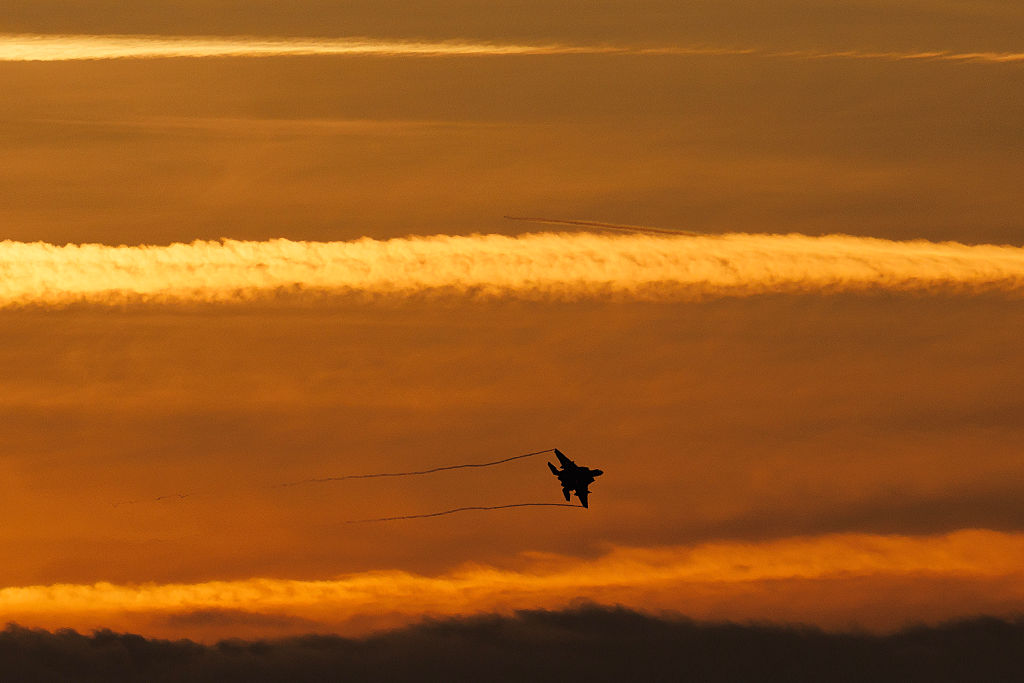
Around dawn on Friday, a McDonnell Douglas F-15E Strike Eagle from the US Air Force’s 494th Fighter Squadron was shot down over south-western Iran. Although the Iranians initially talked about a ‘massive explosion’, it seems that anti-aircraft fire tore off the F-15E’s tail fin, causing it to crash; but the two crew members seem to have ejected before then.
The capture of a pilot by an enemy regime would rekindle some of the American public’s worst, most horrifying atavistic memories
The pilot has already been rescued by US Special Forces, but the fate of the weapons systems officer (WSO, or ‘wizzo’), who sits behind the pilot and controls the air-to-ground avionics, is unknown. At the same time, an Iranian announcer on the regional state television channel in the mountainous, sparsely populated Kohgiluyeh and Boyer-Ahmad province, made a chilling offer:
‘If you capture the enemy pilot or pilots alive and hand them over to the police, you will receive a precious prize.’
An Iranian businessman has also offered £45,000 to anyone who captures the aircrew alive. Mohammad Bagher Ghalibaf, the chairman of the Islamic Consultative Assembly – Iran’s unicameral legislature – took a different tack. On social media, he poked fun at the Americans.
‘After defeating Iran 37 times in a row, this brilliant no-strategy war they started has now been downgraded from “regime change” to “Hey! Can anyone find our pilots? Please?”’
No one should suppose this conflict is a straightforward clash between good and evil. There is the noxious Christian nationalism of Secretary of Defense Pete Hegseth, a man whose enthusiasm for violence is unsettling. And, as the US missile strike on a girls’ school in Minab, killing around 160 children, proved: war always brings suffering to the innocent.
But the regime in Tehran is a brutal, repressive and murderous one. Since the most recent protests against the theocracy began last December, some estimate the government may have killed 30,000 people, while the security forces use torture and sexual violence as everyday tools of their trade. If the missing WSO falls into the hands of the Iranian authorities, as a representative of ‘the Great Satan’, there must be an enormous, probably existential risk to his safety.
The capture of a pilot by an enemy regime would rekindle some of the American public’s worst, most horrifying atavistic memories. They will think of the torture of Captain Richard Storr and the rape and sexual assault of Major Rhonda Cornum by her Iraqi captors during the First Gulf War. They will think of the systematic abuse of the American prisoners of war during the Vietnam conflict, many of whom died in captivity.
They will also be reminded, inevitably, of the seizure of the US Embassy in Tehran by militant Islamic students in 1979 in which 62 hostages were taken. The action, which began spontaneously and without a plan, gained the approval of the Ayatollah Ruhollah Khomeini, Supreme Leader of the Islamic Republic, and 52 of the hostages spent 444 days in captivity. They endured physical abuse, solitary confinement, mock executions, repeated interrogations and denial of food.
There are serious concerns for the safety of the American serviceman stuck in Iran. Did he, like the pilot, eject safely? Did he land without injury? Where in south-western Iran is he now and can he too can be rescued rather than falling into the hands of Iranian security forces?
In many ways, we have become insulated from the costs of war. In 20 years of combat deployment in Afghanistan, from 2001 to the fall of Kabul in 2021, 2,459 US service personnel were killed. In half that length of time, during the central years of the Vietnam conflict, deaths exceeded 50,000. Meanwhile, within 12 hours on 1 July 1916, the first day of the Battle of the Somme, 19,240 British and Empire soldiers were killed.
Yet the fate of this one US Air Force officer could have a significant effect on the course of America’s operations against Iran. He may not have coined the phrase, but Joseph Stalin observed that ‘the death of one man is always a tragedy. The death of thousands is a matter of statistics.’
Operation Epic Fury has not captured the imagination of the American public. Recent polling shows 59 per cent of respondents think President Trump was wrong to use military force against Iran and 61 per cent disapprove of how he has handled the situation. Some 54 per cent think the conflict will last for at least another six months, and 40 per cent believe it has made the world less safe, with only 22 per cent thinking it has become safer.
An anonymous comment by a senior White House official suggested that the President is ‘getting a little bored with Iran. Not that he regrets it or something – he’s just bored and wants to move on.’
With that level of cynicism, and the fact that Trump’s approval rating is now minus 20 – matching his own and Joe Biden’s worst figures – the President’s response to this developing situation is even more unpredictable than usual. If the aviator is not found and recovered safely, the President could respond with blind violence against Iran, or equally could make a dash to declare the war a success on his own terms.
Today is Holy Saturday, the day Christ spent in his tomb after the crucifixion. May the spirit of resurrection and hope which followed be reflected in the fate of a USAF pilot out there, somewhere in the mountains of Iran.


Comments