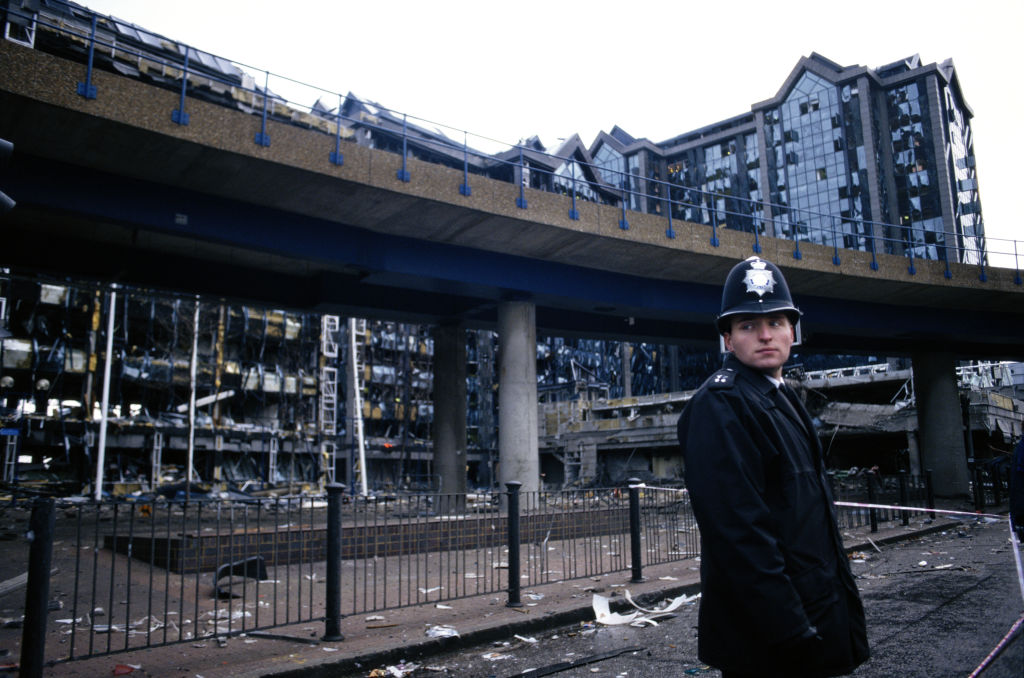
This week marked the 30th anniversary of the IRA bombing of Docklands – the blast which dramatically ended the first IRA ceasefire of 1994.
It should have been the moment that placed the Irish Republican movement beyond the pale. Instead, there is a case for arguing that it actually helped them in the long run.
‘It was treated almost as if it was the cri de coeur of a delinquent teenager rather than a full-scale assault on British democracy’
I say this with some feeling since at that time I was working as a leader writer on the Daily Telegraph in the nearby Canary Wharf tower – and was levitated upwards by the force of the blast.
This was no mean feat, since I was in a sedentary position, on the far side of the building, and weighed well over 15 stone at the time; the device had been placed on a flatbed truck one third of a mile away across the narrow stretch of water at nearby South Quay.
Had we still been in our previous offices at Marsh Wall in South Quay – where the Telegraph had first moved after our departure from Fleet Street in 1987 – many of us would have perished. As it was, the two newsagents at the site were murdered and a hundred were injured, some of them seriously.
It was two minutes past seven in the evening at the end of soporific, cold, Friday in February. The only journalists left on the comment desk by that hour were Boris Johnson and myself; Charles Moore, then a newly-minted editor, was away at an Any Questions? panel in Norwich.
When he came back in on the Sunday morning to produce Monday’s edition, Moore discovered that the clock in his office had been blown off the wall: its face had been smashed and the hands had stopped at one minute past seven; Moore never had it repaired and to this day it remains in his East Sussex home as a memento of one of those rare moments when a national newspaper is physically at the heart of global events.
Boris Johnson duly began writing the new leader, but it was hard going, not least because everything was still so murky; initially, even Ian Paisley seemed to be hedging his bets, wondering if the blast was the handiwork of a dissident IRA faction.
Things were equally opaque at the highest levels of international diplomacy. Just prior to the explosion, Gerry Adams called the Clinton White House to inform them that he had heard ‘disturbing reports’ about the IRA ceasefire; Anthony Lake, the US National Security Advisor of the time, told me some years later that the Sinn Fein President was ‘elliptical and sounded concerned. But we didn’t know what he meant. And I still don’t know whether he knew what was going to happen.’
In the coming days of the renascent IRA campaign, I proved either very lucky or very unlucky. I was in Covent Garden when the Aldwych bomb went off on 18 February; a bomb went off at Brompton Cemetery on 9 March 1996, just a few hundred feet from where I was living in Earl’s Court; and I was in Manchester on 15 June, when the Provisionals bombed the Arndale Centre. For a campaign that supposedly ended up petering out in the following year, all this was proving to be rather too much ‘action’ for my tastes.
Most of the IRA foot soldiers who did the actual legwork for the Docklands bomb were eventually tracked down by supremely skilled inter-agency intelligence and detective work – whose leading public light was John Grieve, the highly unconventional, rumpled and well-read anti-hero who headed the old Anti-Terrorist Branch. However, the Republican godfathers who schemed these atrocities got off rather more lightly – seemingly almost as a matter of conscious policy at the highest levels of the British state.
It’s worth reconstructing the politics of the moment. The IRA had called its first ceasefire at the end of August 1994 – hoping to secure Sinn Fein’s swift entry into all-party talks after 25 years of violence, with minimal preconditions.
Republicans believed that a ceasefire ought to be enough to secure them the full fruits of political legitimacy – hence their refusal to agree to the demand from John Major’s government that they confirm the ceasefire was ‘permanent’. Much of nationalist Ireland and Irish America (often with the backing of the Clinton White House) agreed with them.
But the British government – conscious that a truly inclusive peace process required the involvement of Northern Ireland’s Unionist population – demurred, rightly. Unionists feared that if the IRA’s arsenal remained under the counter as a kind of ‘supplementary mandate’, then the mere threat of a return to violence could leverage endless political concessions.
The government had therefore insisted that the bona fides of Republicans be properly tested by an IRA handover of weapons, otherwise known as ‘prior decommissioning’; or at minimum, a process of simultaneous decommissioning with the talks process.
Nationalist Ireland contended that such preconditions either flowed from a government anxious to shore up its slender Commons majority with Unionist support; or else were a belated pretext for excluding Republicans after the IRA had agreed a ceasefire – a kind of ‘bait and switch’ tactic.
In fact, ministers and officials had insisted on some kind of arms handover well before the first ceasefire and Adams and Martin McGuinness had publicly complained as much at the time. After a quarter century of IRA violence, such as the murder of Tory MP Ian Gow, the government wanted to be sure the IRA was sincere.
All of this proved too much for Republicans who concluded that they needed ‘to put manners on the Brits’. Not only would arms not be surrendered as a price to entry into talks; they would be used to demonstrate the IRA’s continuing capability. The result was the Docklands bombing.
Some in government circles affected to believe this resumption of violence was a piece of theatre – not a serious resumption of the armed struggle. But to those counter-terrorism officers on the ground at the time, however, there seemed nothing half-hearted or ‘performative’ about the IRA’s renewed campaign, to use the contemporary jargon.
As John Grieve recalls, the IRA units on the mainland which were successfully thwarted in Operations Airlines and Tinnitus were amongst the most proficient he had ever seen in his career. Had Operation Airlines not prevailed, the entire power supply for London would have gone down. Could the peace process have survived that?
As it was, there was no great reappraisal of the nature of the Republican movement at the highest levels of government as a consequence of the Docklands bomb. Indeed, at no stage did any Conservative minister or permanent official ever suggest that the process could ultimately go ahead without the involvement of Sinn Fein/IRA. The worst that Republicans could expect was a period in the ‘sin bin’ until they restored the ceasefire.
The Marquess of Salisbury – who as Viscount Cranborne was then serving as Leader of the House and who also sat on the critical Northern Ireland committee of the cabinet – recalls of the government’s response to Docklands bomb: ‘It was treated almost as if it was the cri de coeur of a delinquent teenager rather than a full-scale assault on British democracy.’
The decision to stick to the existing approach also owed much to the increasing influence of the Security Service in the affairs of Northern Ireland. Stephen Lander, the incoming Director-General of the Security Service had been in New Zealand when the Docklands bomb went off – on a farewell tour with the outgoing head of the Service, Dame Stella Rimington.
Lander was a long-time specialist in Northern Ireland and a former head of T Branch. According to the authorised history of MI5 by Christopher Andrew, Lander – who had formally taken over the top job in April 1996 – endorsed Major’s approach, sharing the view with No. 10 that ‘the government should continue with its current strategy’, which included ‘providing reassurance to the Provisional leadership about the nature of the talks process which is on offer.’
Such an intervention with the Prime Minister of the day constituted something new: as another former senior officer observes, when the Heath government (on MI5 advice) expelled 105 Soviet diplomats for engaging in espionage in 1971, it would have been unthinkable for the Director-General of that time, Sir Martin Furnival-Jones, then to offer policy advice to No. 10 to the effect that ‘notwithstanding these expulsions, the Government should now continue to seek détente with Moscow’.
One official states that the difference is that MI5 had far greater equities in Northern Ireland – and thus proportionately mattered much more to the conflict there than it ever did in the totality of national security responses in the Cold War.
As such, Northern Ireland proved to be a kind of ‘pathway drug’ for the Service into a much more consequential role across the piste – not least in terms of the wider approach to Islamism after 9/11. Today, a senior MI5 representative sits formally on the National Security Council, a body which did not even exist during the Cold War. The Service is also much larger than it was back then – 5,500 officers compared to 1,900. But considering its policy weight and self-confidence (again, another big change from the Cold War epoch) is it sufficiently scrutinised?
What can be said of this final period of Conservative government – is that in cooperation with elements of the Deep State, the Tories laid the groundwork for the serious dilution of the remaining British ‘preconditions’ to entering all-party talks with Irish Republicans – paving the way for Tony Blair’s Labour party to launch dialogue when it entered office.
By late 1996 to early 1997, Major knew that the next general election was lost. Having come to that realisation, Salisbury recalls, ‘he wanted a peace agreement more than anything else.’ But the Provisionals realised that he was a loser, too: they wanted to deal with the coming force of Blair’s Labour and restored the ceasefire in July 1997, without having to declare a permanent end to violence nor hand in a single weapon.
Later, after the successful negotiation of the 1998 Good Friday Agreement an ‘international ideology of Northern Ireland’ began to emerge – with Blair’s former chief of staff, Jonathan Powell, as its best-known public exponent. Today, its lessons are imbibed across the world in conflict zones, most notably in Gaza.
One key official in the current Gaza talks states that the two key takeaways derive from this critical period in the winding down of the Troubles: don’t demand the decommissioning of weapons up-front and if and when you do, make sure that it isn’t done publicly to ‘humiliate’ armed insurgents (‘no Spielbergs’, as Martin McGuinness used to say).
The Docklands conspirators were duly caught and sentenced; they got out of prison early under the terms of the Good Friday Agreement. In 2000, after serving just two years of his sentence, one of them was even granted a Royal Prerogative of Mercy. Such a document had to be signed personally by the Sovereign – on the advice of ministers.
That minister was the then-Secretary of State for Northern Ireland, Peter Mandelson – with the full backing of Jonathan Powell and No. 10. The Sinn Fein leadership had insisted on nothing less.
Why? Because by that point, sustaining the Sinn Fein/IRA leadership against republican ‘hardliners’ had become one of the highest goals of state policy. And this model of ‘conflict resolution is, for now at least, a core part of what the British state thinks it can offer to the world.
Dean Godson is Director of Policy Exchange and a member of the House of Lords. He is the author of Himself Alone: David Trimble and the ordeal of Unionism (HarperCollins, 2004).


Comments