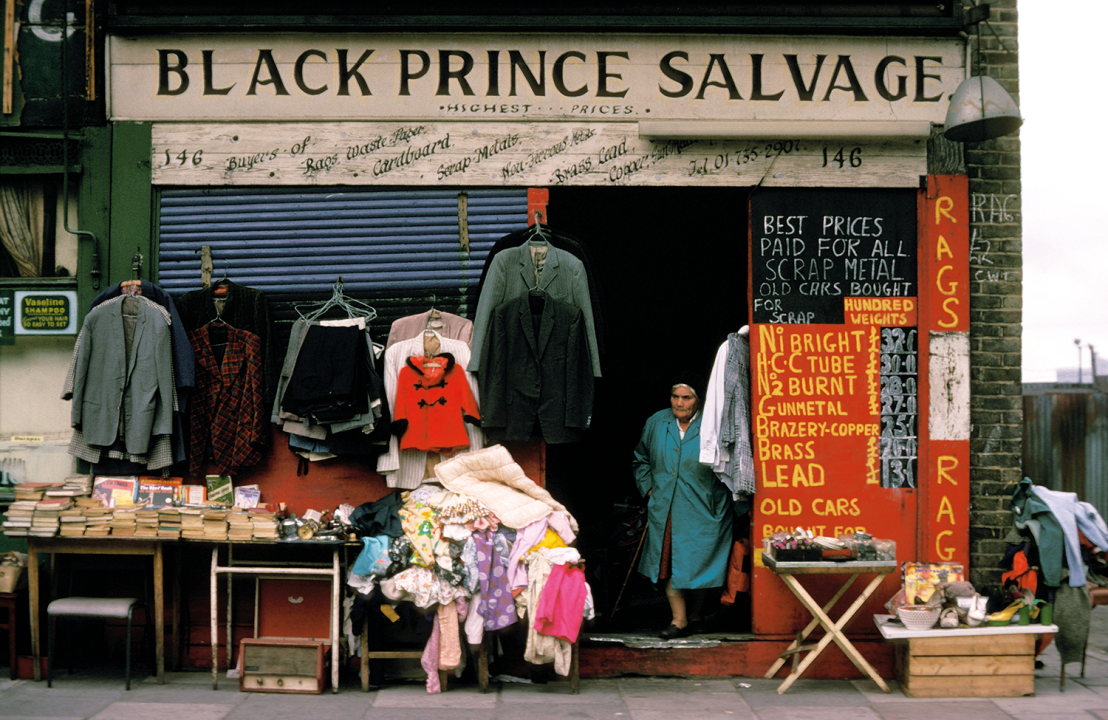
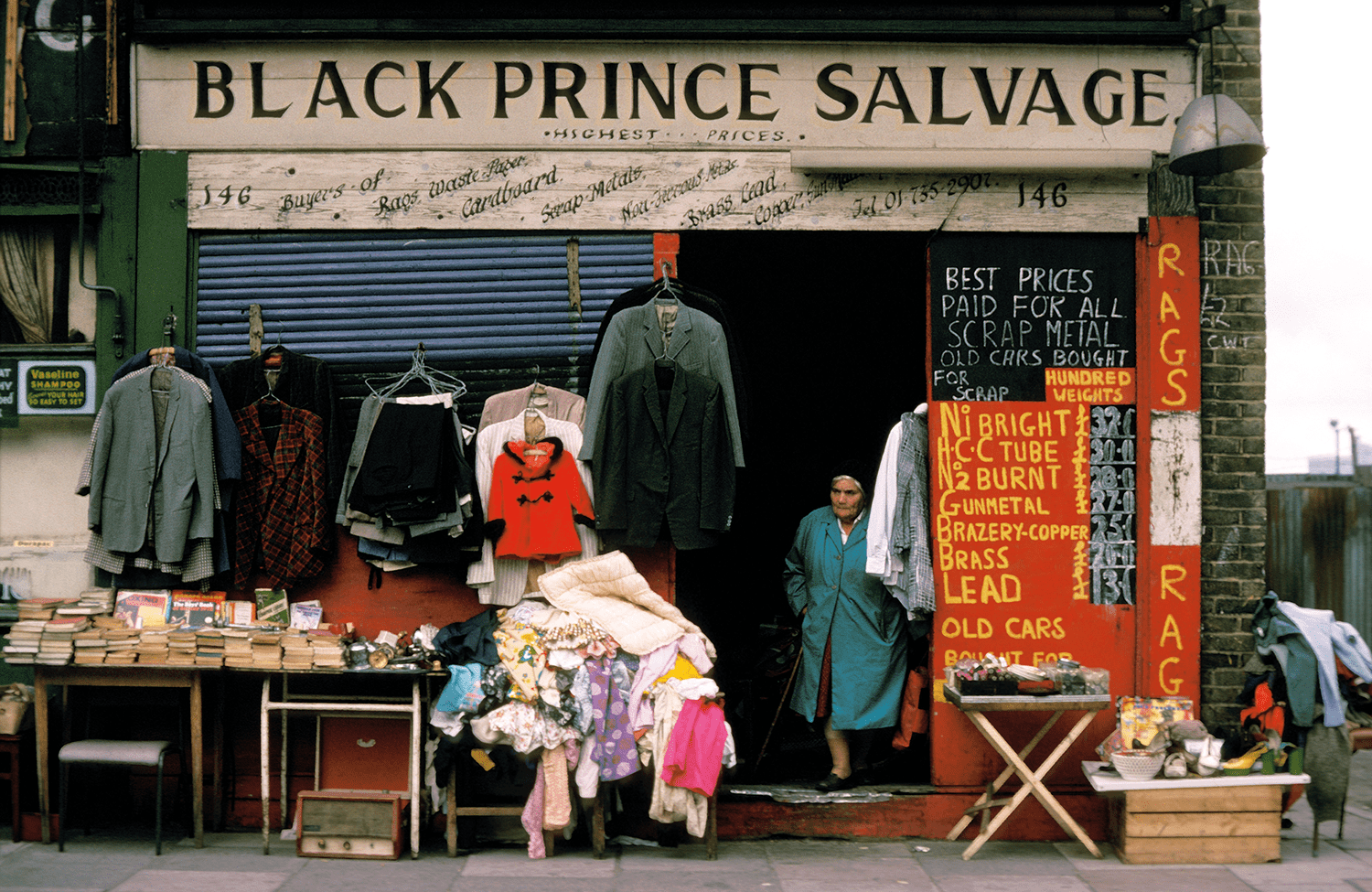
‘The place through which he made his way at leisure was one of those receptacles for old and curious things which seem to crouch in odd corners of this town and to hide their musty treasures from the public eye in jealousy and distrust.’ In Dickens’s The Old Curiosity Shop, Nell Trent’s grandfather loses his precious shop to the malicious money-lender Quilp. London’s junk shops have, it seems, always been under some form of threat. But the forces against them today appear unstoppable.
The junk shop is increasingly the sole preserve of the city’s ‘odd corners’ – pushed out by hiked rents, the charity-shop boom with its variety of cost dispensations, and the popularity of eBay and Vinted. Even the Old Curiosity Shop on Portsmouth Street which has long revelled in the contested notion that it inspired Dickens’s story – and is now owned by the London School of Economics – trades in Japanese designer shoes rather than anything more Dickensian. It seems that the London junk shop has a precarious future, in spite of junk being a constant presence in our culture.
The junk shop, idiosyncratic, eccentric, has always played a role in British creative life
In Michelangelo Antonioni’s Blow-Up (1966), the David Bailey-esque fashion photographer, played by David Hemmings, spends the early part of the film trying to buy a junk shop in Charlton. It epitomises the ideal of the London bric-a-brac emporium. Hemmings can barely get inside to look around, the items within having gathered over so many years that they’ve become an architectural necessity. Antonioni hints at the unstable future of such establishments. The area’s brutalist developments, seen sprouting ominously in the background, eventually rumbled over the beautiful shop and its street entirely.
The junk shop, idiosyncratic, eccentric, has always played a role in British creative life. Film director Ken Russell trawled junk shops around Notting Hill looking for props when he was starting out as a photographer. ‘I’d see a hip bath in Portobello Road and I’d buy it and I’d take pictures of [it] being used,’ he once excitedly proclaimed. ‘I’d buy a big old 1920s lampshade… and I’d make it into a skirt for a woman or a hat for another woman.’ Russell was far from alone.

Sculptor Eduardo Paolozzi scoured similar shops in search of material for his collages and sculptures, his own studio in Chelsea eventually resembling one large junk shop. Peter Blake, meanwhile, has been a junk enthusiast since youth. ‘I realised I was going [to Gravesend Art School] with no cultural history at all,’ he told the Independent in 2011 ahead of the junk-themed exhibition A Museum for Myself, ‘So for the very first time I went into a junk shop and I bought a papier-mâché tray, a painting of the Queen Mary and a set of Shakespeare. I’ve been going to them ever since.’
What would eventually become Vivienne Westwood and Malcolm McLaren’s Sex shop at 430 King’s Road started out as a junk shop. ‘The shop purported to sell relics,’ explained McLaren in the New Yorker. ‘Brylcreem, wallpaper, and posters that we judged to be authentic in their expression. Scavenging London’s street markets, we turned the place into a replica of a 1950s working-class living room.’
W.G. Sebald would often potter around the junk shops near his East Anglian home, some of his finds eventually littering the pages of his books. In a 1998 interview on Dutch television, Sebald happily went off on a tangent about one of his finds. ‘About two months ago in a junk shop in Bungay,’ he told the interviewer, ‘I fished out of a box of cheap prints a little card, which had lichen on it, dried lichen, and underneath in neat handwriting it said “Gathered from the tomb of Marshall Ney, Paris on 7 July 1833”. And something like this, totally valueless as such, really gets me going.’
Television is haunted by junk. Emily’s shop housing her saggy old cloth cat in Oliver Postgate’s Bagpuss; the rag-and-bone trading of Albert and Harold at 26A Oil Drum Lane in Steptoe & Son; William Hartnell’s Doctor landing in the junkyard of 76 Totter’s Lane in the very first episode of Doctor Who. In fact the Tardis disguising itself as a police box is itself a form of camouflage fit for the junkyard.
The junk shop still just about survives in some parts of London, albeit in a manner as precarious as its stacked items. The most wonderful is in Greenwich. Open since 1954, the Junk Shop – its rickety M.C. Escher staircases leading nowhere – feels like a last remnant of an older London, a place of utter joy. On Brick Lane, meanwhile, in between the overpriced stalls and aggressive restaurant touts, This Shop Rocks once sat quietly with a small array of bits and bobs spilling out on to the pavement. Its basement was especially exciting, a kind of dingy remnant of the gothic East End. I remember rescuing a lovely old edition of Norman Collins’s London Belongs to Me from the bottom of a stack that threatened to bury me. If a shop’s items fail to imperil the rummaging devotee with imminent demise from an impending collapse then it’s likely not a proper junk shop.
The disappearance of junk shops from the capital heralds a victory for conformity
This Shop Rocks had to move to the edge of Hackney’s marshes in 2018. Around the corner, the wonderful Des & Lorraine’s was similarly banished to the suburbs – closing their doors on Bacon Street after 35 years, and moving to an industrial estate in Leyton. Crystal Palace is the last haven, a kind of Dunkirk for junk shops. Bambino is still its best; a shop so packed that it’s difficult to get too far in before worrying you may never escape.
The disappearance of junk shops from the capital heralds a victory for conformity. There’s a reason why Winston Smith finds solace in Mr Charrington’s shop in Nineteen Eighty-Four. The room seemed ‘to contain nothing but useless rubbish’, Orwell wrote of the building, but there was an indefinable air ‘of belonging to a quite different age’. Charrington’s shop may have been the perfect trap to lure the dissident Smith on the path to Room 101, but the bait of ‘a pocket of the past, where extinct animals could walk’ is still an irresistible temptation in this increasingly hollowed-out city of ours.



Comments