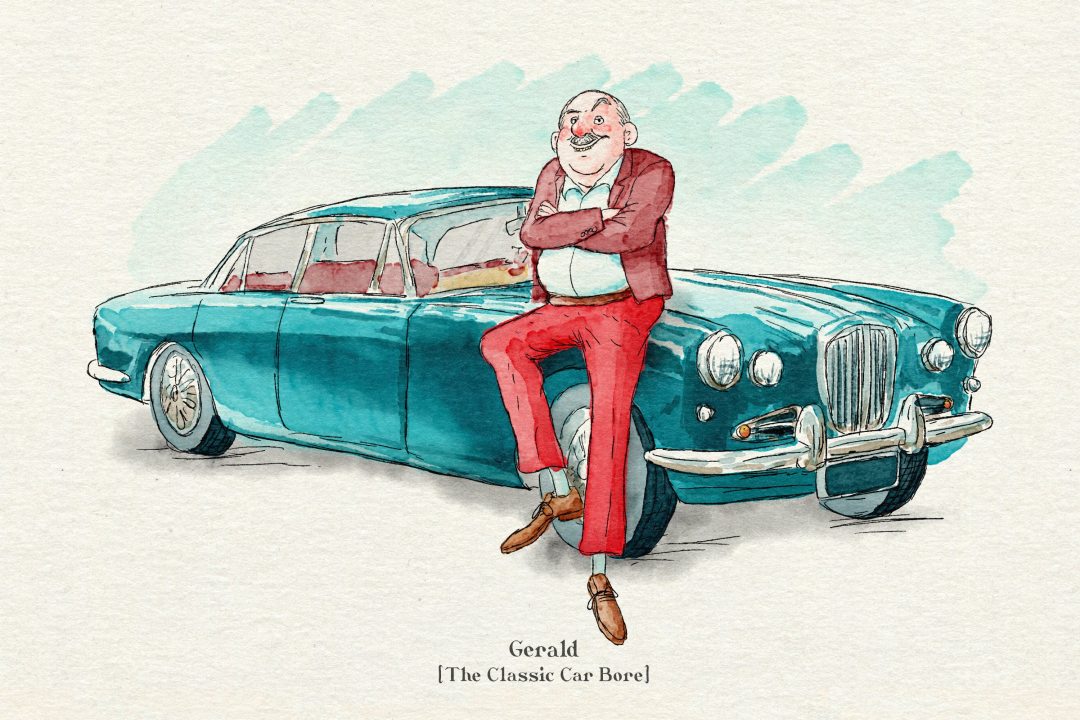
Gerald’s just back from Florence. Two-and-a-half-thousand miles in the old Aston, thunderous straight six booming all over the Alps. ‘Took the Gothard Pass out of Switzerland. Bloody marvellous. You could hear us coming three valleys away! The old girl almost boiled over at seven thousand feet. The Aston was pretty, hot too, hahaha, wasn’t she, Lucinda?’

Long-suffering Lucinda, who has been married to Gerald for 48 challenging years, has heard all the stories before and only winces inwardly. The ‘jokes’, innuendo and double entendres about big end rebuilds, lubing the shaft, greasing the nipples and piston slap are more wearying than wounding these days.
The Aston in question, Gerald will tell anyone who’s interested – and plenty more who aren’t – is a rare, 1962 Lagonda Rapide, based on the DB4, with a four-litre inline six and twin overhead cam, styled by Carozzeria Touring over a Superleggera steel tube frame. It’s worth a couple of hundred thousand, give or take, but he insists it’s an ‘understated gentleman’s car’, perhaps failing to understand the meaning of either word.
Gerald is a retired banker, a ruddy-faced Home Counties septuagenarian. Decades of generous lubrication with the good stuff from Château Palmer, Romanée-Conti, Lagavulin and Armagnac, combined with countless Cohibas, have left their mottled tracery across his nose. The spider veins match his red trousers, which he believes ‘cut a dash’ in a monochrome world.
Every classic car adventure, and there have been many, from reckless, money-no-object bare metal restorations to stupendously expensive cross-continental rallies, must be recounted in great and invariably tedious detail. In 2013 he finished third in class in the Peking to Paris in a heavily modified, Mulliner-bodied Bentley S2 Continental from 1960. ‘That’s when the chaps at Crewe ditched the old inline six from the S1 and really went for it with a 6.2-litre V8. Bloody brilliant.’
Though he can barely change a spark plug – ‘I’ve got chaps to do all the technical work, I mean why have a dog and bark yourself, hahaha!’ – Gerald goes on to tell their glazed-eyed dinner party guests about the forged alloy pistons, the gas-flowed high compression cylinder head and the crankshaft adapted to accept viscous fluid dampers.
‘We were getting through rear shocks every couple of days and then the blasted clutch release bearing went in the middle of Mongolia and we were toast until this shepherd boy had a look and got us back on the road before you could say Genghis Khan!’
Gerald has never really gone in for introspection. He remains a stranger to Socrates’ maxim that the unexamined life is not worth living. Life, when it comes down to brass tacks, is the roar of a straight six or the rumble of a big V8, perhaps the odd four-pot Triumph TR3 – ‘wonderful little thing, all curves like Anita Ekberg. Look it up, Marcello Mastroiannni drove one in La Dolce Vita.’
Though gregarious by nature, his bluff management style is not to everyone’s taste. He was once president of the Alvis Owners’ Club, but his tenure was not an unqualified success. It led to the rapid emergence of a rival offshoot, the Alvis Enthusiasts’ Association, followed in quick order – and an unfortunate homage to Monty Python’s Judean People’s Front and the People’s Front of Judea – by a third group, the Alvis Drivers’ Club. Splittists! All three clubs are now non-speaks, which makes any gathering of Alvises a socially fraught proposition.
If Lucinda has heard all the jokes before, so has Gerald. When he had a Bristol 404 – a little twitchy on the limit, wheelbase too short, no two ways about it – and a 411 – huge Chrysler lump, almost seven litres, could get half of Burgundy’s annual harvest in the boot – friends teased him about ‘the lovely pair of Bristols’. Although he prefers his cars to be British and will go misty-eyed when reliving the Golden Era of 1960s car manufacturing ‘before the unions ruined it all’, a rare foray into Italian exotica with a 1967 Fiat Dino Spider was greeted with guffaws about Fiat standing for ‘Fix It Again Tony’.
Same for the 1964 Lotus Elan S1 and the predictable quip: ‘Lotus – did you know it stands for “Lots Of Trouble, Usually Serious”, ha! Or “Left on Track, Unserviceable!”’ Jokes aside, Gerald will tell anyone who’ll listen – and that’s a dwindling constituency – that Colin Chapman of Lotus fame was a really remarkable chap. Simplify and add lightness, that was his thing. Mind you, that lightness came at a heavy price. Jim Clark at Hockenheim in 1968, Jochen Rindt during qualifying at Monza in 1970. Both killed. But that was proper racing. Not like F1 today; it’s a computer game for teenage kids.
Over the course of their marriage the number of cars has steadily increased. For years Gerald could always tell Lucinda these acquisitions, often spurred by another snifter of Calvados and an hour or two more on the RM Sothebys, Bonhams and Car & Classic websites than was strictly advisable, were blue-chip investments. But now she’s cottoned onto the fact that the market is in meltdown and the usual flannel about it being wiser to put the hard-earned dosh into an appreciating classic than in the bank won’t cut it. She realises the old boys are dying off and the new generation wouldn’t be seen dead in a 1960s Jaguar E-Type.
So there haven’t been any purchases for a while, Gerald realises with a shudder. The old girl is keeping a beady eye on the old girls.


Comments