
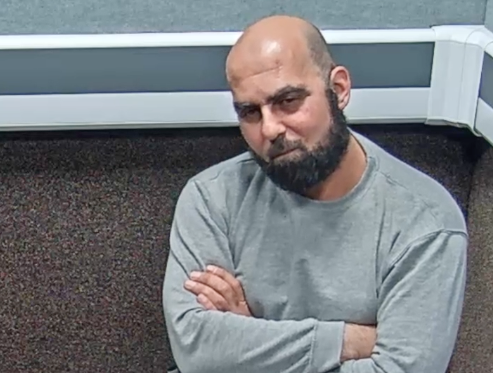
British Jews are under threat. That was the blunt warning from Sir Stephen Watson after a jury at Preston Crown Court convicted Walid Saadaoui and Amar Hussein of preparing acts of terrorism. The Chief Constable of Greater Manchester Police said that had their plan succeeded it would have been ‘one of the worst atrocities’ the world had seen. He was right.
A civilisation cannot limit its terror response to surveillance, infiltration and the disruption of plots moments before execution. That is containment, not resolution
Saadaoui, 38, of Wigan, and Hussein, 52, of Bolton, had set out to replicate the 2015 Paris attacks. Their chosen targets were synagogues, Jewish schools and a kosher supermarket in the north west of England. They purchased assault rifles, handguns and around 1,000 rounds of ammunition. The intention, in the words heard in court, was to ‘kill as many members of the Jewish community as they could’ and to become ‘martyrs’ in revenge for Israel’s actions in Gaza.
According to the prosecution, they intended to escape the first attack scene, steal or use an ambulance as a getaway vehicle, continue attacks at additional locations and potentially fire on responding police officers. The judge later described the plot as ‘very close’ to execution when officers moved in. Saadaoui was arrested ‘red-handed’ in a hotel car park while taking delivery of weapons from the boot of a rented Lexus in an undercover operation.
The sentences reflected the gravity of their crimes. Saadaoui received life imprisonment with a minimum term of 37 years. Hussein was handed life with a minimum of 26 years. Saadaoui’s brother, Bilel, was jailed for six years for failing to disclose information about the plan.
Thank God the authorities intervened. The surveillance, the infiltration by the undercover operative known in court as ‘Farouk’, the patience required to allow evidence to accumulate without allowing bloodshed to occur, all of it deserves public gratitude. Sir Stephen said the force had avoided something that would have ranked among the worst atrocities seen globally. The fact that it was prevented shows the counter-terrorism network is, for the most part, managing an immense and permanent burden.
For the most part. The Manchester synagogue attack in October at Heaton Park is a reminder that prevention is never total. There are gaps, moments, failures. The threat environment is saturated.
Sir Stephen chose his words carefully. ‘We are seeing the manifestation of hatred moving beyond our shores globally and this is a threat to all of us. It is a threat to our Jewish communities and, if our Jewish communities are under threat, we are all under threat.’ He added that Jewish children are ‘the only children in our country who day to day go to school behind large fences guarded by people with vizzy jackets and where there are routine police patrols in and around those areas.’ That observation lands heavily. It describes a parallel civic reality.
Islamic State-inspired terrorism no longer shocks in Britain. It horrifies, it angers, but it does not surprise. The ideological script is familiar. In this case the jury heard evidence of social-media posts allegedly praising Islamic State, statements praising the 2015 Paris attacks, references to martyrdom, expressions of hatred toward Jews and Christians, and extremist propaganda found on devices. When Hussein was asked directly whether he supported Islamic State, he replied: ‘Do you want a true answer? Yes.’ He explained why: ‘They are Muslims. They make Sharia.’
Saadaoui told the undercover officer that attackers should ‘carry out operations against the Jews and the Crusaders there, and hitting them there affects them badly.’ In a Christmas Day voice note he dismissed knives and vehicles as ‘ineffective’ and concluded: ‘what is needed is an automatic gun.’ This was ideological conviction articulated without disguise.
Some still reach for alternative explanations for Islamic terrorism. Poverty. Marginalisation. Social exclusion. The problem is that Saadaoui does not fit the model. He arrived in Britain legally in 2012 after marrying an English woman he met while working as a hotel entertainer in Tunisia. He worked at a Haven Holiday Village, saved, trained as a chef, bought the Albatross Italian restaurant in Great Yarmouth for £25,000, ran weddings and birthday parties, owned a house on Ipswich Road, sold it for £169,000, remarried, had children. He appeared to be a conventional immigrant success story. Integrated. Industrious. Embedded.
Before his arrest, he allegedly transferred assets to family members, withdrew large amounts of cash, wrote a will and discussed leaving messages for his family after ‘martyrdom’. That preparation for death did not grow out of economic despair but out of belief. Indeed, if poverty caused terrorism, we would see waves of attacks by the poor and disadvantaged from other backgrounds, but we do not.
In Britain the distribution of threat does not mirror deprivation indices or general crime statistics. By the government’s own assessments, Islamist extremism accounts for roughly three quarters of MI5’s counter-terrorism workload. A similar proportion in custody for terrorism-connected offences are linked to Islamist ideologies. In recent years, close to 80 per cent of the Counter Terrorism Policing network’s live investigations have been Islamist in character, with extreme right-wing cases forming most of the remainder. Across Europe, Europol’s most recent assessments show jihadist terrorism dominant both in arrests and in lethality. Globally the pattern is starker still, with Islamic State and its affiliates responsible for the overwhelming majority of terrorism deaths in recent reporting periods.
This pattern is visible elsewhere, and it resists the comforting sociology that many still prefer. Mohammad Sidique Khan, the ringleader of the 7/7 London bombings, was a teaching assistant in West Yorkshire, married, embedded in his community, articulate enough to record a video testament framing his mass murder as a moral obligation. Several of the 9/11 hijackers, including Mohamed Atta, were university-educated and technically trained. The 2015 Paris attackers drew on a hybrid of criminal networks and hardened ideological commitment, explicitly invoking Syria, Iraq and the duty to strike civilians as retaliation. In each case the language of grievance was present, but it was filtered through doctrine, disciplined by doctrine, sanctified by doctrine. Ideology did not sit on top of personal frustration as decoration, it structured it. It provided the grammar through which anger became obligation and death became aspiration. That is why the biographies so often look ordinary until the final turn. The decisive shift occurs in belief, not in income bracket.
The techniques, too, have circulated internationally. The plan to conduct sequential attacks, to move between sites, to engage responding officers, echoes tactics refined over decades of jihadist violence. The mass-casualty shooting of Jews on Bondi Beach last year showed how even on the other side of the world a similar marauding gunman attack targeted at Jewish people and those around them played out according to a well-known blueprint. The ideas move first. The tactics follow.
Sir Stephen is right to focus on what he called the threat to Jewish communities. It is unbearable, and it is utterly unacceptable that Jewish children in Britain attend schools behind high fencing with visible security and routine police patrols. Many Jewish families have adjusted to that reality with quiet resilience. They have normalised it because they must.
But it is not just us Jews who are quietly accepting the unacceptable. You have all done the same. Metal detectors appear in spaces that once required none. The massive concrete flowerbeds we increasingly see outside important buildings, and those oversized ‘ARSENAL’ letters outside Emirates Stadium – examples of what is known as ‘Hostile Vehicle Mitigation’ disguised as decoration or branding – are turning our spaces into invisible fortresses. We tell ourselves this is prudence. We tell ourselves this is modern life. Gradually the exceptional becomes ambient.
Of course defence and security are necessary. But a civilisation cannot limit its response to surveillance, infiltration and the disruption of plots moments before execution. That is containment, not resolution. If we are honest, we know that the ideological engine behind these attacks remains active.
The uncomfortable task is to confront that ideology directly, to strip it of legitimacy, to refuse indulgence or euphemism, to challenge its theological claims and its political narratives with seriousness rather than embarrassment. That means intellectual clarity, legal firmness and cultural confidence. It means recognising that tolerance cannot extend to doctrines that sanctify slaughter.
If we fail to do that, we remain in the water, adjusting to the temperature. We Jews have felt the heat first. Others will feel it later. The pot, meanwhile, continues to warm.




Comments