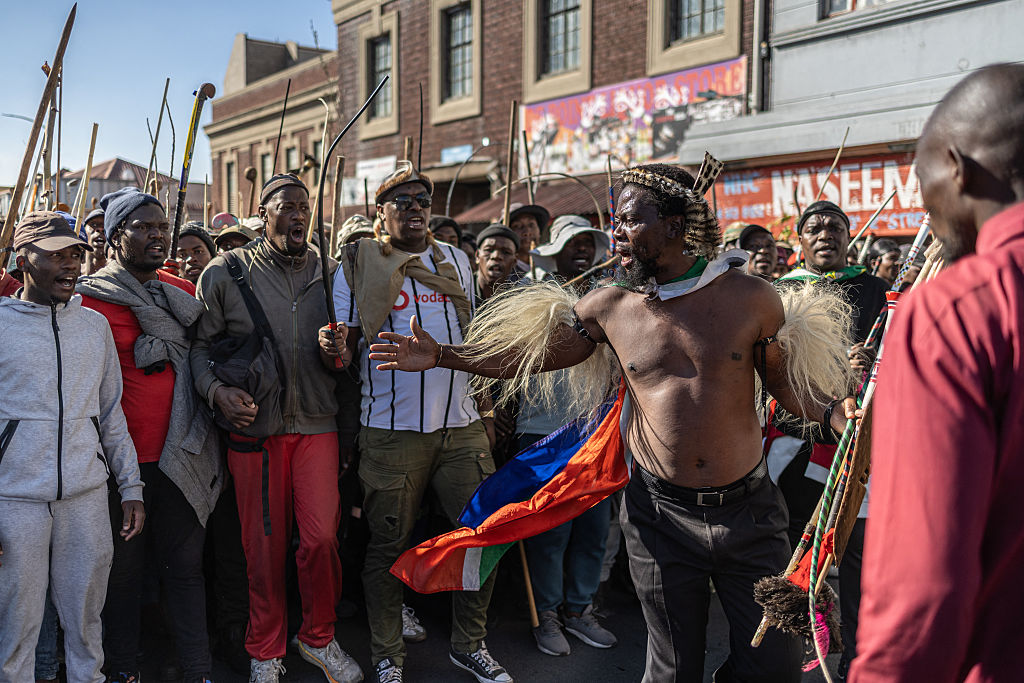
For months, South African social media has been awash with videos of men marching through the country’s streets carrying sticks, clubs and whips. Some of the clips are theatrical, others are more menacing. Running through them are repeated references to a date: 30 June, the deadline set by anti-immigration groups for illegal migrants from neighbouring African countries to leave the country… or else.
South Africa might be the biggest mass migration story you have never heard of
South Africa has seen this before. A protest movement appears, gathers momentum online, threatens to spiral, and then usually dissipates. Yet this country is far too combustible for anyone to assume that this movement will simply pass.
For the ordinary person in South Africa, things are not going well. As in much of the West, the effects of mass immigration are unevenly felt. The wealthier sections of society insulate themselves in enclaves and often regard migrants as a source of cheap, reliable, non-unionised labour. By contrast, poorer communities face the daily pressures of competition for jobs, housing and public services, compounded by cultural and linguistic tensions in a stagnant economy. These factors have created the tinderbox which has led to the current situation.
Sensing danger, the governments of Ghana, Nigeria, Malawi and Mozambique have all been involved in efforts to repatriate citizens from South Africa, while President Cyril Ramaphosa has warned that his government will act against those exploiting concern over illegal immigration for ‘political, personal or criminal agendas’.
The term routinely trotted out for this anti-immigrant angst is ‘xenophobia’. Labelling real and pressing grievances as ‘phobias’ has been one of the left’s most effective ways to dismiss their opponents. But the concerns about resource competition and the breakdown of social cohesion arising from mass migration are more like disquiet, insecurity and frustration rather than fear. Actions sparked by deep-rooted political grievances can often themselves be harmful, misdirected and disproportionate, of course. But this is a distinct problem from the validity of the grievance itself. Take the recent events in Northern Ireland. After a Sudanese man was charged over an alleged knife attack, political leaders condemned the violence that followed. Yet if condemnation is the only response leaders have after such incidents, the public will increasingly sense that official institutions are more comfortable denouncing the reaction than confronting the conditions that produced it.
Nobody really knows how many illegal migrants live in South Africa. Official and semi-official estimates usually place the number in the low millions, within a population of roughly 65 million. Yet trust in these figures is weak, with the veracity of the census challenged by demographers due to a very high undercount. Some organisations working in South Africa’s township economy have argued that the true immigrant population may be considerably higher.
But in South Africa, the problem of migration goes far beyond people crossing internationally recognised borders. South Africa, like much of the continent, is full of languages, tribes and religions layered awkwardly on top of borders laid down in the colonial era. In this context, migration across unofficial borders can matter just as much as migration across official ones. Inside South Africa, to take a hot-button example, the movement of large numbers of people from the Xhosa-majority Eastern Cape into the Western Cape, with its various and long-established Western-centric communities, has contributed to an intensifying sense of cultural displacement and insecurity.
It is not much of a stretch to say that with its porous international border and the constant movement of black South Africans to the commercial urban centres sustained by the country’s Western business class, South Africa might be the biggest mass migration story you have never heard of.
And this story matters to the West for at least two important reasons.
Firstly, South Africa is a foretaste for Western countries of the intense desire of Africans to live in orderly, prosperous Western economic regions. It also shows the rapid onset of disorder that occurs in these regions following mass, rapid and unchecked immigration.
Secondly, South Africa’s stability directly affects the Western immigration crisis. For all its troubles, the country still has the infrastructure, institutions and economic strength to be a crucial stabilising force in sub-Saharan Africa. This, in turn, means it continues to attract African migrants southward and anchors Africans in Africa. But if the country becomes poorer, more chaotic and more hostile to migrants, the migration flows will not dry up but rather be redirected northwards towards Europe and the wider West.
The South African migration story is not peripheral to the Western immigration saga, but one of its leading and most dramatic frontiers.




Comments