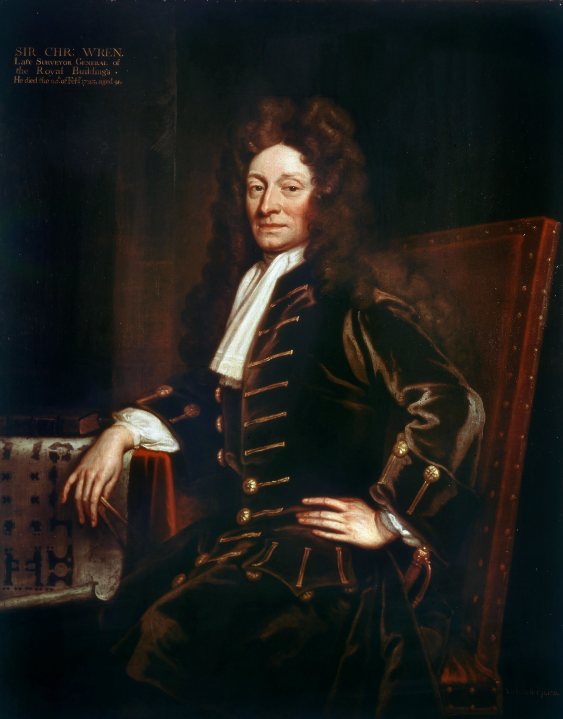
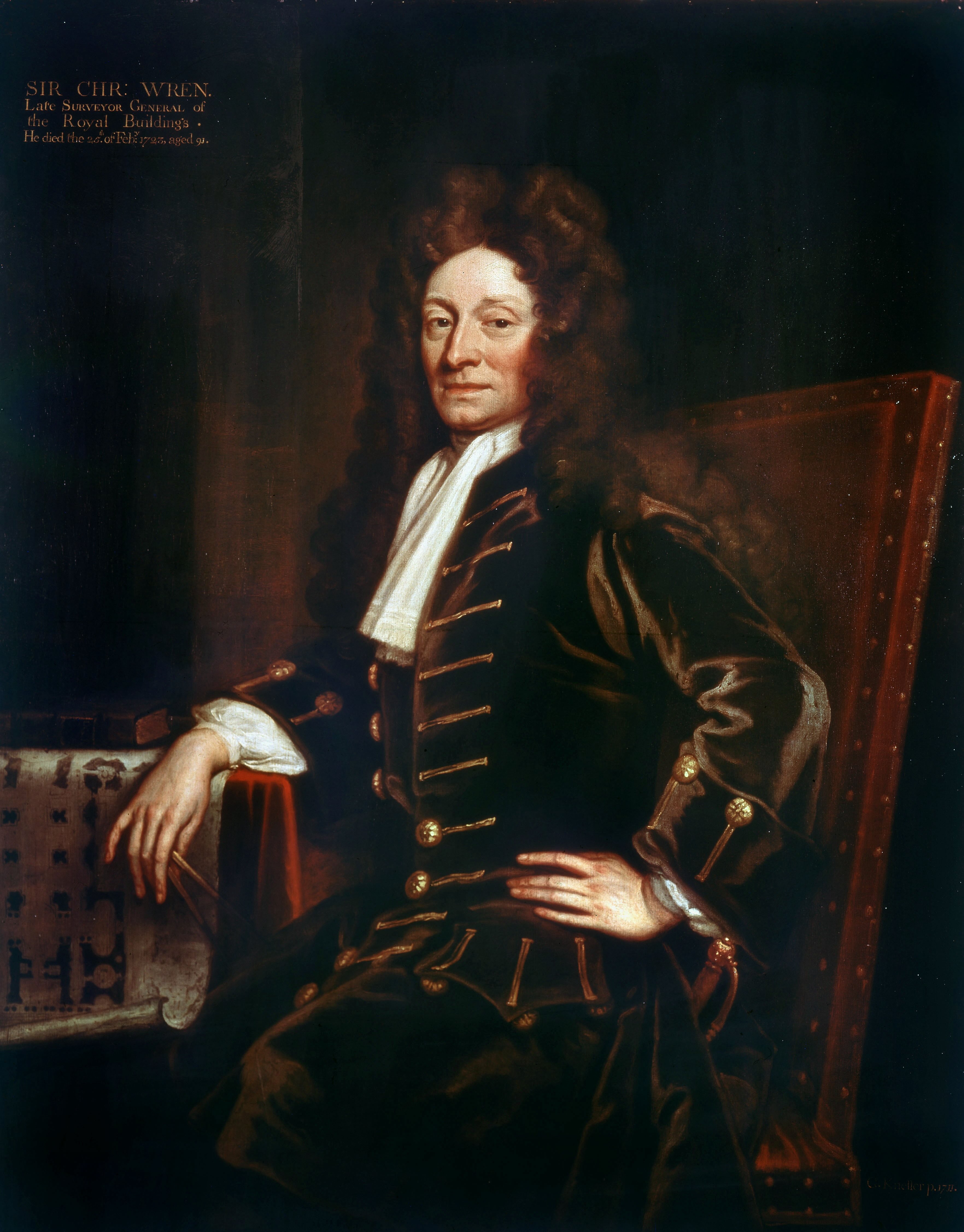
Sir Christopher Wren did it all. 51 City Churches after the Great Fire of London. St Paul’s Cathedral. Hampton Court, Greenwich Hospital, Royal Hospital Chelsea… But he never built an English country church. Or did he? This weekend, I went to an enchanting service at St Mary’s, Ingestre, Staffordshire, to celebrate its 350th anniversary.
There is only one document connecting Wren to the church – his design for ‘Mr Chetwynd’s tower’. The Chetwynds built the neighbouring pile, Ingestre Hall. Their descendant, Aaron Chetwynd, lives in the neighbouring stables and kindly asked me to give a talk on Wren at the Ingestre Hall orangery after the church service.
Walk inside St Mary’s and it’s spine-tinglingly moving. It’s just like one of Wren’s City churches, with an exceptional, Grinling Gibbons-like pulpit and screen and alarmingly lifelike cherubs – with several of them so idiosyncratic that they must have been based on real people.
The carving of the plaster ceiling is world-class. Even Nikolaus Pevsner, the great guide to Britain’s buildings, rarely moved to passion, called it ‘gorgeous’. The hand of Gibbons – or Edward Pierce, who carved a famous bust of Wren – looks to be at work. The undercutting of fruit, garlands and razor-sharp reeds could only have done by a supreme craftsman.
St Mary’s was certainly built in 1676 – an inscription over the door says so. That was when Wren, then 44, was at the height of his powers. He had embarked on St Paul’s and had already completed a dozen of his City Churches. They included his most beautiful – St Stephen Walbrook, with its spreading dome, thought to be a try-out for St Paul’s; St Vedast, Foster Lane, with its gently baroque spire, John Betjeman’s favourite; the wedding-cake spire, the most famous of all, of St Bride’s, Fleet Street.
1676 was the year Wren finished St Mary-at-Hill – the church most like the exterior of St Mary’s, Ingestre, with a flat-topped tower, quoins and a pedimented entrance. It’s also the year Wren began St James’s, Piccadilly – which he thought his ideal London church because it was built on the empty fields of what was then genuinely the city’s West End. It meant that, unlike with his City Churches built on cramped, medieval sites in the ancient city, Wren could be expansive, constructing a huge, great airy rectangle with vast galleries for a large, urban congregation.
Even Nikolaus Pevsner, the great guide to Britain’s buildings, rarely moved to passion, called it ‘gorgeous’.
At Ingestre, Wren played around with his City Church models. He used a flat-topped square tower – as you find in so many English, rural churches. There was no need for a spire, like most of the City Churches had. They had to rise over the bustling, crammed city to identify themselves – whereas, in Staffordshire, St Mary’s is the tallest building for miles around, with no need for the boost of a spire.
But, because Ingestre is a small village, the church didn’t need to cater to a big congregation. So there was no need for the galleries you find in most City Churches. That means, at St Mary’s, the walls can move in closer to the nave, flooding the place with light.
Wren the scientist was brilliant at acoustics. Still, when I was giving a talk in 2023, the 300th anniversary of his death, aged 90, I praised his acoustics in one of his loveliest City Churches, St Mary Abchurch. A lady in the congregation put up her hand and said, ‘No, he wasn’t great at acoustics. I haven’t heard a word you’ve said for the past half an hour.’
In fact, that wasn’t Wren’s fault. Anywhere with a dome, like St Mary Abchurch, will kill the acoustics, as the words head skywards. That’s why, at St Paul’s, Wren designed the chancel for the choir to sing in, rather than in the great domed central space.
The acoustics in St Mary’s, Ingestre, for the Chetwynd Choir at the weekend were sublime. In the small church, the ceilings are that much lower. But, even then, the choir came forward from the chancel, with its slightly higher roof, to the nave, with its lower roof, to deliver heart-stirring Brahms. I bet Wren planned it that way.
Happy 350th birthday, St Mary’s, Ingestre, and many congratulations to Sir Christopher Wren – who, I am absolutely certain, designed his only country church here. It’s the City of London in Staffordshire – and it’s heaven on earth!





Comments