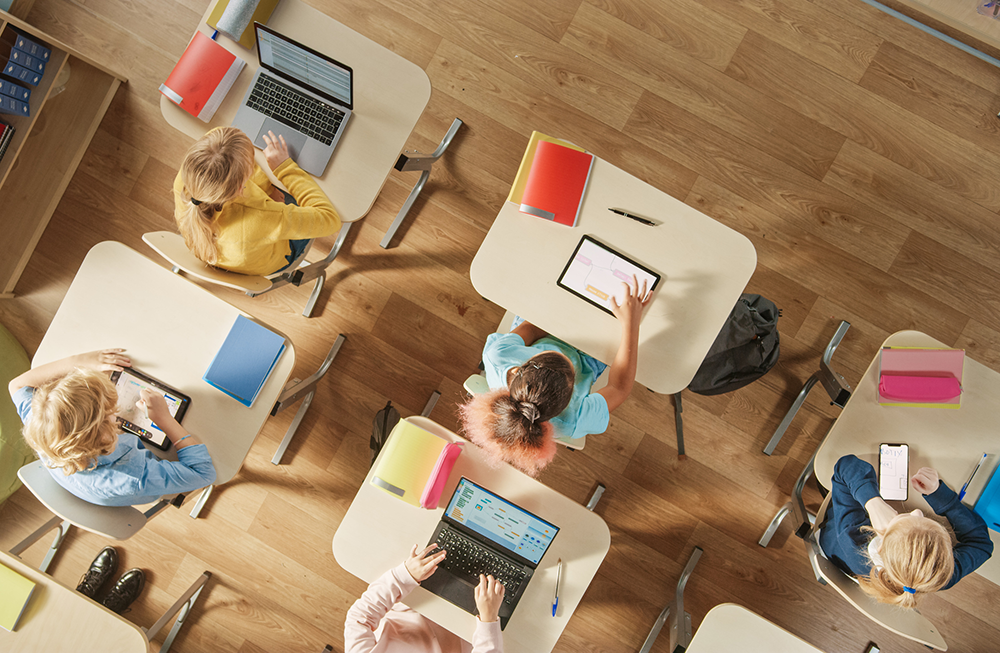



About a decade ago, the people I dreaded meeting most at parties were the ed tech evangelists – men and women who lit up with zealous excitement about bringing screens into schools. If only every schoolchild had a laptop, they thought, then humanity could flourish, nurtured by the great river of the internet and by an exciting stream of educational apps. It was as if a school laptop was a Mary Poppins bag out of which whatever they most wanted was sure to appear. For the ed tech utopians of the right, what they dreamt of was a great stream of savvy little Einsteins, liberated from turgid teachers. For those on the left, it was about equal access, fairness, “pupil-centered learning.” Both enjoyed talking eagerly of ‘enhanced engagement’ as fellow guests muttered into their drinks and backed away.
Real learning requires real thinking – a screen is a constant temptation to stray from mental slog
The chief ed tech evangelist at the time was Bill Gates, who in 2013 announced that computers in classrooms would, over the next decade, revolutionize education. “The power of the digital platform is just going to keep getting better and better,” he promised.
Poor Bill. More bad news is not what he needs right now, but that decade has passed and the effects of the revolution are horribly clear. Screens in schools have been catastrophic. Wherever they’ve been introduced, pupils’ scores have not only failed to improve but have declined – significantly and relentlessly. Because of screen-learning, for the first time in modern history a younger generation is cognitively less able than their parents. How’s that for a result?
And yes it’s the screens – not Covid, anxiety or even simply smartphones. It’s not just that computers in schools coincide with poor performance; there’s a direct and strong correlation between the number of school hours students spend on screens and the dismalness of their scores.
The situation in America makes it plain. Different states adopted different ed tech strategies, so it’s easy to compare. Maine, for instance, was the first state to really go all in on computer learning. In spring 2002 the then governor, Angus King, began a program of distributing laptops to students. By 2016 there were 66,000 in schools, and by 2017 public school test scores were collapsing. In 2022, Maine was the only state to have record lows in all four testing categories, and it’s been only downhill from that sorry point ever since.

How could screens, portals to a world of infinite knowledge, be responsible for a great dumbing down? Perhaps a better question is: how could they not? Real learning requires real thinking, a painful mental slog – and a screen is a distraction machine, a constant temptation to stray from that slog. We all know this. I know it as I sit here, trying not to buy towels on Amazon. The ed tech evangelists know it, even as they do their ed tech accounts, pausing to ogle X, while totting up the staggering sums they’ve made from all the apps and platforms sold into schools.
In every hour a student spends “learning” on a laptop, an average of 39 minutes is spent on “off-task” activities: looking online, messaging friends, trying to access Roblox. My teenage godchildren, agents in the field, report that whatever a teacher thinks, whatever Apple promises, it’s always possible to hack through to something fun. Where there’s a screen there’s a way. In online forums, teachers share strategies: face the students’ screens outwards; do sudden swoop checks for recently closed tabs. Where’s the gain in turning teachers into screen police?
The most outspoken critic of screen-based learning in America is the neuro-scientist Jared Cooney Horvath, author of The Digital Delusion. Horvath gave written testimony to the US Senate earlier this year about the cognitive decline in Gen Z. Expecting children to focus in front of a screen is delusional, he says, because for the vast majority of them computers mean fun. Asking them to focus on an educational screen is like asking a toddler to eat broccoli in a sweet shop. And it’s not just going “off task” that’s the problem, says Horvath, but the mental effort of refocusing after you have.
We’re just not cut out as a species to learn from screens, he maintains – and the apps that seek to make learning fun don’t really work. Schools across the world have adopted “gamification”: apps that test times tables, say, or French vocabulary and reward results with points or badges. But these apps don’t appear to promote long-term learning. A child only remembers the answers for long enough to get the rewards; then the information fades away.
So what about a great leap backwards, educators? Even in a world wracked by wars and surrounded by threats, it seems worth making time to save the next generation. Making future humans ever more stupid is a one-way ticket to extinction.
Some countries have actually been brave enough to change tack. This magazine once quite rightly celebrated the “free school” education reforms in Sweden, and cheered on the then UK education secretary (a Mr. Michael Gove) when he devised and pushed through the free school movement here. And Sweden has, for the past three years, been removing screens from schools.
Time, then, for another Sweden-inspired schools revolution? Fat chance under the Labour government, I’m afraid. A few weeks ago a group of MPs tried to lobby it to do something to curb the increasing use of screens in schools. The Department for Education responded with a commitment to double down: “We recognize the global debate around social media, mobile phones and screen time. When used effectively and – most importantly – safely, technology can be a powerful tool to help support children’s learning, improve access and free up teachers’ time to help deliver the excellent education every child deserves.”
There was also news of a new £23 million investment to expand the UK’s exciting ed tech program.




Comments