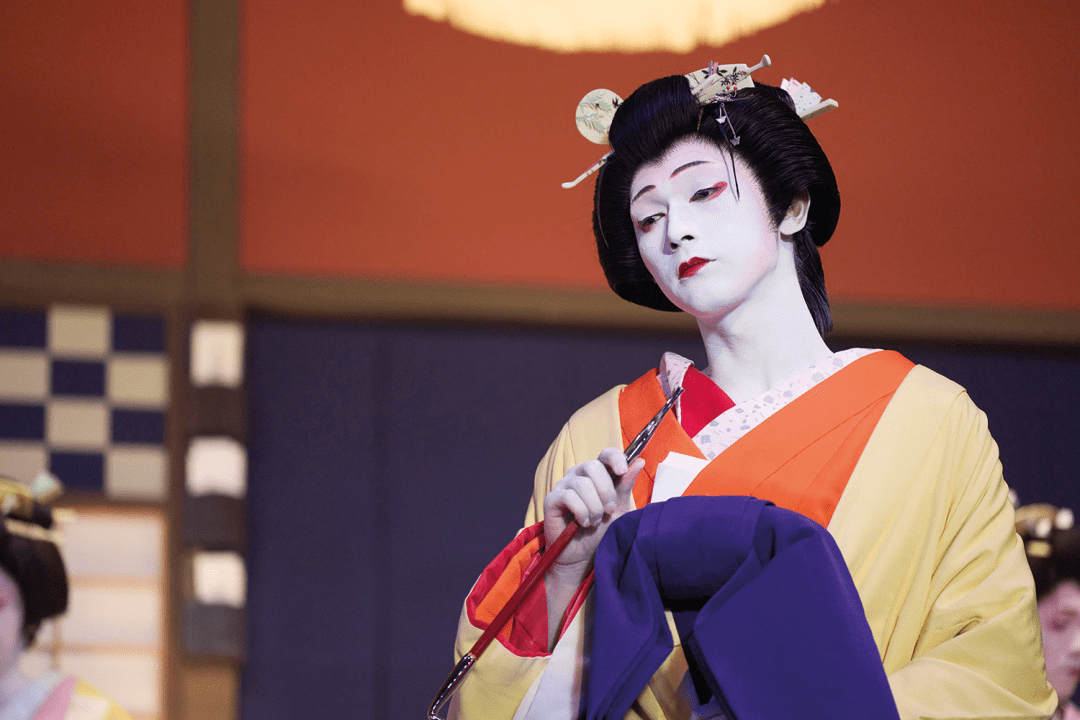

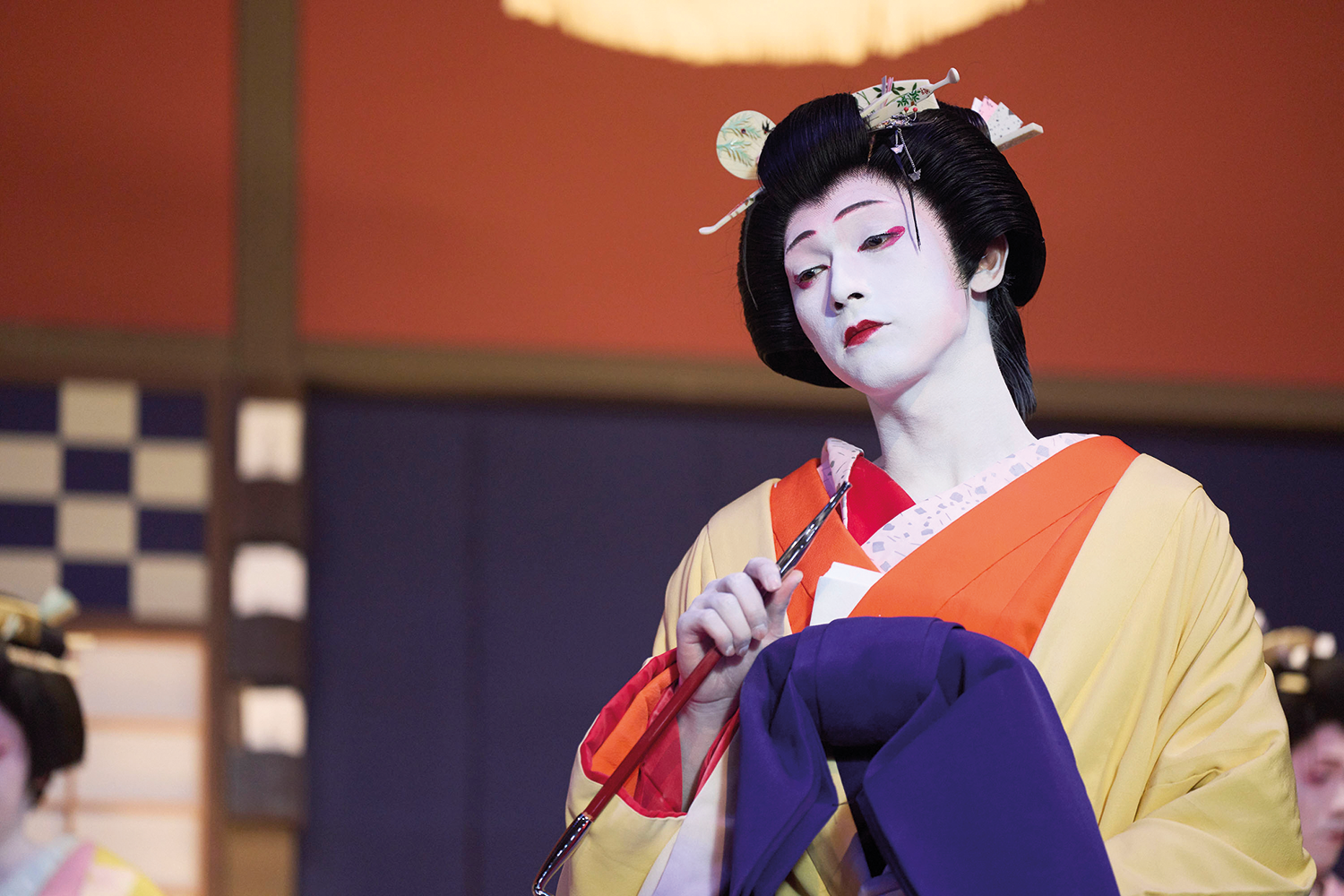
A three-hour Japanese epic about a classical performance art (kabuki) isn’t the easiest sell, I’ll grant you, but I’ll give it my best. Kokuho is multi-award winning. It is the highest grossing live-action film in Japan ever. It is sumptuously filmed. It is masterfully sweeping. The kabuki itself is stunning, so much so that you may one day wish to visit the kabuki theater in Tokyo, although be warned: the shortest production is four hours. Some last all day. Looked at this way, you are getting off lightly here.
Directed by Lee Sang-il, and adapted from Shuichi Yoshida’s two-part novel, the film is a drama spanning 50 years. It opens in 1964, in Nagasaki, with the shocking killing of a crime boss while his 14-year-old son Kikuo (Soya Kurokawa) looks on. A year later, Kikuo, who has already shown promise as an amateur kabuki artist, is dispatched to Osaka to train with Hanjiro (played by the great Ken Watanabe). Hanjiro is head of a kabuki dynasty and widely considered to be the best kabuki actor of all time. Such is his celebrity that he is greeted everywhere as if he were, say, the Mick Jagger of his day. Hanjiro has a son, Shunsuke (Keitatsu Koshiyama), who is the same age as Kikuo, and the two are trained together as onnagata. That is, the men who play the female roles. (The shogunate, as the opening titles tell us, banned women from kabuki in 1629 on the grounds it would lead to “excessive prostitution”; go figure.)
It is a serious business. It is art at the highest level. The training is rigorous and demands several hours of practice a day. In terms of the physicality required, it is probably up there with ballet. Kabuki is a family affair where bloodlines mean everything. Shunsuke is the legacy. Nepo babies aren’t reviled, they’re beloved. But might Kikuo’s star shine brighter? Even though he’s an outsider, a cuckoo in the nest? The two share a deep friendship but also a blistering rivalry. Both desire the title kokuho (“living national treasure”), awarded by the Japanese government to an artist with exceptional skill. Will one make it and the other not?
We follow their fortunes down the years with Ryusei Yokohama and Ryo Yoshizawa taking over Shunsuke and Kikuo as adults. Both actors trained as onnagata for more than a year and are extraordinary, as is the kabuki. We see the elaborate backstage preparations: the makeup, the hair, the amazing costumes. The performances are highly stylized and involve fantastically precise movements, poses that are held, dancing to clapping wood blocks, as a story is told. (Helpfully, the stories being shown are summarized in subtitles.) We see The Heron Maiden where a heron falls in love with a man, transforms herself into a woman and sings for him until she dies. The stories do not tend to be cheerful. It looks both agonizing and beautiful. I don’t know good kabuki from bad kabuki but was always riveted. It is a true spectacle.
It does not stint on the kabuki front, as we must understand what is at stake here and the self-sacrifice that must be made to make it to the top. What are the personal costs and are they worth it? We’re with the main characters as one rises while the other falls.
Or one may even disappear for a decade while taking the other’s girlfriend with him. The film is episodic narratively which does lead to both feeling distant, but maybe that’s the point? That their own minds are always elsewhere? There are nuances that will no doubt escape non-Japanese audiences but it doesn’t matter. It always gives you enough without overexplaining. I felt entirely immersed in a world I had known little about. It may even be that you’ll come away thinking: was three hours enough?






Comments