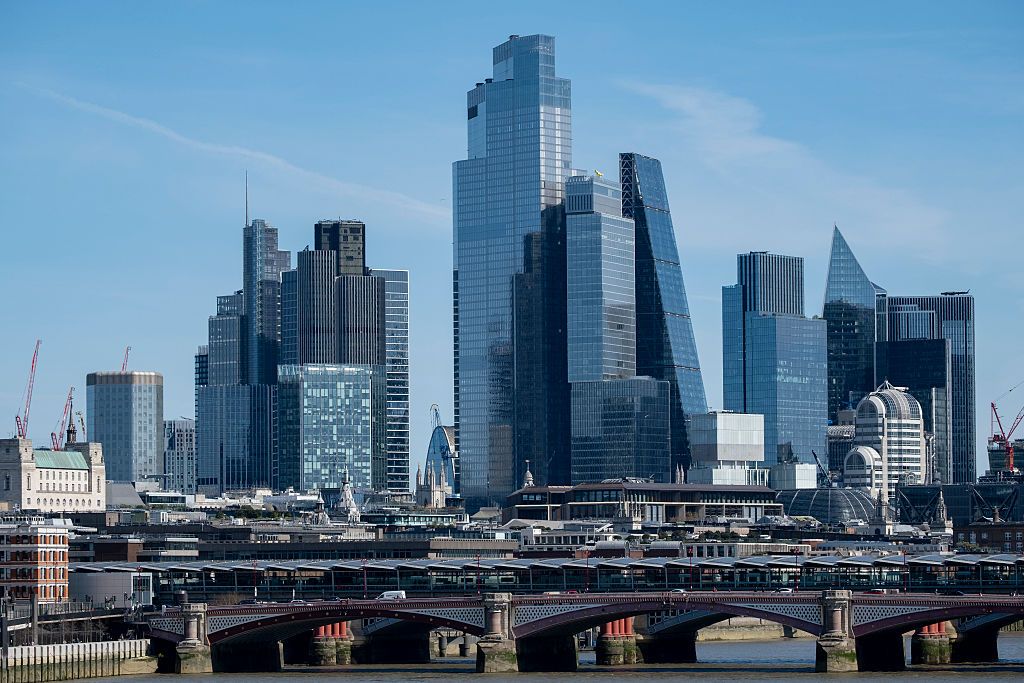
‘You need a better class of work, my boy.’ My GP father’s well-meaning but unhelpful reaction to my second redundancy, both of which occurred in 1989. I was barely 27; he had a job for life.
Four short years but a historical era earlier, I had sallied forth to the London Stock Exchange in September 1985 as a graduate trainee with Laurie, Milbank & Co. Convinced of the old boy network, without malice my erstwhile lecturer John Hutton, now Lord Hutton and former Labour defence secretary, gently ribbed, ‘So Uncle Laurie came up trumps, then.’ There was no Uncle Laurie. The merger with Simon & Coates in October 1986 formed American bank Chase Manhattan’s new London-based securities business.
My first year in the City was straight from The Pickwick Papers. The Exchange was still a physical marketplace, an explicitly exclusive and paternalistic very male club entirely owned by its members. Convivial lunches were the norm. My 35p a day luncheon vouchers helped. Today, the listed London Stock Exchange Group with its new moniker ‘L-Seg’ is less a market than a securities data mining company.
‘Wages exploded, bonuses became multiples of salary instead of modest percentages, Porsche sales boomed (still a newbie, my allocated budget funded a modest but punchy Peugeot 205GTi 1.9)’
Supported by fixed commissions, London operated a ‘single capacity’ system. Brokers were strictly agents transacting business on behalf of clients and barred from proprietary trading; they charged fixed commission rates for services and advice. ‘Jobbers’ were purely wholesalers, profiting from the volume of shares going through their books, making a turn between the bid and the offer price. Neither brokers nor jobbers were allowed to be owned by third parties including banks.
The Government Broker has been replaced by the more mundane Debt Management Office. Traditionally the incumbent was the senior partner of Mullens & Co. responsible for managing the government’s gilts (bonds) business; even in 1985 convention demanded he wore a silk top hat when on the floor of the Exchange, a symbol of his authority making him instantly identifiable to the gilt jobbers on their pitches. An imposing figure, he commanded respect. A mere minion, I was in awe.

There were no investment banks. The City had merchant banks: 17 blue-blooded members of the Accepting Houses Committee. S.G. Warburg, N.M. Rothschild, J. Henry Schroder Wagg, Lazard Brothers and other grand old names financed international trade through accepting and discounting bills of exchange, just as they had for more than 200 years.
On October 27 1986, on one single day, this longstanding but anachronistic structure of strict single capacity and private membership was consigned to history. This was the ‘Big Bang’.
Big Bang was the fundamental structural change derived from the enforced abolition of fixed commission rates for securities transactions in the City. Overseen by the LSE’s chairman, Sir Nicholas Goodison, the reforms instantaneously catapulted London’s capital markets out the late 17th century into the late 20th. Far-sightedly, restructuring, integration and recapitalisation created the foundations necessary for London still to remain at the competitive forefront today as we head towards the mid-21st century.
Professionalism replaced paternalism (but those old boys were canny businessmen); competition for experienced talent was intense, especially the ‘marzipan layer’, qualified practitioners who had not been partnership principals. Wages exploded, bonuses became multiples of salary instead of modest percentages, Porsche sales boomed (still a newbie, my allocated budget funded a modest but punchy Peugeot 205GTi 1.9). The late 1980s in the City was Margaret Thatcher’s capitalist revolution on steroids. Yuppies displaced Sloane Rangers, Harry Enfield created the obnoxious ‘Loadsamoney!’; these were heady days of excess. As Philip Augur accurately entitled his book, in every sense it was The Death of Gentlemanly Capitalism.
Costs ballooned despite revenues declining following the inevitable collapse in commission rates (they evaporated entirely in gilts). Competition for access to the new marketplace was strong; single capacity had given way to dual capacity and integration; what resulted was overcapacity. The 1987 stock market crash didn’t help (an almost imperceptible blip on the chart today, at the time it was a seismic shock registering on the financial Richter Scale). The reckoning soon came.
My employers ceased trading in 1989: in January Chase’s redundancy money afforded me a new sofa with little left over; in November the former Capel-Cure Myers succumbed when its owner, Australia New Zealand Bank, on the opposite side of the world, lost sight of it and also pulled the plug. In between times I got married, happily enduringly so; it was a year of one high, two lows. More casualties followed. Still, some of today’s international investment banking behemoths can trace their direct ancestry to 1986 even if the wonderful old names have disappeared. For example, jobber Ackroyd & Smithers begat UBS; another jobber, Wedd, Durlacher, Mordaunt & Co. – you can almost picture the black frock coats, neck stocks and quill pens – became part of Barclays.
Nostalgia leaves no room for pathos, however: the intimate, clubbable and it must be said misogynistic Dickensian world of the pre-1986 City would simply not have survived the technological revolution which rapidly transformed capital markets. Without those structural reforms, London could not have coped with algorithmic trading and the explosion of sophisticated instruments which developed from the mid-1980s simple traded options to highly complex derivatives; leverage; the interconnecting of different asset classes; highly geared profits but open-ended liabilities; rapid settlement terms and globalised trading. All would have defeated it.
Innovation can be so quick that regulators, compliance and risk management systems are unable to keep up. The board’s inability to understand the risks being taken by trader Nick Leeson, but letting him carry on anyway because he was making serious money for his employer, led to the shock collapse of centuries-old Barings bank in 1995 for example.
The system was tested almost to destruction in the 2007–2010 Global Financial Crisis. My then employer, the investment bank Merrill Lynch, was unwittingly at the epicentre: as its balance sheet imploded, the enforced rescue of the blindly galloping ‘Thundering Herd’ by Bank of America secured its trillion-plus dollars of Mainstreet American savings and investments. The price was Lehman Brothers going under (and me losing another job). But that’s the point: it should not have been unwitting at all. The GFC was an abject failure of regulators and boards to constrain, understand or keep up with floor-level product development and to maintain appropriate risk management and oversight systems. Regulations and governance are much tighter today. Should it happen again? No. Could it happen again? It is not impossible.
Big Bang was a blow-it-all-up-start-from-scratch event. However, even if fundamental, it was merely part of the evolution that has maintained London’s centuries’ long leadership as a financial centre. But it can never be taken for granted.
Competition is intense. Capital is fluid and knows no boundaries. The chief commercial threat to London is New York: listing regulations are less onerous, market valuations are higher, the pool of capital is much deeper; for an increasing number of UK companies it is not only the path of least resistance but the greatest opportunity. A phenomenon is the new technology AI mega-IPOs: listings with multi-trillion-dollar capitalisations by Space X, Anthropic, Open AI and others will not only dominate the US market but through passive investing (global equity index trackers etc) suck capital from centres including London.
The capital raising environment is changing. Passive investing is immensely popular (tracker costs are very low); but it is pure momentum investing based on size; it makes no judgements about quality or value; trackers distort efficient capital allocation, undermining the fundamental purpose of capital markets. Private equity provides alternatives to expensive public listings. Today, far fewer large listed companies in the UK raise new permanent capital through secondary equity issues such as rights issues than access temporary loan capital through the bond markets. Block chain technology and AI will play a big part in the markets’ constantly changing modus operandi. Disruptor crypto currencies present a recurring challenge to the status quo.
London has not only survived but maintained leadership for so long thanks to its willingness to adapt. Darwinian capitalism is a true meritocracy. Tempered by appropriate regulation, it thrives on an entrepreneurial free-market approach. It sits uneasily with our current government’s hostility to the long-term continuity of capital in private businesses (Rachel Reeves’s IHT business relief reforms) and Labour’s belief that centrist intervention is a better way of allocating capital.
The UK’s financial and insurance services sector contributed 8 per cent to GDP last year, 12 per cent including related accountancy and legal services. It generated a trade surplus of £120 billion.
But, perhaps the greater long-term threat is political. The EU is contemplating capital markets union; as Andy Burnham pursues closer ties with Europe and pitch rolls the UK re-joining (accurately, re-applying) in the next parliament, he should beware Brussels grabbing a large slug of London’s action.
I cannot counsel him strongly enough to understand the integrated nature of the City of London’s commercial standing: global leadership spanning equity, bond, commodity and currency trading, interlinked with advisory services and settlements. Lloyd’s of London is the leading global centre for insurance. Sterling is one of the five Strategic Drawing Rights group of Reserve Currencies. Chip away at the fabric and the integrity of the whole declines disproportionately. In the event proceedings ever get that far, Burnham should strongly resist the inevitable pressure or temptation irreversibly to bargain away the jewel in the UK’s economic crown merely to curry transient political favour in Europe. There will only be one loser.
My four-decade career spans a generational change encompassing equity research, management, the ‘sell-side’ as a broker and now the ‘buy-side’ in fund management. The highs significantly outweigh the lows, even if the lows felt very low indeed. Today’s riposte to my father’s ‘better class of work’ is unequivocal: ‘Thanks, Dad; I wouldn’t have changed it for the world.’






Comments