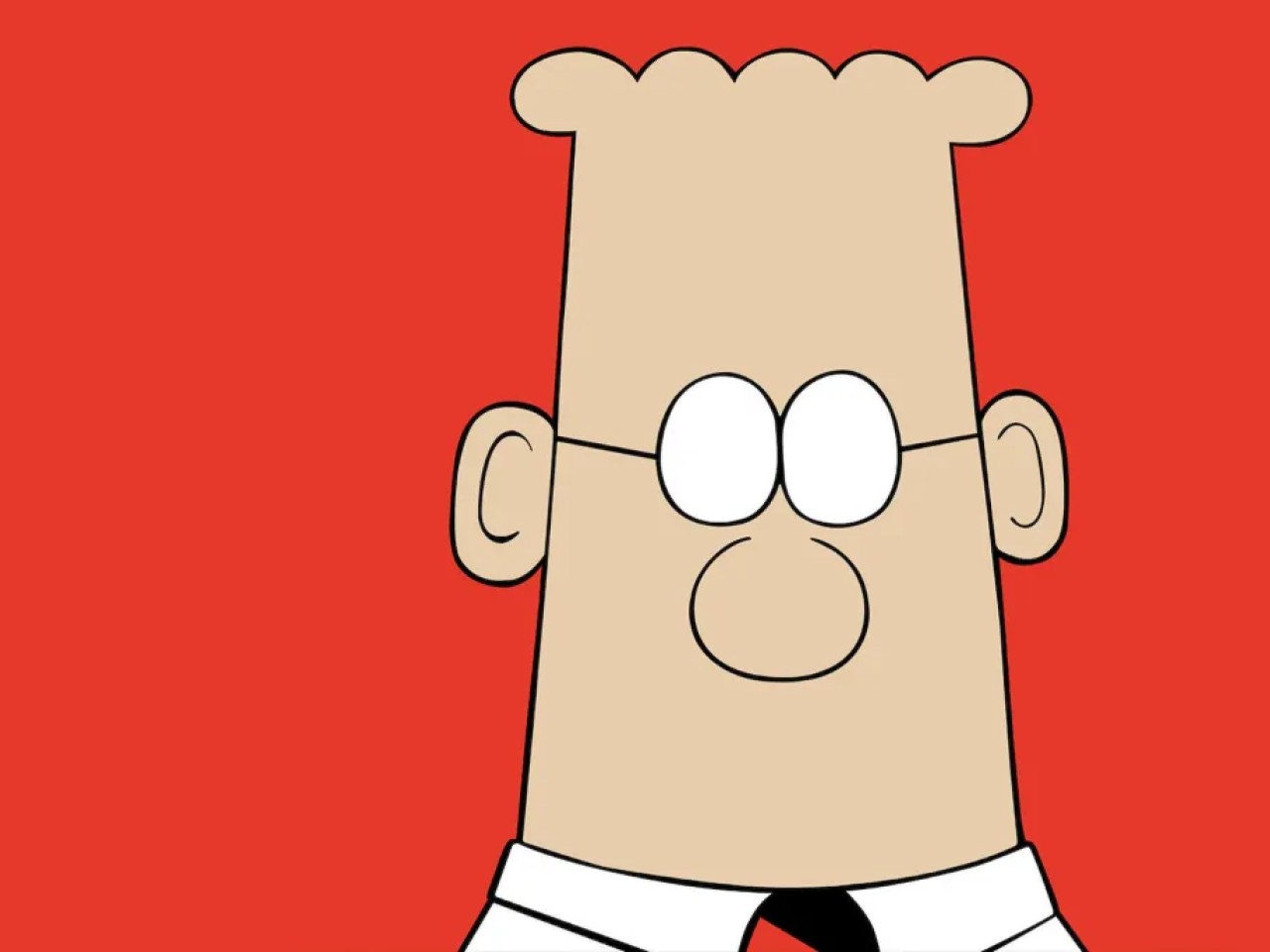



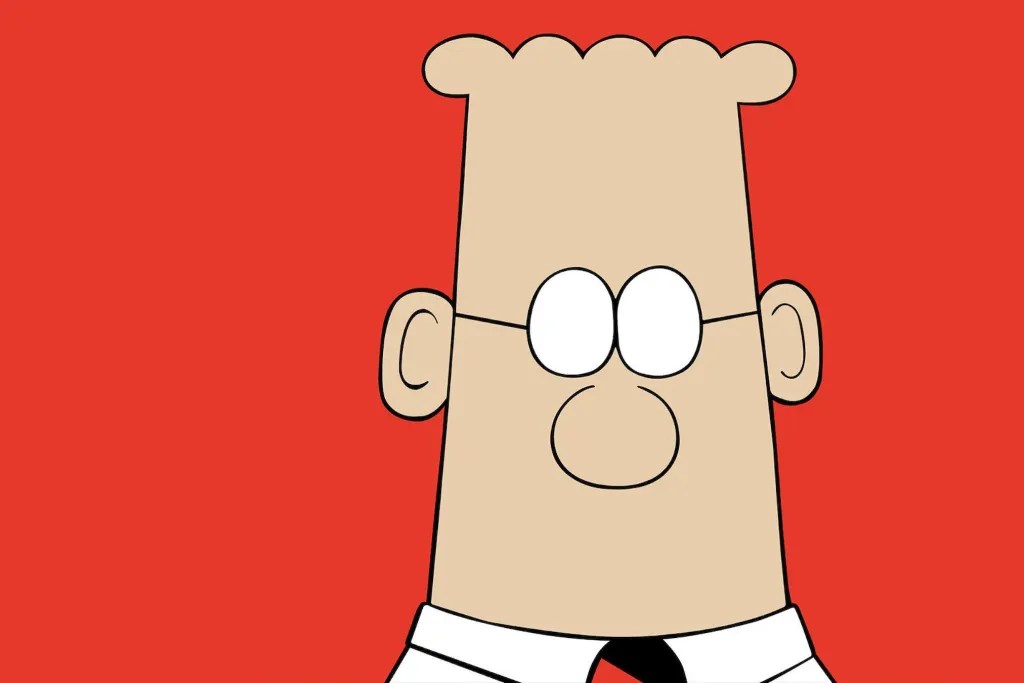
Dilbert taught me how to read. Stacked perilously high – between Calvin & Hobbes and The Far Side – in my childhood home’s bathroom, Scott Adams’s cartoon provided the perfect reading material for the porcelain throne. Even before I knew what most of the words meant, I’d belly laugh at page after page of banal workplace humor. This is bizarre: why, as a preschooler, was I so tickled by these jokes about human-resources departments and fax machines?
Adams, who died in the night, enjoyed more than a three-decade run as honcho of the funny pages, starting in 1989. For much of this century, his was the biggest cartoon in the world: Dilbert, Dogbert, Alice, the Pointy-Haired Boss, Wally and Catbert appeared in some 2,000 newspapers every day, often at the top of the page. There were yearly calendars and best-selling books, television spin-offs and Dilbert-branded vegetarian burritos. His characters were pasted onto office doors and outside cubicles across the countries like mezuzahs.
It was a nice run, until 2023 when Adams went on a livestream to gab about a Rasmussen poll that said nearly half of black respondents wouldn’t confirm the statement “It’s OK to be white.” Half jokingly, half seriously, he said black people are therefore a hate group and white people should get away from them. He disappeared from newspapers practically overnight.
Probably his overlords had been looking for an excuse to drop him for a while. Adams had spent the better part of the last decade criticizing ESG, DEI and the left. He was one of the first commentators to see that Trump was in fact not merely a buffoon, but a savant persuader – a “clown genius,” as he put it in a 2015 blog post that was years ahead of its time. He then endorsed Trump and confidently predicted his victory. Many of his readers were apoplectic. How could their favorite cartoonist be a Trump supporter?

I suspect that those who were shocked at this development are just bad at reading. The fundamental premise of Adams’s cartoon is that America’s professional class is composed of blockheads, and the suits at the top – the Pointy-Haired Bosses of the world – are the most blockheaded of all. Or, as the Don once said: “We are led by very, very stupid people.” Adams probably heard this and recognized Trump as the prophet he’d been waiting for.
After he was dropped in 2023, Adams moved his work online and renamed it Dilbert Reborn. With all respect to the dead and everything, a hard truth: the funny pages weren’t losing a whole lot of funny when Dilbert got the pink slip. Unlike, say, Bill Watterson or Gary Larson, who retired while their comedy remained fresh, Adams held onto Dilbert well after the punchlines had any punch.
The art style became increasingly simplistic and dull; the humor became inert, predictable, stale – in a word, Boomer. It appealed to the lowest-common denominator of taste – which was, again, Boomer. Still, a spree of two or three decades of comic dominance is no small thing. And you can’t blame someone for holding onto the cash cow’s udders with a death grip (again: Boomer).
But his plain little cartoon contained insights that the country still hasn’t fully recognized – for example, that much of Silicon Valley, where the strip presumably takes place, is populated not primarily by tech whizzes and visionaries but small-minded, socially inept dweebs. That was an especially against-the-grain take in the 1990s and 2000s, when Silicon Valley’s masters were fashioning themselves as the virtuous architects of the future.
Peter Thiel’s got a hunch that America has slid into a period of moral and technological stagnation. Dilbert works as an illustration of this. No wonder we’ve hit a wall, the argument goes – dips like Wally won’t get us back to the moon, and good luck getting any work done with evil HR directors like Catbert prowling the office. Dilbert is history’s Last Man, fiddling away at nothing in his cubicle, allergic to greatness and happily resigned to mediocrity.
But I wasn’t thinking about any of that when I was guffawing at the strip as a 6-year-old, and I doubt anyone else was. Because what really made Adams’s work great was the simple idea that most adults are little more than tall, portly children – and that notion will make anyone of any age laugh. The intellectual development of most working professionals stalled out around the age of 16; the artifice of workplace customs conceals this fact but doesn’t negate it. Adams pulled the curtain back on this façade again and again, giving his audience glimpses of the goofy truth underneath American professional life.
Adams’s cynical, comical worldview is perhaps best depicted in one his most famous Sunday strips, which lists the “seven habits of highly defective people.” In the final frame, Adams shows the Pointy-Haired Boss, with his absurd hairdo on full display, reading a newspaper and exclaiming, “Hee hee! Look at the hair on that guy!” Above him, the cartoonist deals the final habit of highly defective people: “Think the comics are not about you.”
Remembering Scott Adams


Comments