
Jan Timman, the Dutch grandmaster who at his peak reached second place in the world rankings, died in February at the age of 74. For much of the 1980s, when Soviet players (especially Karpov and Kasparov) dominated the game, Timman was regarded as the ‘Best of the West’.
As a young man, Timman was drawn to the bohemian lifestyle that the life of a professional chess player readily affords — itinerant, living off one’s wits and unburdened by the tyranny of early mornings. In his best games collection, Timman’s Triumphs (New In Chess, 2020) he recounts attempting a more ascetic approach in the lead-up to the 1971 IBM tournament in Amsterdam, striving to begin the event in optimal form. The immediate effect was disastrous – five straight losses – so Timman changed tack: ‘My nights were full of alcohol abuse again, and this had a positive effect on my play.’
Later, when Timman succeeded his compatriot and fellow grandmaster Jan Hein Donner as the Netherlands’ top board, Donner praised Timman’s profundity but reflected, with manufactured solemnity, ‘I urge Jan Hendrik Timman to observe strict discipline, without which no chess player can prosper.’
And prosper he did. Following a sustained career at the elite level, the closest Timman came to the world title was in 1993, when he lost the Candidates final match against Nigel Short, whose subsequent title match against Kasparov saw a schism with Fide, the international governing body. Fide sanctioned its own match between Timman and Karpov in 1993, which was won by Karpov.
Timman was a prolific writer, whose curiosity extended to literary matters outside of chess. He authored more than a dozen books and was honorary editor of New in Chess magazine. I have never found his playing style easy to characterise, but above all one senses a zeal for the game in all its aspects. His opening repertoire was wide, and he loved to analyse deeply, in the old style, without the assistance of computers. His best games feel tactically vibrant, but there is also an affinity for the nuances of endgames, and of endgame studies. Some of his books were dedicated to that field, and right up until days before he died he posted regularly on X, sharing problems which caught his eye.
Timman was himself an accomplished composer, and the study below – White to play and win – makes a strong impression.
White to play and win. Composed by Jan Timman, 1999, and amended 2011
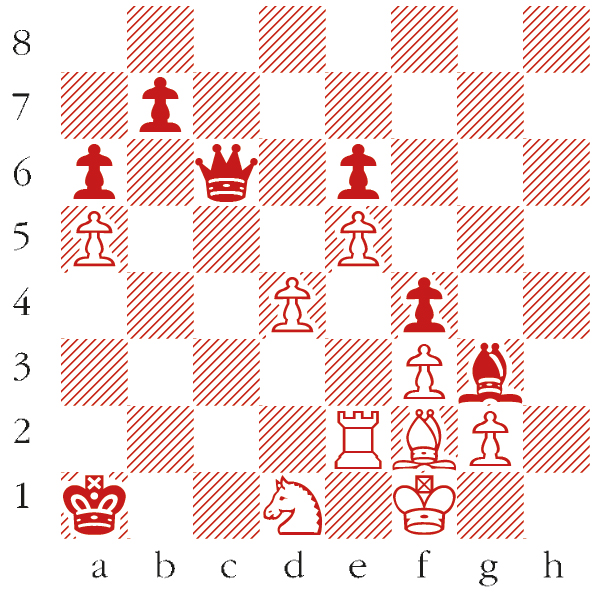
1 d5 Qxd5 If Black captures with the pawn, the e-pawn’s advance is too strong. 2 Ra2+!! Qxa2 King moves allow an immediate knight fork 3 Bd4+ Kb1 4 Nc3+ Kb2 5 Nxa2+ Kxa2 Now the real action begins. 6 Bf2 Bh2 With the king so far away on a2, Black must decline the exchange of bishops. For example, 6…Bxf2 7 Kxf2 Kb3 8 g4 wins 7 Bg1 Bg3 There appears to be an impasse: 8 Ke2 Kb3 9 Kd3 Kb4 10 Bb6 is drawn. 8 Bh2!! An astonishing solution Bxh2 9 g4 Timman wrote ‘Recently I read about someone who wanted to abolish the en passant rule. The game of chess would lose a lot of its beauty in that case.’ fxg3 After 9…Bg3 10 g5 the pawn is unstoppable. 10 Kg2! Now the Bh2 is locked in, so the pawn march can begun. Kb3 11 f4 Kc4 12 f5 Kd5 13 f6 White wins






Comments