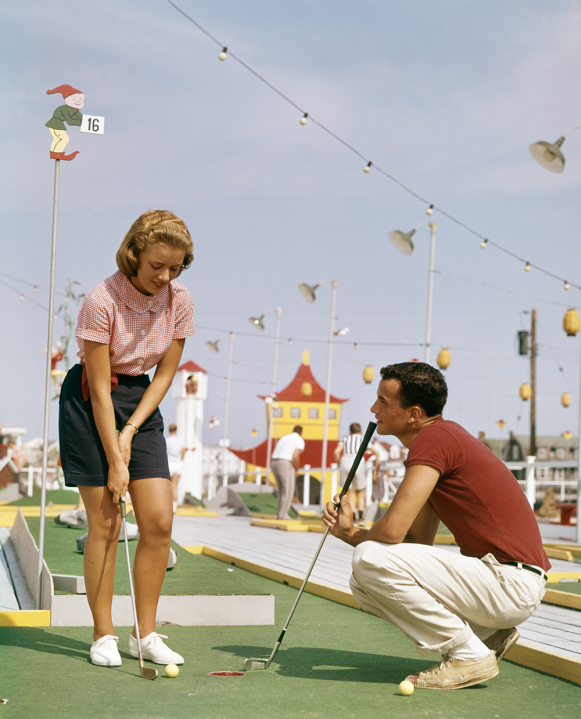

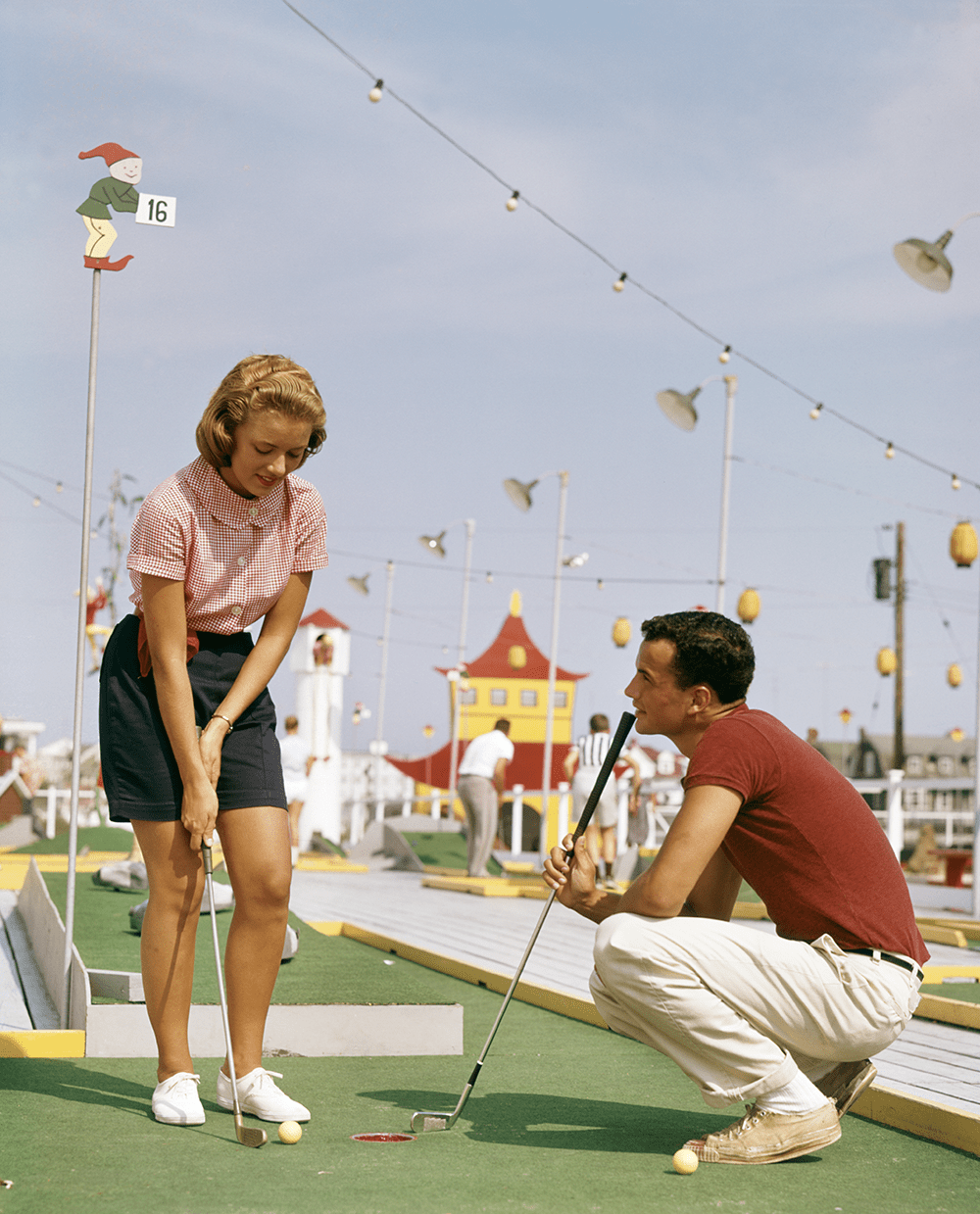
It is a great family disappointment that I could never get into golf. My late grandfather would become so engrossed watching the Masters that he used to light one cigarette off the other. But it was always unfathomable to me. Attempts to play at school were less a good walk spoiled and more a Friday afternoon wasted. Yet my antipathy has a glorious exception: there are few things in life I enjoy more than a round of crazy golf.
For years I have toured the nation’s courses, putting past plastic dinosaurs and animatronic windmills, Slush Puppy and scorecard in hand. ‘Proper’ golf is difficult. Crazy golf reduces it to the essentials: hole, putter and Newtonian physics, the odd stegosaurus notwithstanding. Whereas traditional golf seems stuffy, crazy golf is relaxed and accessible – as silly a sport as one can play without becoming one of those real-life Quidditch nutters.

Miniature golf (the ‘crazy’ refers to the version incorporating unusual obstacles on the course) was a great British invention. The Victorian Scots loved golf, but ladies were not allowed to play properly since swinging a club above their shoulders was too unseemly for the fairer sex. Putting, however, was fine, so a course was laid out at St Andrews in 1867. It’s called the Himalayas and can still be played today.
The windmills were still a long way off. The first miniature golf course we might recognise was built in 1916 by James Barber, a steamship magnate. Flower beds lined the edges; a fountain featured in one of the holes. Surveying his new arena, Barber declared: ‘This’ll do.’ This became ‘Thistle Dhu’, the course’s name. He set a trend. Obstacle golf tournaments were soon being staged across America. By 1930, New York alone had 150 rooftop courses. But when the Great Depression hit, mini golf seemed far too frivolous, and the sport’s popularity plummeted.
Fortunately, enterprising Swedes and Germans had by then brought it over to Europe. The game would only revive in popularity in America once Joseph and Robert Taylor, two New York brothers, had the canny idea to incorporate landscaping and windmills. Dinosaurs wouldn’t be added until the 1990s after the success of Jurassic Park.
In Britain, crazy golf is more popular than ever. Hastings hosts a tournament each June, while companies such as Swingers, Junkyard Golf and Puttshack have transformed it into a funky social activity, combining courses with cocktail bars and street food. Crazy golf is the perfect date: an opportunity to impress a lady with your sporting prowess with minimal physical effort. To put this theory to the test, I resolved to take a female companion to the Puttshack in the City. I couldn’t find a date at midday on a Thursday, so I instead took a married mother of one I found hanging around Bank station. What we found, after a glass of wine, was dystopian.
Puttshack has ruined the world’s simplest sport: digital courses with automatic ball-tracking, a point system based on completing silly extra tasks and a terrible All-Bar-One aesthetic. Somehow, the company has reintroduced the pointless complexity of traditional golf in the tackiest way possible. A windmill doesn’t need a computer screen. We played our nine holes and got out. James Barber, where are you now?




Comments