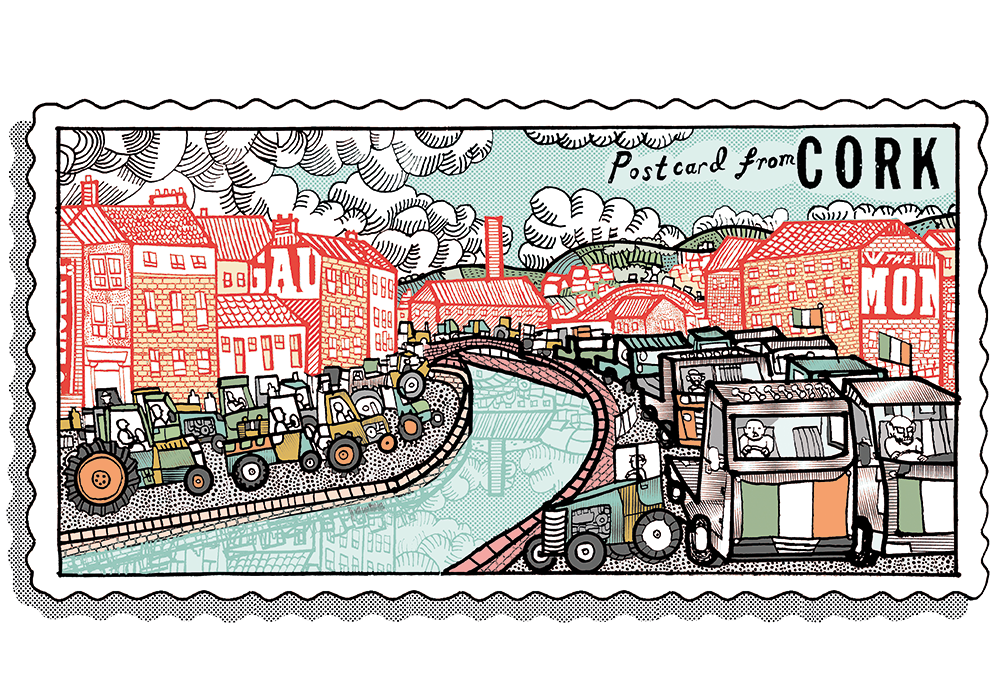

A fuel protester stood on top of a tractor waving a tricolor. In Ireland, everything is about nationhood and the price of oil is being contested here like a new war of independence.
I got into the middle of a scrum of farmers and haulers blockading Whitegate oil refinery, a kamikaze sort of protest, for it has been stopping tankers getting in and out to supply the country, severely limiting supplies.
Here on the windswept coast of Cork, traditionally dubbed the rebel county, working men have been sending out the message that they have nothing left to lose. The oil crisis sent this lot over the edge arguably because they were already on the verge of a collective nervous breakdown over fuel costs, higher than in Britain partly due to EU carbon taxes.
A fair-haired young construction worker was giving speeches with all the passion of Michael Collins
As I crammed with them against the barriers of the police lines, one of the men told me he was losing nothing by being in this blockade all week because the cost of living was so high, and the money he earned from driving his lorry was so little, there was no point going to work anyway.
A fair-haired young construction worker was giving speeches at the center of the scrum with all the passion of Michael Collins. He pushed his way towards me, telling me to take this down: “We’re here today, right, because our country is going to rack and ruin. The cost of living here has got out of control, we’re paying the highest rates of electricity in Europe, some of the highest gas rates, 60 per cent tax on fuel. People are at breaking point. We can barely fill our cars to get to work. The farmers are the ones who feed us and they’re on the verge of going bust. The price of food is going up. We’re already struggling as it is… And they’ve done a golden handshake again and given €40 million ($47 million) to Ukraine the other week. That’s our money. They’re spending €3.2 million ($3.8 million) a day on IPAS centers in our country but they’ve no money for their own people.”
Ah, now we’re getting to it. The notorious expansion of International Protection Accommodation Services, refugee housing, known as IPAS centers, which are springing up all over Ireland. Many of the 113,000 new entrants are housed in them in a country of 5 million people. The convoys of trucks, tractors, coaches and vans bringing Ireland to a standstill have really been about the Irish working classes demanding that their government put them first.
Haulers, farmers and every kind of manual worker demanded the government lift green taxes and cap fuel costs, but the anger was out of all proportion even to the price of oil. In Dublin, long lines of vehicles blocked O’Connell Street and the bridges, bringing motorways to a standstill, with tourists seen walking to the airport along the hard shoulder. Large crowds gathered in 25 regional towns including Sligo, Tipperary and Wexford. And in Cork, not far from where I live, arguably the most daring protest blockaded the road to Whitegate, the country’s only oil refinery, stopping tankers getting in and out and threatening to make every filling station in Ireland run dry.
By the time I got there, the Taoiseach, Micheál Martin, had deployed the army and the Gardai (police) were preparing to water-cannon the protesters. Most of the Gardai on the police lines were wearing snoods pulled up so high they acted as balaclavas. Those whose faces were showing looked embarrassed. As their chief shouted orders to advance, some continued to chat amicably with the lads demonstrating, as if to show they didn’t want to be doing this to them.
The chief shouted “Back! Back! Back!” into his megaphone at the protesters and the lines of Gardai started to push. A barrier had been erected in front of us and another behind, and the two were being pushed closer together, cramming everyone tighter in between. We were in a cattle crush, effectively, as the police chief shouted into his megaphone: “You are committing an offense under the Offenses Against the State Act 1939.” It was slightly Orwellian. That Act was intended to target subversive groups, terrorism and political violence.
“Bring it on!” someone shouted. A man next to me yelled: “The Black and Tans are back! The Black and Tans are back!” The reference to the hated British paramilitary force that fought the IRA in the 1920s was not lost on the crowd. They roared and tried to push the police the other way. But to no avail. People started to scream as the police opened up with pepper spray. A man balanced on the wheel of a tractor began to sing “Back Home In Derry,” a protest song written by the hunger striker Bobby Sands.
Extraordinary to think that the last time I saw scenes like this was on the streets of Northern Ireland in the 1990s when I was reporting on the Troubles. No RUC or British Army now, just the Irish police and army crushing Irish dissent.
The young construction worker who was auditioning for the role of Michael Collins stood in the middle of the fracas. “I hope you’re proud of yourselves!” he yelled as the Gardai went on pushing. An old farmer called Denis said: “I never thought I would see this in my lifetime.”
A male Garda grabbed me by my clothes and pulled me through a gap in the barrier saying “Thanks miss” and “Sorry miss.” A female Garda joined in, pushing me up a steep bank. “Thank you, thank you, this way!” she said cheerily, while shoving me. It was certainly the strangest example of police brutality I’ve ever seen. The authorities were apologizing and groveling as they manhandled demonstrators and covered them in pepper spray.
After we had all been pushed out of the road, demonstrators stood washing their eyes with bottles of mineral water. A child had been hurt, someone said, and needed taking to hospital. It all triggered an even greater sense of victimhood in this crowd and made the singing of songs about the struggle for independence seem apt, when really, the Irish ought not to be struggling for independence against their own state and invoking the name of Bobby Sands to deal with fuel prices.
Of course, the real struggle is against the EU. A few of the demonstrators did spit out the view that the imperialist oppressor was Ursula von der Leyen, President of the European Commission. “It’s the death of our country,” a hauler called Dan told me. “It’s the death of democracy, of being Irish in this country. You can see there’s a young fellow there, a Guard, he’s almost ready to cry… It’s not right. This is not about fuel. It’s about being treated like mongrels. We have money for Ukraine but none for our own children. This country is broken. The only thing that changed this country was when there was revolution and we’re going near that stage again.” Are they though? I thought. And what would that revolution constitute? “Our leaders are reading from the EU script and anyone who doesn’t agree is the far right,” said a woman called Karen.
‘It’s about being treated like mongrels. We have money for Ukraine but none for our own children’
These fuel protests are about who runs Ireland, and who Ireland is for. But the protesters are being put down the same way left-leaning authorities do it everywhere, by the government likening them to fascists.
Barely half an hour after the demonstrators were dispersed, the army towed tractors, JCBs, carpentry vans and even a horsebox out of the road – and a dozen fuel tankers drove through as a hailstorm battered the seafront. What a waste of energy, I couldn’t help thinking. And I felt that as someone who admires the fighting Irish so much that I moved to live here three years ago. I would like to think that if anyone can stand up and be counted it’s them, but even their volatility is not going to end green taxes, never mind fix immigration.
A man rinsing his eyes by the road proclaimed: “Our country has been captured by a treasonous government and this is only the beginning!” Another chap in orange road-worker’s kit shouted: “They’re a shower of knackers!” Fine sentiments. I suggested the country’s departure from the European Union to a hauler as the only real solution, but he sounded uncertain as he said: “Maybe.”
The problem is, the Irish have loved the EU and its subsidies for so long that now it has turned on them they are reeling. They cannot quite believe Brussels is extracting something in return for its decades of largesse – more than 100,000 refugees housed. It’s all a shock after so many years of win-win EU membership.
The tractors blocking the oil refinery to protest at fuel taxes may well have been paid for by the EU. But the subsidies and handouts are being cut, and it feels like they’re finally being handed the bill. As a Brit, I often feel a bit like telling the Irish: “Do you see what we were on about now?” I had to stop myself telling farmers at the protest: “You brought this on yourself when you took that free tractor!”
I feel sympathy for them, but as the tankers got through I sighed with relief that while the lads are trying to work out how to fight the EU, I’d be able to fill my car up.



Comments