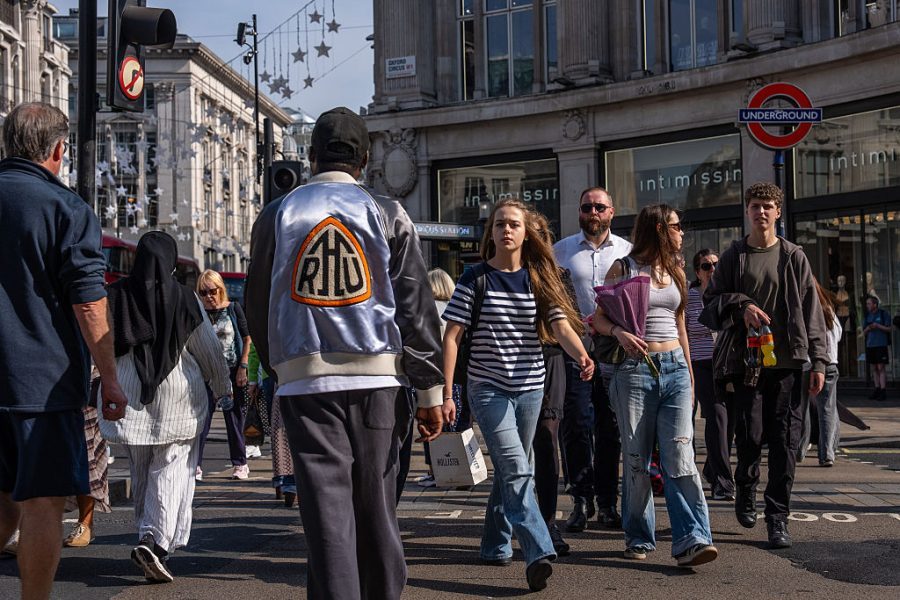
‘Oxford Street ought to be the finest thoroughfare in the world.’ To try and live up to that potential, it’s going traffic-free tomorrow. This does not foreshadow the end of Western civilisation, nor another front in the Mayor of London’s war on cars. It is just good business.
The line that opened this article is not mine. It was written in 1879 by Charles Dickens Jr. We have had 150 years to think about it and now have the evidence base, growth agenda, and political leadership to make it happen.
Like Dickens Jr., I am a lifelong Londoner. As such, I avoid Oxford Street like the plague. Today, the experience consists largely of dodging traffic, ducking scaffolding and avoiding shops selling cheap t-shirts and expensive sweets. Despite this grim shopping experience, the wider Oxford Street area attracts over half a million visitors a day and generates over £25 billion in gross value added (GVA) – roughly 1 per cent of the UK’s economy. That’s more than the entire UK pharmaceutical manufacturing industry and around two-and-a-half times that of our world-famous Premier League.
Removing traffic does not magically create prosperity, but doing so strategically does
Yet Oxford Street is badly underperforming. Footfall remains 43 per cent lower than it was 20 years ago. This highlights the tension at the heart of all shopping streets: speed. Traffic engineers are trained to move people from A to B as quickly and efficiently as possible. Shops and restaurants want almost the opposite: people out of vehicles, on foot, moving slowly, looking in windows, stopping for coffee and spending money. One system values throughput, the other dwell time. But while there are lots of streets in London that can take traffic from east to west, there is only one in Europe that generates £25 billion in GVA.

Like the Premier League, Oxford Street’s value to UK Plc goes beyond GVA. It is part of Britain’s shop window to the world, drawing millions of overseas visitors and hosting global brands. Oxford Street is not competing with Camberwell Church Street or Hampstead High Street, but rather Fifth Avenue in New York, the Champs Élysées in Paris, Dubai Mall, Nanjing Road in Shanghai and Ginza in Tokyo. Globally, two dozen shopping streets compete for the same high-value visitors, global brands, inward investment and spending. The best brands want the best addresses because everyone else wants to be there too.
This ‘winner-takes-most market’ is exaggerated by the breaking down of the old distinction between online and offline retail. The best retailers now use one to reinforce the other: digital builds audience and demand; the flagship store turns that demand into ‘experiences’ and content; those visits then drive more online sales. Opening a physical shop lifts online sales in the same area by 6.9 per cent, whilst closing one sees a 11.5 per cent slide. The modern flagship is part shop, part showroom, part billboard and part digital platform.
The risk for Oxford Street is in losing the flagship investments that increasingly anchor a brand’s online and offline presence in a city. Successful cities make their shopping districts places people want to spend time in, that attract more visitors and increase dwell time. They increase spend and that translates to higher rents, attracts more inward investment and ultimately economic growth.
There is nothing radical about making great shopping streets places for people. Milan opened the Galleria Vittorio Emanuele II in 1867 as a covered pedestrian promenade and it still ranks as some of the most valuable land in the world, with annual rents up to €20,000 per square metre (£1,500 per square foot). A century later, Copenhagen and Munich both closed their main shopping districts to traffic and enjoyed significant growth in the number of people spending time and money in the city centre.
Visitors to Times Square in New York City increased by 11 per cent when it was pedestrianised in 2009. Within three years, street-level retail rents had doubled, despite a national recession, and 42 per cent of New Yorkers admitted to shopping there more often. On Oxford Street, the market is already voting with its feet: in the 18 months since formal plans were announced, vacancies have fallen from 4.3 per cent to just 0.4 per cent.
Removing traffic does not magically create prosperity, but doing so strategically does. For the most valuable land in the world, every square metre has an opportunity cost. Cars are greedy for space. A moving car consumes much more than its physical footprint. At 18.6 mph, a single car requires around 105 square metres of road space, 35 times more than a pedestrian.
When it comes to Oxford Street, the details matter enormously. There are real challenges around disabled access, displaced traffic, re-routing buses, and ensuring seamless deliveries for shops. But those are questions of execution, not arguments for doing nothing. Westminster City Council is right to scrutinise these plans; their job is to ensure that their residents and businesses are not adversely impacted by a national asset on their doorstep.
The Prime Minister and Chancellor will need to engage properly with the scale of this opportunity and avoid the political urge to do some more London-bashing. Westminster City Council, a single borough within Greater London, generates £1.95 billion in business rates – more than the whole of Greater Manchester (£1.16 billion) and twice that of the country of Wales (£0.98 billion). Yet Westminster retains only 1.9 per cent of the business rates it collects. Under the current settlement with the national government, improved economic outcomes from Oxford Street disproportionately benefit other parts of the country.
So, forget, for a moment, how you get there. Let’s think of Oxford Street as an asset-generating 1 per cent of UK GVA but not living up to its full potential. You are offered the chance to invest 0.6 per cent of one year’s economic output to improve it. What would you do? We talk endlessly about economic growth while overlooking productive assets already under our nose. A happy byproduct might just be that it makes our city a better place to live.






Comments