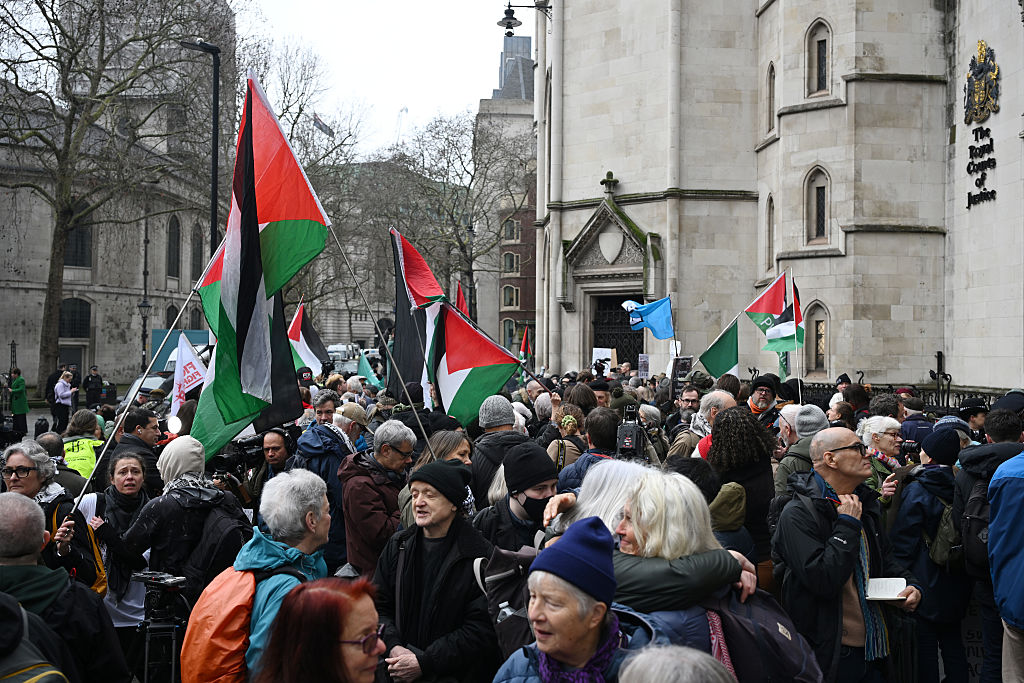
This morning, the High Court ruled that the proscription of Palestine Action was unlawful as the group’s activities had not yet ‘reached the level, scale and persistence’ necessary to justify it being banned.
A panel of three judges, including Dame Victoria Sharp, president of the King’s Bench Division, found that the ban, which made membership of and expressions of support for the group illegal, had been legally flawed as the Home Secretary had failed to follow her own policy on proscription. It also ruled that it constituted a ‘very significant interference with the right to freedom of speech and the right to freedom of assembly’ under the ECHR and was ‘disproportionate’.
The court reached this conclusion even though its judgment acknowledged that ‘Palestine Action is an organisation that promotes its political cause through criminality and encouragement of criminality’. The court also recognised that a very small number of the group’s activities amounted to acts of terrorism within the statutory definition.
The ruling is extremely unfortunate. The Terrorism Act 2000, which sets out the framework for proscribing terrorist organisations, makes clear that terrorism includes ‘serious damage to property’ where it is designed to influence the government and where the threat or action is undertaken for the purpose of advancing a political, religious, racial or ideological cause.
The legislation was heavily influenced by an inquiry conducted by the Law Lord, Lord Lloyd of Berwick, which recommended a permanent counter-terrorism statute following the peace process in Northern Ireland. It is evident that the Act was designed to capture the sort of activities encouraged by Palestine Action, which are alleged to have caused millions of pounds of damage.
When the then-Home Secretary, Yvette Cooper, announced the proscription of Palestine Action following the disgraceful attack on RAF Brize Norton, she made plain that the group had:
‘Orchestrated a nationwide campaign of direct criminal action against businesses and institutions, including key national infrastructure and defence firms that provide services and supplies to support Ukraine, the North Atlantic Treaty Organisation (Nato), Five Eyes allies and the UK defence enterprise.’
This was not a case of silly protesters throwing paint around. Rather, the group is alleged to have conducted attacks on targets involving national security, including a factory which made submarine parts and two Voyager aircraft used by the RAF for air-to-air refuelling. This is not peaceful protest, or legitimate freedom of expression. It is difficult to see why individuals should be permitted to support or encourage this group. The ban on Palestine Action did not prevent advocates for Palestinian rights from protesting or exercising their right to free speech by supporting any number of other pro-Palestinian groups.
The purpose of specialised terrorism legislation is, at least in part, to enable the state to prevent dangerous terrorist-related activity before it occurs. According to the government, Palestine Action had released an ‘Underground Manual’ encouraging ‘the creation of cells’; providing ‘practical guidance on how to carry out activity against private companies and government buildings on behalf of Palestine Action’; and providing ‘a link to a website which contains a map of specific targets across the UK’. The government plainly has a legitimate interest in disrupting such activities and should not be required to wait until groups take repeated direct action against UK military equipment before responding.
Rather than making it clear that groups which incite action against UK defence targets can and should be banned, this judgment encourages legal uncertainty and is likely to embolden further such activity. This is fantastically naïve.
It does not require much imagination to envisage hostile state actors such as Iran or Russia seeking to infiltrate groups like Palestine Action and encourage damage to critical defence infrastructure. As matters stand, it is difficult to see how activists could possibly assess whether damaging aircraft or destroying submarine components would have no impact on UK military operations. That fact alone should have led the judges to conclude that its activities were dangerous and justified proscription.
It is inevitable that this decision will further discredit Labour’s Human Rights Act and increase hostility to the UK’s continued membership of the ECHR. The Conservatives and Reform are already calling for the UK to leave the ECHR. Judgments such as this will place further pressure on the Home Secretary to explain how the government can keep citizens safe if the courts prioritise activists who believe their ideology trumps UK security interests. When making its assessment of the proportionality of the ban, arguably the court should have shown more deference to the decision of the government and Parliament.
The proscription of Palestine Action will remain in effect until a further hearing later in February. A conclusion may yet be months away.
The Home Secretary has already said that she must ‘retain the ability to take action to protect our national security and keep the public safe’ and that she intends to fight this judgment in the Court of Appeal. That is a right and proper response. But there is no guarantee that the higher courts will take a different view. In the meantime, one can only hope that the judgment does not invigorate the group or inspire it to further outrages.






Comments