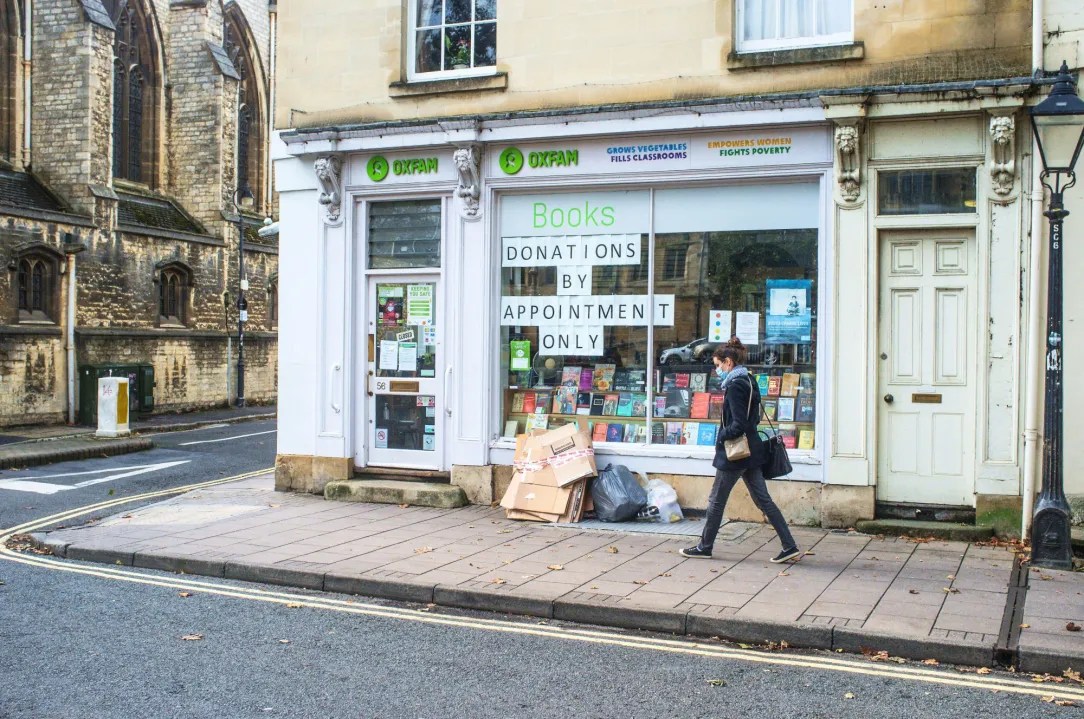
The news that the original Oxfam bookshop on St Giles in Oxford is not to close is not just a relief, but a rare victory in the ongoing battles between town and gown in the city. The building’s owners, Regent’s Park College, had attempted to take back the relatively modest space that the bookshop occupies and turn it into a common room for graduate students to ‘socialise and study’ in, which sounds like an arch euphemism. The college (my alma mater, in the interests of transparency) is keen to attract lucrative academics, and was apparently happy to ride roughshod over the literary desires of locals to do so.
The university, and its constituent colleges, have been gradually turning what should be a thriving, beautiful place to live into somewhere that is exclusive, overpriced and increasingly unrewarding
Thankfully, their intentions have been thwarted. The city council have refused the college permission for the change of use, citing a mysterious but welcome ‘Local Plan’ that states that institutions that exist for the good of the local community, such as a charity bookshop, take precedence over the demands of an academic institution to lure more graduates in. While it is possible, even likely, that Regent’s Park may appeal against the decision, a precedent has now been set. Hopefully Oxford’s bibliophiles, of which I proudly count myself amongst, will be free to browse the shelves at the Oxfam bookshop without fear of imminent closure.
Still, while I celebrated this news with the purchase of a couple of Slightly Foxed editions from the shop, I fear that this is not the watershed moment for Oxford that it should be. Instead, the university, and its constituent colleges, have been gradually turning what should be a thriving, beautiful place to live into somewhere that is exclusive, overpriced and increasingly unrewarding. This was a process that accelerated during Covid and the subsequent explosion in the cost of living, and now small and independent businesses have not so much been forced out of existence as never having stood a chance in the first place.

There are several egregious examples of institutional overreach, but two – one from the university, one college-based – stand out. In the city centre, there is a substantial building, once home to Oxford’s branch of Debenhams, that has been empty for years. An institution that valued individual enterprise might have allowed it to be turned into a combination of food and craft market, where small businesses might have set up shop at peppercorn rents and where food traders could have delighted locals and visitors alike. Oxford, after all, is a city sorely lacking in independent restaurants in the centre, where chains dominate. Instead, it was recently revealed that the university is to turn it into a science centre, at the cost of £125 million. It will, of course, be of no use to anyone living locally whatsoever.
On a smaller but nonetheless depressing level, one of Oxford’s best loved bars and restaurants, the Jam Factory, shut down a few years ago. They announced at the time that, ‘we were saddened to learn of terms in a new contract with the landlords that would have seen the company liable for significant repairs and improvements to their building that were financially untenable.’ Their landlords were Nuffield College, the academic institution with the highest endowment per capita in the world. That Nuffield would have been perfectly capable of offering a compromise does not matter. For them, as for all the colleges, money speaks louder than community cohesion. The building, which was once the headquarters of Frank Cooper’s Oxford marmalade, has therefore been empty ever since 2022, although plans were put forward earlier this year to allow it to reopen as a café. I would not be surprised, however, that if this does not come to pass, the Jam Factory becomes yet another undistinguished branch of student accommodation.
If it does, it will join the hugely expensive, hugely unwelcome new development for the ever-controversial Saïd Business School in West Oxford that is now squatting in the city’s former power station. It was once supposedly home to the overflow from the Ashmolean museum, and might, had a far-sighted and generous-spirited philanthropist become involved, have become Oxford’s own equivalent of the V&A Storehouse; alas, it was not to be.
Still, we must be grateful for small mercies, and the news that the Oxfam St Giles will, with any luck, celebrate its fortieth anniversary next year is highly welcome. And if Regent’s Park are to be frustrated in their desire to make money out of graduate students, then few would have a great deal of sympathy with these mercantile aims. Yet it is hard not to feel that Oxford, for so long a cradle of learning and literature, is being turned into a harder, colder environment where the bottom line speaks far louder than the values that it has traditionally held dear. And that, in the long term, might be the greatest tragedy of all.






Comments