When you’re the chief of the defence staff, the head of the British armed forces, it’s never a good sign if your phone rings on a Sunday evening and it’s the permanent secretary. On this particular Sunday, in March 2021, the reason for the call was the Integrated Review of Security, Defence, Development and Foreign Policy, which was due to be published the following week. Although we had been closely involved in the work, the permanent secretary had been told that the chancellor had approved a settlement that would lead to punishing cuts. Something had to be done.
I fully expected to get sacked or resign in protest when I made my way to Downing Street the next morning. I exercised my prerogative as the prime minister’s military adviser to seek an urgent audience, which in this case involved pushing my way past his outer officer. Boris Johnson was somewhat surprised when he looked up from his desk. I warned him that we were about to make Britain’s military the equivalent of Belgium’s with nuclear weapons. To his great credit he listened. He instructed his staff to engage in a process that led to a multi-year deal involving more investment, which would avert potential disaster.
We will not survive if we are an analogue military fighting in a digital war
Sadly, this was a momentary blip in what has been a long period of decline in the state of the UK’s defence capability. Our armed forces are now hollow. And I fear our enemies and allies know this. If we are to fix it, everyone involved, not least the Treasury, must be honest about how bad things have become.
I doubt our army could now field many more than 10,000 combat troops. Our navy can only deploy ten combatant warships, and this is unlikely to improve until new frigates begin to enter service towards the end of the decade. The RAF has only nine combat air squadrons, around 140 aircraft, which is roughly a tenth of what we had during the Cold War. And we have parlously low quantities of missiles and munitions. As the American general Omar Bradley put it: ‘Amateurs talk strategy, professionals talk logistics.’
Our starting point must be to fix this baseline. We need adequate stockpiles, we need to be able to mobilise industrial capacity when it’s needed, and we need to invest in recruiting and retaining sailors, soldiers and air personnel. At a time when Nato is in a state of flux, it is more urgent than ever that we meet our obligations. These include modernising our anti-submarine capability to bring real meaning to the idea of the Atlantic Bastion, an allied effort to protect the North Atlantic from Russian submarines. As things stand, we are not likely to meet this obligation before the end of the decade.

We have also agreed to provide a Strategic Reserve Corps of two divisions of combat troops with all the associated equipment and technology. I doubt this can be achieved with current funding before 2035. We have also committed much of our air force to the defence of Europe, and to playing an important role in space. That, too, seems unlikely unless the situation improves.
Meanwhile, the Trump administration has made it clear in its new National Defense Strategy that it will not ‘make up for allied security shortfalls’. The United States is no longer willing to provide for the defence of the Euro Atlantic area as it did in the past. This means that we and our European allies must take more responsibility for our collective defence, for the protection of our strategic interests, and to use strength to deter war. This will depend on whether real military capability can be grown at scale and speed, whether we can make ourselves more interoperable (there are currently at least 12 different sorts of main battle tank), and whether our supply chains are resilient.
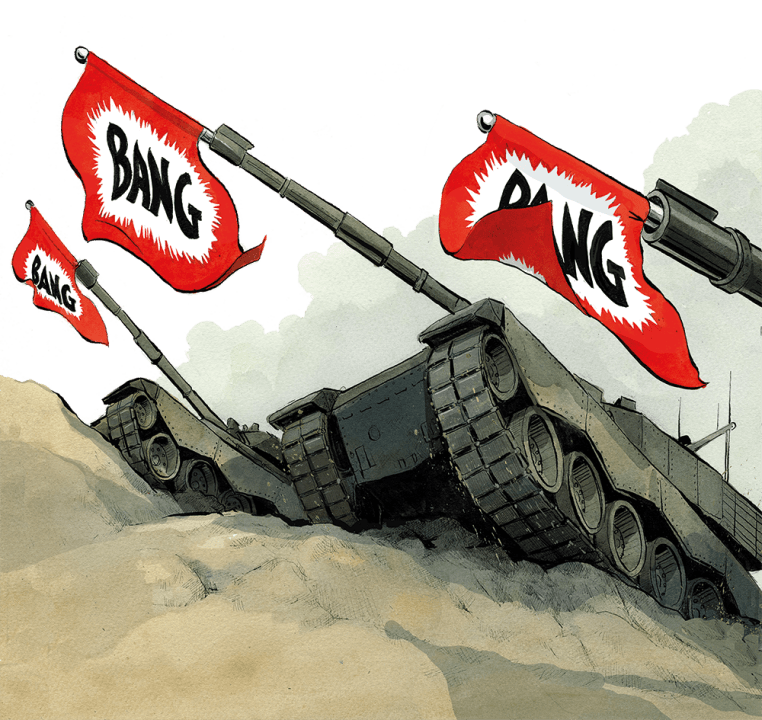
The biggest question is whether we can modernise defence at a time of frenzied progress in AI and quantum computing, which is changing the way our enemies fight. ‘Kill chains’, the systems by which intelligence is fed to those fighting on the front line, are changing. AI is being used to link sensors to weapons systems that can act instantaneously, meaning that the wars of the future will be won by the technology that operates nanoseconds faster than the enemy’s. We cannot afford to be left behind. We will not survive if we are an analogue military fighting in a digital war.
Yet this technological change also creates an opportunity. Rather than trying to match our foes tank for tank – a race that they are more suited to win – or trying to replace all the capabilities that the US is redirecting to the Pacific, we should be smart. Britain and our European allies should play to our strengths in innovation and advance industrial capacity to leapfrog ahead instead of trying to play catch-up.
The UK’s recent ambitious Strategic Defence Review recognised both the challenge and the opportunity when it stated its core vision: ‘By 2035 the UK will be a leading tech-enabled defence power, with an Integrated Force that deters, fights and wins through constant innovation at wartime pace.’ Delivering this vision will require genuine transformation, not simply replacement of existing 20th century capability. Think of something as simple as your iPhone. It receives software updates on a weekly basis. The old idea that complex weapon systems only get updated in decade-long cycles is now patently ridiculous.
All this will probably cost 5 per cent of GDP – a bargain given that history shows nations involved in total war spend closer to half their GDP on defence. In a world that is being rapidly reshaped, it is imperative that the UK can defend itself.
As an island nation we are extraordinarily vulnerable. We import around 40 per cent of our food, 45 per cent of our energy – much of it through undersea pipelines – and around 90 per cent of our data comes through undersea cables. The cyber threat to our national infrastructure is always growing. We have almost no ability to protect ourselves from ballistic missiles, and our air defences are no match for what we have seen playing out in Ukraine.
The enemy must be convinced that hostile incidents like sabotage, incursions into Nato air space and cyber attacks will be met with an effective response. They must understand that we can credibly beat them, whatever the threat. What would be our answer if Russia took over Narva in Estonia or Svalbard in northern Norway on Christmas Day 2026?
This is an entirely plausible scenario, reminiscent of the famous scene from Yes Prime Minister where Jim Hacker is being quizzed by a defence expert about when he’d press the nuclear button, as Russia ‘salami slices’ parts of Europe. Russia continues to flex her muscles knowing our ability to respond is limited. We need a whole ladder of conventional weapons, including ballistic missiles and other long-range conventional missiles, so that we can deter the enemy long before the nuclear option is ever considered. The threat from our enemies is much more proximate than some might imagine.
Meeting these challenges will need more government expenditure than is currently planned. But spending alone does not generate military capability and readiness. We must also address a persistent failure to use funds effectively. If political leaders are to turn commitments into real action, they must also be able to sustain public support for defence at a time of economic pressure. Without public backing, neither higher spending nor institutional reform will endure.
Public concern about security has risen sharply since Russia’s invasion of Ukraine, but this should not be mistaken for automatic or permanent support, let alone an assumption that people would fight for their country. A recent YouGov poll found that a third of 18- to 40-year-olds would refuse to serve in the armed forces in a major war.
We live in a world that is being reshaped at speed, one best understood by Thucydides, who wrote all those years ago: ‘The strong do what they can, and the weak suffer what they must.’ To survive in this new world means ensuring we have hard power. That means hard choices and political commitment. We cannot afford to underinvest in our national security and defence.




Comments