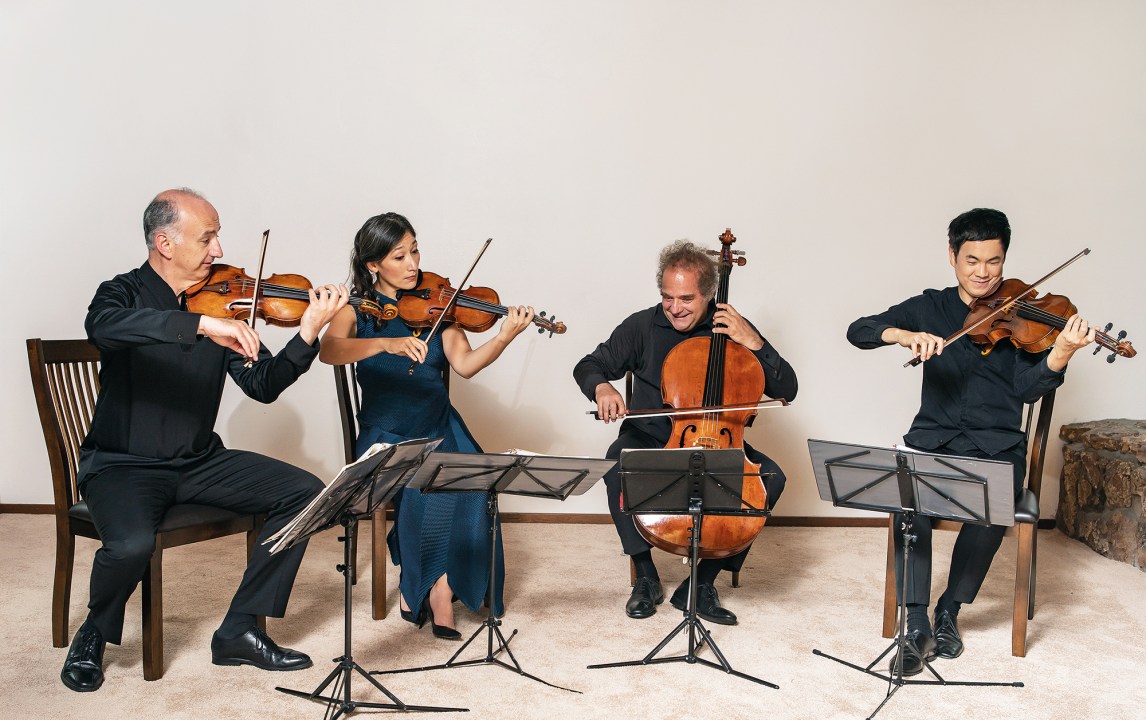
Once upon a time in communist Hungary – 1975, in fact – four students at the Liszt Academy decided to form a string quartet. That’s always an interesting choice. For a gifted and ambitious young musician, it takes a special kind of self-knowledge to pool your artistic future with three colleagues. But it’s what followed that makes the Takacs Quartet so fascinating. A relocation from the eastern bloc to the free West, the retirement of all but one of the founding members – and yet 51 years later the Takacs Quartet is still, recognisably, the same group. Some would say that it’s currently the finest string quartet in the world.
But throughout the story, there has been one constant: the group’s cellist, Andras Fejer. He’s the golden thread in the Takacs story: the last remaining member (and the last Hungarian) from that original four. And now he’s announced his retirement. He’ll be playing with the quartet on four dates in the UK later this month. There will be a few more concerts in the USA (where the Quartet has been based since leaving Hungary in 1983), and then he’s done. A small change, perhaps, as the world turns, but in chamber music, small things can carry huge significance and Fejer’s retirement feels like a moment worth marking. He’s a living connection to a fast-receding era of central-European music-making.
Fejer is a living connection to a fast-receding era of central-European music-making
‘The Liszt Academy was a wonderful place for us,’ he recalls. ‘We were lucky because the communist administration in Hungary already saw the reputational value of performing arts and sports. So we ticked the right boxes. Whenever we grumbled among each other that this was not the way things should be, one of us always said, “Look at the big picture – look what artists in the Soviet Union must endure.”’ The fledgling Takacs Quartet had access to a dizzying depth of expertise and tradition.
‘Gyorgy Kurtag was one of our mentors at college, as was the cellist Andras Mihaly,’ says Fejer. ‘Mihaly was a great man on so many levels. First and foremost, he insisted on character in our playing – that we needed to be persuasive in a way which made sense for the audience. If we fell short, that was the greatest sin in his eyes.’ Later, they studied Bartok’s six quartets with Zoltan Szekely, the violinist for whom Bartok wrote his Second Violin Concerto. ‘Szekely was very different. He was of an analytical mind. But we got his input, and also his forgiving smiles, his little smirks. And we got his delightful memories, when he saw us fighting in front of him – which was in most ways unexpected; on the other hand, totally natural.’
It certainly sounds natural – positively liberal in fact, compared with the hothouse environment endured by other quartets in the former eastern bloc. In the USSR, the Borodin Quartet was monitored at all times by the socialist state, and deployed (not always subtly) as an instrument of Soviet soft power. In Budapest, however, the student players seem to have made their own luck, as Fejer recalls. ‘Early on, one of us didn’t feel that playing second violin was rewarding enough. So he got out. We played trios for a year, and then we found Karoly [second violinist Karoly Schranz] in the dark matter of chamber music places, namely on the soccer field.’

What, while having a kick-around? ‘Well, it’s exercise,’ says Fejer. ‘It’s good for the soul. It releases you from certain built-up tensions and aggressions.’ Actually, a fondness for team sports is surprisingly common among quartet players. The Pavel Haas Quartet recruited a viola player while playing five-a-side and the great quartet theorist and Schoenberg disciple Hans Keller was obsessed with the beautiful game. Edward Dusinberre – who took over as the quartet’s first violin in 1993 – jumps in. ‘And also you spend a lot of time passing the ball to each other, which is pretty useful for chamber music!’
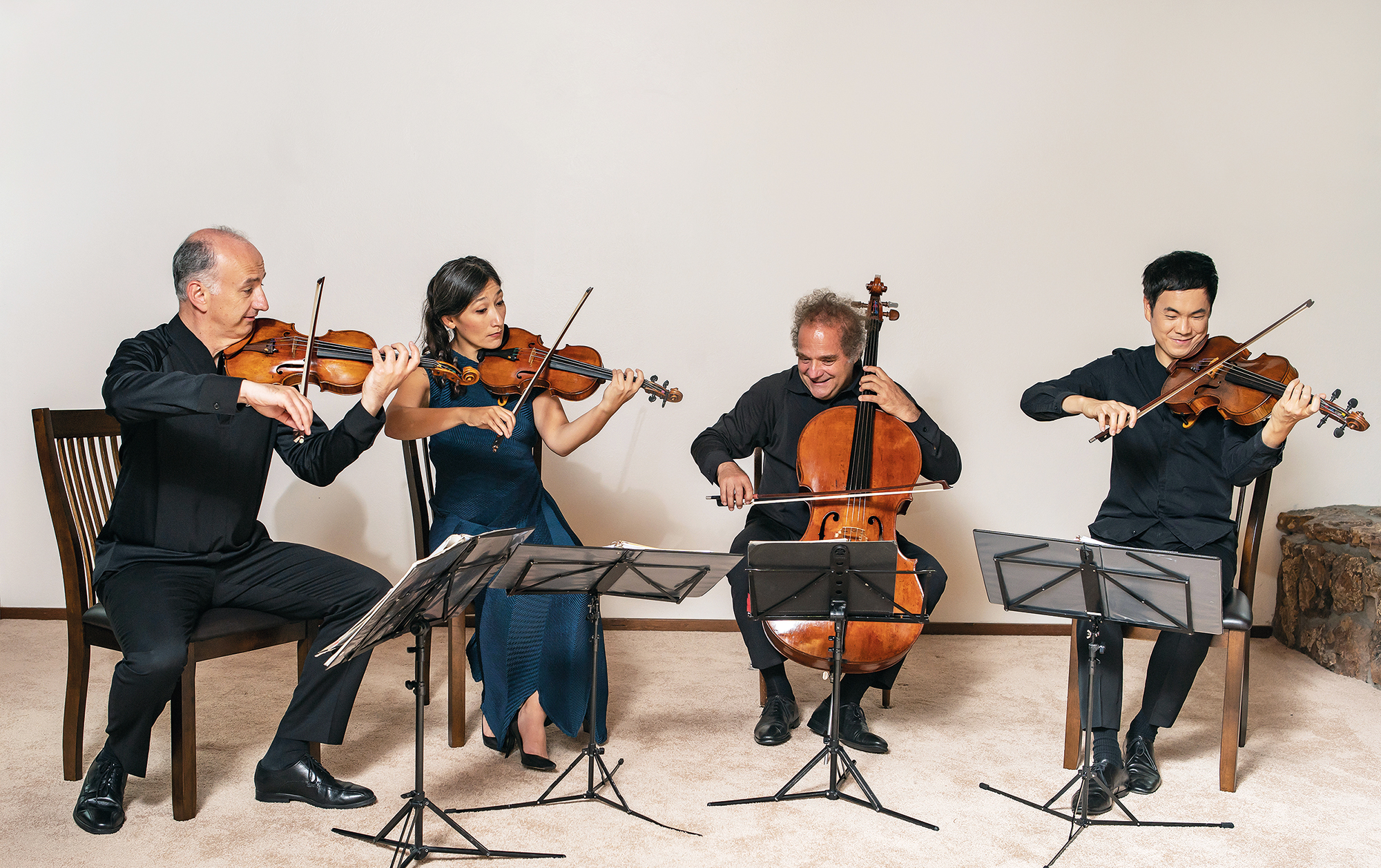
They laugh; and there, in its candour, is the essence of an art form. The aim in a string quartet is a meaningful conversation between four equally articulate participants. The reality takes many forms, from the top-down precision of the (now disbanded) Alban Berg Quartet to the very British quirks of the three Viennese emigrés plus a Londoner who made up the Amadeus Quartet. To hear the Takacs Quartet playing live might be as close to the ideal as this world allows: four different personalities who sacrifice none of their own individuality, but somehow speak with one voice, simultaneously playful and profound.
That alchemy is about to change; and it’s important to remember that the Takacs Quartet has been here before. Its original first violin, Gabor Takacs-Nagy, left the group after ill health (and much soul-searching) in 1992. Did they consider disbanding? ‘Oh, no!’ exclaims Fejer. ‘No, no, no. I mean, quitting has never been an option. Once you are inoculated with string quartets, that’s your passion for life, and there’s no way to go on and do something else because everything else is…’ He pauses. ‘Somehow nothing fulfils me like a string quartet.’
Yet he’s retiring. His successor, the Romanian cellist Mihai Marica, joins the group in September after a pair of concerts in which he plays alongside Fejer in Schubert’s C major Quintet. ‘I still love the guys and the music passionately,’ says Fejer. ‘I could have gone on, hopefully, for a couple more years, but the convergence of various factors suggested to me that now would be best. I don’t know if there’s such a thing as an optimal time to retire, but this might be close to that.’
‘For me, it’ll be difficult in the last few concerts,’ says Dusinberre. ‘When we played Brahms’s Piano Quintet a little while back, and there’s that gorgeous duet in the slow movement between cello and first violin, I was very aware of the fact – yeah, this is the last time I’m going to play this with Andras. But it does feel natural, like a life-stage thing. Andras is incredibly classy in the way he’s handling it. He’s playing as well as ever. He’s fully committed to the work. There’s no sense from him that he’s got a foot out the door.’
‘The whole life experience that we have together contributes to the chemistry on stage’
And after that final concert at the quartet’s long-term base in Boulder, Colorado, well, no one seriously doubts that the Takacs will still be the Takacs. The sense of musical character that the young founders learned from Mihaly and the bristling intelligence (and forgiving smile) instilled by Szekely have long since become a shared possession. ‘A wonderfully forever alive organism’ is how Fejer describes the evolving ensemble, and unlike the founder-members of some other long-lived quartets, he has never stood upon his seniority.
‘There was never some block Hungarian “Takacs” way of doing things,’ says Dusinberre, recalling his own early days with the group. Tolerance, up to and including a robust willingness to disagree, is part of the group’s make-up, and if you believe (despite everything) that music can be a way of life – possibly even a blueprint for living – there’s no better example than a great string quartet. ‘What you observe on the stage is related to the sheer amount of time that four people spend together,’ says Dusinberre.
‘And what you feel while we’re playing the most beautiful Beethoven slow movement is somehow related to us also being at some nasty little petrol station at 6.30 a.m. on the M25, refuelling before we go to Heathrow. The whole life experience that we have together contributes to the chemistry on stage.’ ‘True,’ says Fejer. ‘However miserable we might feel at times, we’d know that the following day we’ll be playing at the Wigmore, and all would be well.’
Dusinberre is optimistic. ‘As soon as Mihai gets on board, it’s both the Takacs, and a new project; and we will fully embrace that. But I also feel grateful that Andras is just a 15-minute drive away and we’ll be able to ask his advice.’ Fejer smiles. ‘We’ll see how it can be worked out. I just bought a wonderful new cello, and I need to rehearse different repertoire,’ he says. ‘Hopefully I can teach a little bit. I’m going to listen to lots of opera. And also in my tennis, my top- spin backhand sucks, so I need to improve that.’ He’ll still be playing, then, in every sense? ‘Well, I have never been bored in my whole life.’
The Takacs Quartet is playing at the Cambridge Music Festival (23 March), the Wigmore Hall (24 and 26 March) and the Ryedale Festival (27 March).






Comments