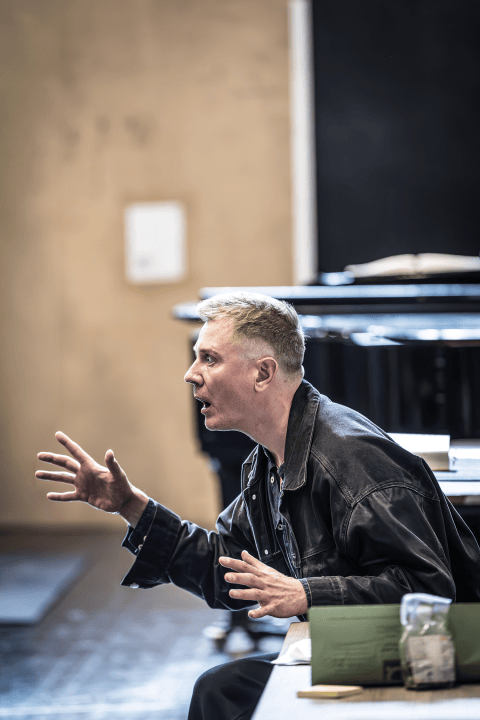
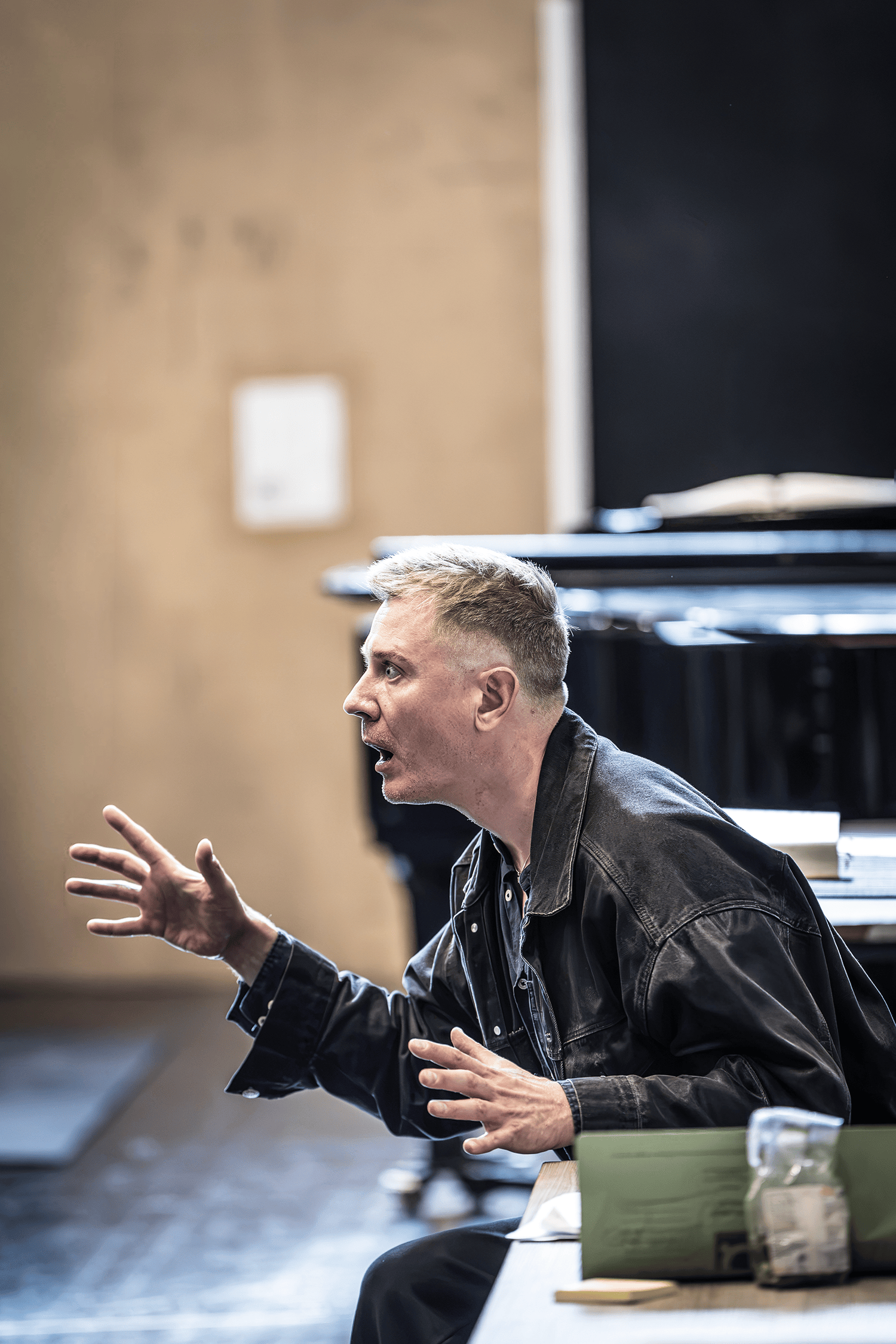
Evgeny Titov has landed at the Royal Opera, and he has good news for Britain’s beleaguered opera scene. ‘It’s the best place to work,’ he declares, leaning forward with enthusiasm; and already he’s thrown the interview off course. Usually with overseas artists there are courtesies, and then a tactful acknowledgment that British companies work under unavoidable pressures of time and money. But this actor-turned-opera director, whose career has taken him from St Petersburg to the Salzburg Festival, has seen a few things, and he means what he says. He likes it here.
‘Everybody told me before I came, “You will love it,”’ he says. ‘“Oh, is that so?”, I thought: I visited a few times for preparation and I was, like, “Yeah, it’s good, but I don’t see the difference.” But when you start rehearsing, it’s amazing. Amazing! Because of the people, because of the working conditions, because of how they take care of you, and how quickly they react. Everything’s prepared, everything’s thought through. Honestly, I’m not the kind of person who goes to Zurich, and then Vienna, and tells them all that they’re best. No, the Royal Ballet and Opera is definitely the best organised place I’ve ever been, and the most supportive. Really! It’s impressive.’
‘I’m very crazy, absolutely free, six years old!’
He sits back, beaming. Titov has just completed a full day’s rehearsal on the Royal Opera’s new production of Parsifal, but you wouldn’t guess it. Wagner’s final opera is a work apart, as vast and as beautiful as Tristan und Isolde or Götterdämmerung, but freighted with a philosophical complexity that can daunt even the most devoted Wagnerite. Wagner didn’t even call Parsifal an opera; to him it was a ‘Bühnenweihfestspiel’ – a ‘consecrational stage festival’ – and the Nazis, troubled by its Christian symbolism, discouraged performances. There’s enough here to put any director through the wringer.
Titov, however, has a reputation as a livewire, and right now he seems far from tired. ‘I work very passionately, and I’m very emotional,’ he says, and his collaborators across Europe (his operatic credits range from Enescu’s Oedipe in Berlin to George Benjamin’s Lessons in Love and Violence in Zurich) testify that his is the kind of energy that rubs off. Parsifal, though – surely this is different; a special case. Isn’t it draining to immerse yourself so completely in this, of all operas?
‘No. I would say everything from Monteverdi onwards requires a different approach. If you do Sir George Benjamin: the same. And Tchaikovsky is Tchaikovsky: I’m directing The Queen of Spades this winter and that’s also something completely different. It’s almost as big as Parsifal, in some ways, but with a completely different energy. Everything, if you do it right, requires a special treatment, because every piece is its own world.’

And Titov knows all about moving between worlds. Raised in Ust-Kamenogorsk, Kazakhstan, he trained at the St Petersburg Theatre Arts Academy and spent the early years of his career as an actor. ‘I was successful – I was doing films in Russia, and getting good stage roles; Jason in Medea, Jim in The Glass Menagerie. I was doing Ostrovsky. But I realised that I needed to be out in the world. I hadn’t seen London or New York or Rome’. With only the sketchiest grasp of German, he applied to study directing at the Max Reinhardt Seminar in Vienna, was rejected, and then, a year later, on his second attempt, accepted – all while holding down a repertory job in Russia.
‘I was flying back to Russia twice a month, to perform. My biggest and worst fear, every time, was that afterwards I would get to border control at the airport and they would not let me go back to Vienna. They would not let me out.’ After fobbing off his employers with a story of a lost passport, he burned his bridges and settled in the West. ‘I haven’t been back to Russia since 2014, and I definitely don’t want to go now. I don’t want to find out what would happen. In Vienna I found that I could be free, and learned the most important thing, which is to really understand who you are. This, you have to learn.’
So go on, then: who is Evgeny Titov, as he makes his British debut with his first ever Parsifal? ‘I’m very crazy, absolutely free, six years old!’ Well, he said it, and there’s no ignoring the boyish exuberance that Titov projects both in person, and (by all accounts) in his working methods. That’s one reason why companies across Europe are so keen to work with him. Titov’s uninhibited energy and directness has a way of breaking familiar works wide open, of releasing fresh insights and surprising perspectives.
Still, ‘It’s very hard for me to talk about my own work,’ he admits. ‘The critics are always saying it’s existential, it’s deep, it’s going into characters. I don’t know. In Germany directors are interested in “concepts” where Parsifal takes place on Mars, or in a factory where they kill chickens. That’s not a concept. It’s nothing – just a very, very bad staging. So I try to go deep into the play.’ His own ideas about Wagner’s Grail legend centre on the twin figures of Parsifal – a redeemer who stands in need of redemption – and Kundry, the cursed, undying woman and the opera’s only female protagonist. Early reports suggest that the setting will be post-apocalyptic.
‘I’m not doing propaganda theatre – writing slogans on the wall. That’s too easy’
‘No spoilers!’ laughs Titov, and he is anxious that audiences should let his – and Wagner’s – work speak on its own terms. He has said that in theatre direction, ‘intuition plays a bigger part than knowledge’; his productions, he insists, have no personal agenda. ‘I’m not doing propaganda theatre. I’m not this political director who’s doing, “Women should be liberated,” or whatever – writing slogans on the wall and saying, “Look, look, this is what I’m doing.” I think that’s too easy. I think it’s too simple. I’m not saying, “Oh, I’ll show you, this stupid Wagner.” I don’t want to destroy anything.’
‘I believe the art is more clever than the artist,’ says Titov, and few would dispute that Parsifal is very clever indeed. It’s just that Titov believes that – like any enduring art work – it might not necessarily mean what its creator said it meant. ‘Maybe Wagner is not as free and as right as he thought, because wherever there is certainty, you are in danger.’
To art, then, its freedom. Certainly, Titov accepts that his own work might escape his imagination, to reveal a life and meaning of its own. In fact, for a director with roots in conventional theatre, the discipline of opera – where so much of the performance (and our response to it) is dictated by music that is beyond the stage director’s control – is itself a sort of liberation. That’s not merely a backhanded compliment to the conductor (Titov is a big fan of Covent Garden’s Jakub Hrusa. ‘In my opinion, he’s really a wall of passion – he just doesn’t show it’). It’s an acceptance that creative freedom can take many forms, and Titov thinks often about freedom.
‘Yes, we have to think about what is behind the music, and not be anaesthetised by it. But you can only be free if you have very clear borders; because real freedom only comes when you know that not everything is possible. If everything is possible, that’s not freedom. You can find it if you really squeeze; if you ask questions about a work of art. Then you can discover what the work means to you. If you just reject the questions, that’s not freedom. It’s a salad. You need the shadow, to see the light.’
Parsifal is at the Royal Opera House until 17 October.




Comments