
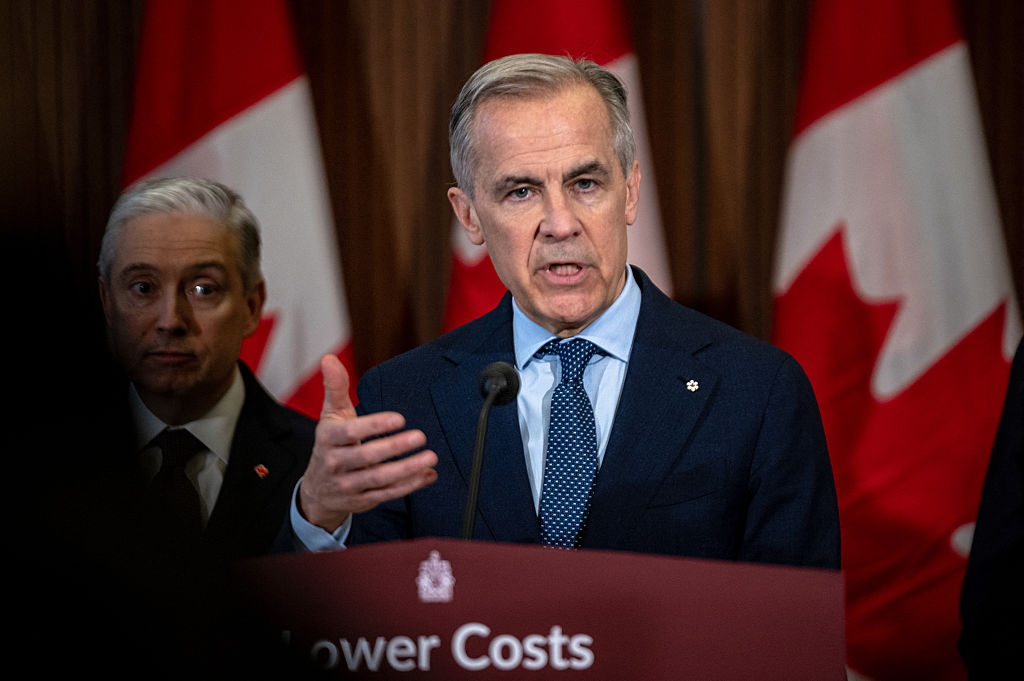
Mark Carney is swaggering about Canada with his new majority government, acting as if he’d just received a landslide mandate from the electorate. The truth is he acquired his precious majority not by climbing up on his soapbox and convincing voters, but by whispering sweet nothings to five MPs from other parties, upon which they mysteriously lost their political principles and crossed the floor. Does Carney believe in democracy? It’s hard to be sure.
Yes, his party did just win three special elections. But only one of those counted (the other two were held by Liberals already and in safe Liberal ridings, so made no difference to the number of seats the party held). Without the floor-crossings, Carney would be stuck with the minority he won last April.
What’s unusual about these floor crossings is that the MPs in question – four Conservatives and one from the NDP – didn’t seem to have any particular disagreement with their parties. Marilyn Gladu, their latest convert, has sat as a Conservative since 2015. She has been vocally prolife and anti-euthanasia the entire time. She backed the Freedom Convoy, opposed the ban on conversion therapy, and even ran for leader of the Conservative party. Yet suddenly a week ago, she announced she was crossing the floor.
Liberals turned pale with horror on hearing that such unprogressive views were being welcomed into their midst. But Carney reassured them: Gladu – who you would have sworn was a staunch social conservative, if ever there was one – had promised to vote with the government on social issues. And Gladu confirmed.
This isn’t what Gladu’s constituents voted for, and the Conservatives are understandably upset. “The Carney Liberals did not win a majority government through a general election or today’s by-elections,” Pierre Poilievre, Conservative Party leader, wrote in an X post. “Instead, it was won through backroom deals with politicians who betrayed the people who voted for them.”
Carney has sought to deflect criticism by saying that in Westminster-style democracies like Canada, voters choose an MP to represent them, not a party. But it’s the representation, not the party, that’s at issue here. Voters wanted Gladu’s socially conservative principles, but they’re getting Carney’s progressive ones.
Some said Carney should call a general election in order to legitimize his majority, but he didn’t want to go there. “I am not considering calling an election,” he said firmly – because what Canadians want is for him to get on with governing the country. Perhaps he’s wise not to put that theory to the test.
What will happen now? Carney has announced that his first course of action will be to replenish the parliamentary committees with a majority of Liberals, to prevent what he calls “showboating” from other parties, which he finds a hindrance to the passage of legislation. (Perhaps somebody ought to explain to him that parliamentary debate is one of those Westminster-style-democracy things…)
Carney is particularly sore about the Conservative filibuster on Bill C-9. “We’ve had a variety of issues over the course of the Parliament where things have taken longer than they necessarily would, where debates have been more performative,” Carney said bitterly.
But Bill C-9 (currently before the Senate) touches on an absolute powder keg of an issue. It intends to do away with the good-faith protection for religious speech based on the Bible or other religious texts, and it opens the door for religious persecution in Canada – a nation whose entire system of law, ethics and justice is founded on the Bible. How could Carney imply that prolonged debate on such a serious topic could be merely “performative”?
On the very parliamentary committees he wants better control of, his cabinet minister Marc Miller made headlines by listing off the passages of the Bible he thinks are hateful and should be open to criminal prosecution. But somehow, critics of this outrageously offensive statement are the problem?
There are plenty of other problematic pieces of legislation that Liberal-heavy committees could swiftly wave through. Bill C-15, for instance, allowing government to unilaterally exempt certain corporations from federal law. Or Bill C-22 on lawful access, forcing all telecommunications service providers to set up surveillance tools to record and retain personal user data for a year, in case the government wants to investigate users for suspected illegal behavior.
It seems typical of Carney that his first move with a majority is to start shutting down debate. His instincts since he entered the prime minister’s office have been to centralize power, expand censorship and overrule those who disagree with him. For instance, with regard to the “notwithstanding” clause in the Canadian Charter, which enables provinces to override certain Charter rights as defined by the courts. Alberta recently invoked this clause in legislation banning the medical transitioning of children.
Carney does not want provinces to have this crucial freedom, and has quietly asked the unelected Supreme Court to end it. They say democracy dies in darkness. But sometimes it dies in broad daylight – and nobody does a thing.






Comments