
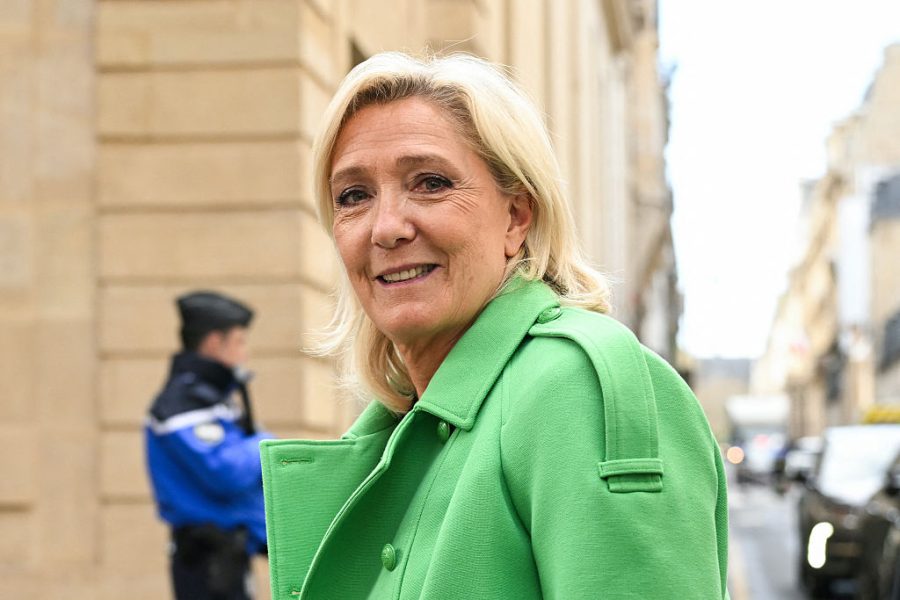
The first round of voting in France’s municipal elections has laid bare the country’s deep fractures. In a turnout of 56 per cent yesterday, none of the parties emerged dominant ahead of this Sunday’s second round, but the results underlined the mainstream support now enjoyed by Marine Le Pen’s National Rally and Jean-Luc Melenchon’s la France Insoumise (LFI).
Last month, France’s Interior Minister, Laurent Nunez, categorised the LFI as ‘extreme-left’, to go with the representation of the National Rally as ‘extreme-right’. If he had hoped to deter voters from casting a ballot for either party, Nunez’s tactic failed. Nothing, it seems, will stop the rise of either Le Pen or Melenchon.
The municipal elections are the first time the French have gone to the polls since the leader of the National Rally was convicted by a court last year of misusing EU funds. Le Pen has appealed her five-year ban from politics (the result of which will be known in July) but her conviction hasn’t dented her popularity.
This is a taste of things to come ahead of next year’s presidential and parliamentary elections
Her party was re-elected to power in the deep south city of Perpignan while they or their allies are in the running for winning the cities of Marseille, Nimes, Toulon and Nice. Overall, the National Rally and the Union of the Right came out top in more than 60 towns or cities, compared to 11 in the 2020 elections. In a message on X yesterday evening, Le Pen described the results of the first round as ‘a huge victory for our movement’, adding:
We are making gains, with a real chance of victory on 22 March in the second round of these local elections. I call on the French people to mobilise and build on this momentum.
Of course, Le Pen has been here before. Jubilation after the first round of voting in municipal, regional and parliamentary elections that, a week later, turns to recrimination.
For years the ‘Republican Front’, or ‘cordon sanitaire’ has been erected between the first and the second rounds of voting to block the National Rally from power. It is unlikely that such a front will still hold. Indeed, Le Pen’s number two, Jordan Bardella (who will run as the party’s candidate in next year’s presidential election if Le Pen’s appeal fails), recently called on a cordon sanitaire to be placed around Melenchon’s LFI.
Describing Melenchon as a ‘disgrace to the Republic’, Bardella said that the party’s links to an extreme-left group called the Young Guard made them unfit for office. Last month members of the Young Guard, including two men who had worked as parliamentary assistants for the LFI, were charged with the death of a nationalist student in Lyon. Melenchon has also been accused in recent weeks of anti-Semitism, accusations he denies and which evidently didn’t turn off voters.
Although the LFI didn’t score well in Paris (where the Socialist candidate is on course for victory in this weekend’s second round), the party performed strongly in many places such as Lille, Toulouse and Saint-Denis, the sprawling suburb to the north of Paris.
What the LFI needs for the second round to win power is the help of the Socialists and, to a lesser extent, the Greens. The latter did well in the cities in the 2020 municipal elections because they were held at the height of Covid. The turnout was only 38 per cent because many older people didn’t dare go to the voting booth. Younger voters did vote and many cast their ballots for the Greens.
After the LFI was indirectly linked to the death of the student last month, many senior figures in the Socialist party, such as former president Francois Hollande, ruled out any future collaboration with Melenchon. Other Socialists aren’t quite so scrupulous and this morning the Socialist and LFI candidates in Toulouse announced a partnership for the second round in the hope of defeating the centre-right candidate.
There will be other alliances before the second round of voting takes place. The left believes the bogeyman is the ‘fascism’ of Le Pen’s party, while the right warns that the ‘Islamism’ of the left is the greatest danger facing France.
It is a taste of things to come ahead of next year’s presidential and parliamentary elections. They will be the most bitterly contested elections in the history of the Fifth Republic: progressives against traditionalists, Metropolitan France against Provincial France, Melenchon’s ‘New France’ of immigration against Le Pen’s Old France.
The only thing these opposing visions – and their voters – share is a contempt for Emmanuel Macron. His centrist party and their allies suffered a series of humiliating results in the first round of voting. As one government minister put it this morning, Macronism faces the ‘risk of erasure’. It won’t be missed, although what replaces it next year might not be much better.




Comments