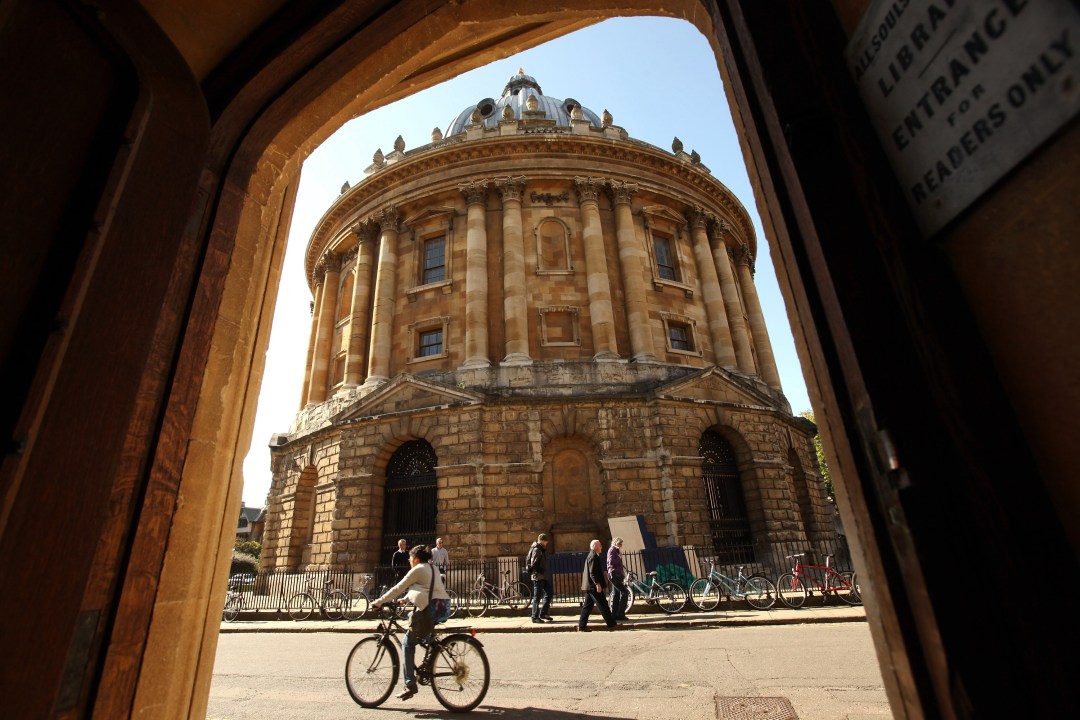
Peter Mandelson — twice-resigned Cabinet minister, architect of New Labour and, until recently, His Majesty’s Ambassador to the United States — went to the University of Oxford from Hendon County Grammar. Mandelson read PPE at St Catherine’s College from 1972 to 1976. Young Mandelson’s impressions of Oxford, as detailed in Donald Macintyre’s Mandelson: The Biography, are mixed at best: Hertford College ‘stank of cabbage’ while St Edmund Hall was ‘sort of thirteenth century’, the Union ‘hoorayish’ and ‘off putting’. With too many Peters in his year, Mandy was known, simply, as ‘Benj’.

Fast forward some 40 years and Mandelson was awarded an honorary fellowship by St Catherine’s College in 2018. In 2024, with his ties to Epstein already a matter of public record, he unsuccessfully stood as a candidate for Oxford University Chancellor. His honorary fellowship survived until November 2025, when he resigned it following the release of emails detailing the full extent of his relationship with the convicted sex offender. The college said he had ‘decided to step back from public life’ and offered no further comment. The St Catherine’s JCR President at the time was slightly less restrained, stating that Mandelson’s activities ‘do not align with [our] values as a student body.’
Mandelson is certainly no stranger to controversy. This is a man who resigned from Cabinet in 1998 after failing to declare a £373,000 interest-free loan from a ministerial colleague whose business affairs were under investigation by Mandelson’s own department. His second resignation came in 2001, this time over allegations of improperly influencing a passport application. Perhaps most illuminating of all is the brief email exchange between Mandelson and Epstein on the day of Epstein’s release from prison in 2009, after serving thirteen months for procuring a minor for prostitution. ‘Free and home’, Epstein wrote. ‘How shall we celebrate?’ Mandelson replied.
If you know Oxford, you know the drill. The university has, across its long and storied history, produced scientists, politicians, writers, and thinkers of world-advancing brilliance. It has also, with a consistency that would impress even the most dedicated recidivist, produced individuals whose relationship with acceptable conduct is, at best, flexible. I won’t patronise the educated readership of The Spectator by reeling them off, but Mandelson is, by no means, an aberration. Consequently, Oxford is now extremely well versed in the art of distancing itself from its graduates — the withdrawn fellowship, the unrenewed invitation, the portrait that migrates from the dining hall to the corridor, and, eventually, from the corridor to Redbridge Recycling Centre.
In fact, Mandelson isn’t even the most notorious Oxford graduate to find themselves caught up in the Epstein affair. That honour belongs — by some margin — to Ghislaine Maxwell, who read Modern History with Languages at Balliol. She went on to become one of Epstein’s closest associates and, in December 2021, was found guilty of five charges, including sex trafficking a minor. Her path into Oxford was slightly dodgy in itself: her father, the media proprietor Robert Maxwell, reportedly endowed a scholarship in her name to secure her a place. One hopes the admissions process has tightened somewhat since.
Oxford is now extremely well versed in the art of distancing itself from its graduates
So, is this all the fault of the University of Oxford? Not directly, no. A university cannot reasonably be held responsible for what its alumni get up to decades after graduation, and it would be unfair to allow a handful of them to obscure the thousands of Oxford graduates who go on to lead lives of genuine distinction and perfectly adequate probity.
Oxford is many things — and I speak as someone who has adored their time at the institution — but it is, inescapably, a bubble. The formal dinners, the academic dress, the weight of just shy of a thousand years of academic history pressing down on every cobblestone. It is an experience so removed from ordinary life that it is perhaps unsurprising if, for some, it loosens their grip on reality ever so slightly. I don’t believe that Oxford sets out to produce people who consider themselves untouchable. But when you have spent three or four years being told, both implicitly and explicitly, that you are among the brightest students on earth, a certain detachment from the rules that govern everyone else’s lives appears to be, for some, an inevitable by-product.
Oxford will survive all of this. It survived the Bullingdon Club, it survived Maxwell, and it will survive Mandelson. The spires will continue to gleam, the applications will continue to flood in, and graduates will continue to populate Cabinet rooms, ambassadorial residences and, occasionally, prison cells.
As for St Catherine’s, they have understandably moved with some purpose to put distance between themselves and Mandy. Perhaps most telling of all, when I visited St Catherine’s this week, the vast majority of students I spoke to had no idea that Mandelson had studied there — or indeed at Oxford at all. For a man who not long ago stood as a candidate to become the university’s Chancellor, it is a remarkably swift slide into obscurity.



Comments