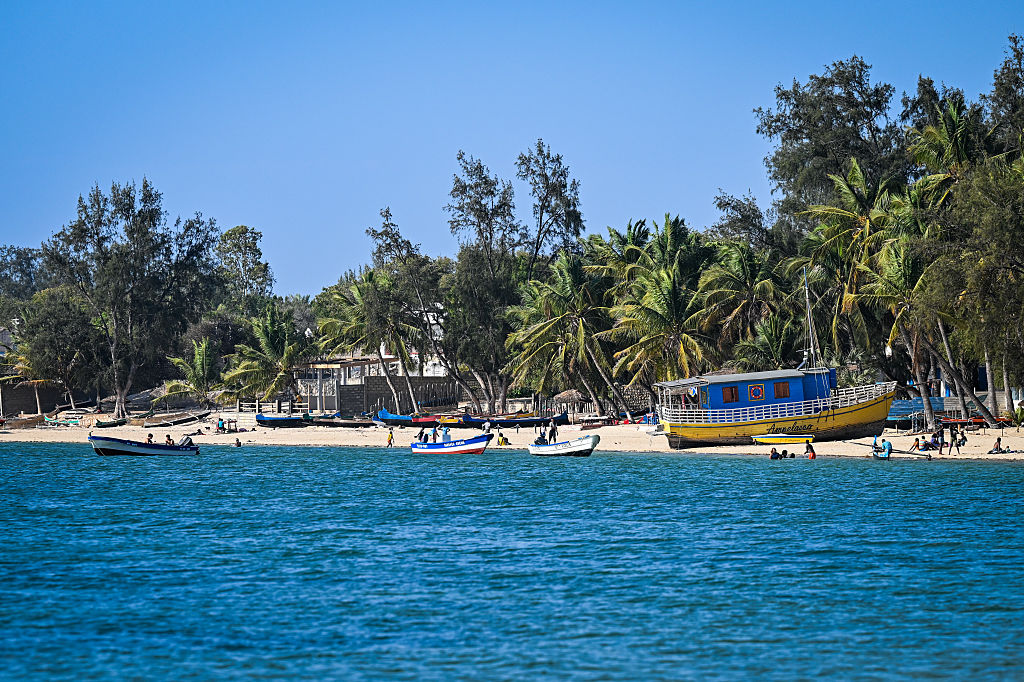

Madagascar, by rights, should be rich and flourishing. It has everything: natural resources, a heavenly climate, picture-book scenery, tropical weather, friendly people. But it is one of the poorest countries in the world – on account of centuries of exploitation, first by the French, and latterly by corrupt elites.
With luck, all that is about to change. If the new regime (which came to power in October when a student-led revolution sent the last one packing) can resist the lure of looting, it could just succeed.
No jet skis, no music, no bars. Maybe a lone fisherman or a sailboat in the distance
As yet the spacious main square of the capital, Antananarivo (known as Tana), is not safe at night, when it becomes the domain of pimps, prostitutes and pickpockets. Theft is common, but there is surprisingly little violence, and drugs are not a problem – people are too poor to interest the dealers. There’s a thriving practice of superrich elites kidnapping each other for massive ransoms.
Tana sprawls across a river valley and several hills, and consists mostly of multicolored houses and churches, dominated by the hilltop palace. The streets are jammed with traffic, the pavements with people, children everywhere, but no one hoots or curses. Women seem obsessed with washing: everyone’s clothes are spotless and riverbanks and roadside grass are covered in laundry, washed in the river and laid out to dry.
We had lunch in the well-known Café de la Gare, housed in the old station, which was built sometime around 1900, and ate zebu steaks from the island’s buffalo-like cattle and excellent crêpes Suzette. The ladies is housed in a former railway car.
Even more interesting is La Varangue, a restaurant which doubles as a free museum. The owner is clearly addicted to collecting musical instruments, Victorian oil lamps, cameras, watches, saxophones, armaments, telephones, brass ornaments, local artists’ colorful pictures of Malagasy life and front pages of newspapers covering the 1880s French conquest of Madagascar. There’s not a spare inch of wall, ceiling, table or shelf space, but nothing is dusty or fusty. The courtyard is full of vintage cars.
Madagascar stretches from the tropical north to the arid south and, due to centuries of isolation, has an astonishing variety of indigenous flora and fauna, the most famous being six species of baobab trees and more than a hundred of lemur. Tana’s Lemurs’ Park, 12 acres of protected forest complete with a cascading river which runs bright red from the iron in the clay, is full of varied and unusual plants, chameleons and kingfishers – and lots of lemurs.
You are led by a knowledgeable guide whose main job is to see you don’t disturb the lemurs, which are fed daily so are unfazed by humans. Tiny babies cling to their mothers’ undercarriages while their bigger siblings ride on her back. Teenagers play in the trees, parents sleep.
As I leaned over a wall watching a couple of tortoises, two blond “dancing lemurs” (about the size of whippets) sprang along the wall toward me, one behind the other, then leapt over me with a mighty bounce, clearing my head with feet to spare.
What I’d been watching so intently was a huge tortoise eating a mango. Along crept a similar-sized tortoise who very slowly examined the back end of “my” tortoise. He obviously liked what he saw, smelled, or felt, because he began, very laboriously, to mount her. It took a while, but he was finally on top and intent on the job in hand, while she paid absolutely no attention: she just got on with her mango. But he was now in a position to see over her shell to her head, from where he clocked she was eating a mango. Whereupon he slid off her with untortoiselike haste and commandeered said mango.
I’d hoped to see the famous avenue of baobabs near Morondava and to walk in the “spiny forests” of indigenous trees, but Madagascan roads are so potholed that the 430-mile drive from Tana could take two days. You can fly, then bump through the potholes for an hour or two, but we judged the expense and discomfort not worth it. We only had ten days in all, and I was desperate for a do-nothing-but-lie-about break.
So we flew to Nosy-Be Airport in the far north. Our hotel, Tsara Komba Lodge on the neighboring island of Nosy Komba, sent a boat to collect us. After a short ride across a millpond sea, we had to remove our shoes and roll up our jeans to wade ashore, the hotel staff carrying our suitcases on their heads. Tsara Komba isn’t grand. It’s small, with only eight suites, spacious and comfy. Most guests are barefoot, as are the waiting staff. The waitresses wear pretty cotton dresses, a different color and style every day.
Fish is bought daily from the local guys who work from canoes with a hand line. The veg comes from the garden and the chef makes juices and sorbets from the island’s fresh lychees, coconuts, pineapples, mangoes and papaya. When my husband John asked for orange juice, the waiter explained, as if to a child, that it wasn’t the season for oranges.
Our palm-thatched cottage was tucked in between the trees, overlooking the perfect empty sea. No jet skis, no music, no bars. Maybe a lone fisherman or a sailboat in the distance. I floated on my back in the water for hours, the gentle currents changing from almost-too-warm to deliciously cool to body temperature. We walked miles along the beach, picking up small wild mangoes and rinsing them in the sea before eating them skin and all: tangy, sweet and deep-flavored. From our terrace, we’d watch children scamper along the beach to school, or village women walking home, their shoes in their hands and their shopping on their heads.
Young Stanisalav, a waiter, was also the hotel’s boat driver and guide for all adventures: we fished from a boat, snorkeled above a coral reef where I swam with a friendly turtle and walked in the forest, where we saw lemurs and chameleons.
We also did a lot of lying about. There was a double daybed on our terrace, on to which the trees dropped red petals in the breeze. In late afternoon, the skies would darken with thunder and lightning, reminding me of my native South Africa.
If you want guaranteed all-day sun, go to Madagascar between April and October. It is the perfect holiday: a touch of culture, a few untaxing activities – and plenty of peace.


Comments