Brute force
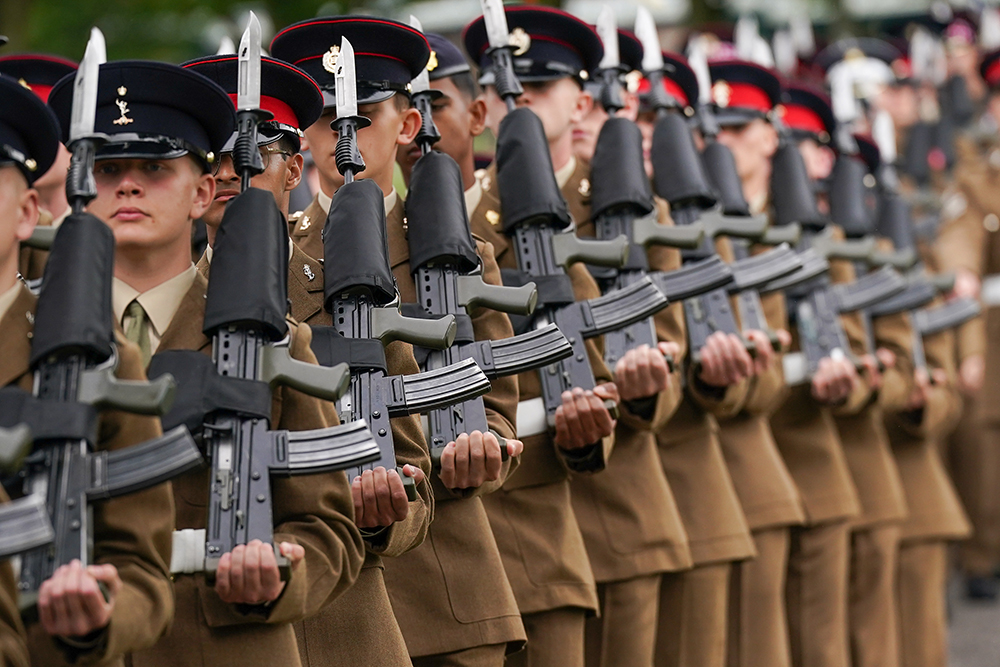
Sir: General Sir Nick Carter is correct to point out the fragility of the UK’s armed forces today (‘Empty shell’, 7 February). He is also right to highlight the level of expenditure which will be necessary to overcome 25 years of structural under-investment in defence if the UK and its allies are to deter or win any future war.
However, the suggestion that the British armed forces might be saved – relatively cheaply – by the institution of AI-automated kill chains alone is questionable. Indeed, it may be just another mirage of the type which has contributed to the current predicament. Autonomous weapons systems have existed for many years. With AI, they will proliferate and may become more important. However, the main use of AI is not to automate weapon platforms. AI processes mass data at speed: used properly, it enables commanders to see across the battlespace more deeply, accurately and quickly than ever. Commanders can then make better decisions about the operational and tactical deployment of their forces (including remote and autonomous weapons) against their enemy.
Here’s the rub. AI does not remotely eliminate the requirement for large, robust military forces which a commander can deploy. Those forces need to be able to expand and to endure heavy casualties in wartime. The limiting factor in Ukraine is soldiers, not drones.
These enlarged forces also need a full suite of military capabilities (from legacy ones, like tanks and artillery, to new ones like FPV drones and loitering munitions), so that they can adapt to unexpected situations. An exquisite autonomous kill chain is not remotely enough. And of course, AI will just add to the expense of generating a capable modern force.
Anthony King
Professor of War Studies
University of Exeter
Not worth it
Sir: As a GP for more than 40 years, much as I might admire the ‘hard-bitten’ doctor who told a patient to ‘fuck off’ for wasting his time with a sticky tongue in the 1990s (‘Spin doctors’, 7 February), I can assure your readers that such a frank response these days would lead to a complaint, endless hours explaining one’s approach to such symptoms, and quite likely a slow walk to the doors of the GMC -– possibly via the NHS Ombudsman and Care Quality Commission. None of these options is at all enticing, I assure you. The approach of many doctors these days is that we are one complaint away from retirement on our full, well-deserved, inflation-linked, publicly funded NHS pension.
Dr Anthony Marks
London NW11
A gift
Sir: Matthew Parris’s article about the assisted dying bill reveals an almost pathological hatred of the Catholic Church (‘Religious hypocrisy killed off assisted dying’, 7 February). Catholics, of whom I am one, oppose assisted dying because of our firmly held belief that life is a gift from God, and therefore every human being possesses an inalienable worth which must be respected in all circumstances. This led the late Pope Francis to maintain that there was never any justification for the death penalty, however appalling someone’s crimes might be.
Catholics also realise that people’s need for comfort, support and effective pain relief is never greater than in their final illness. That is why Dame Cicely Saunders, a Catholic, pioneered the hospice movement, and why Mother Teresa of Calcutta opened the first hospice for Aids sufferers in New York – at a time when many were dying in isolation because fear of infection was so widespread in the medical profession. I suggest Matthew Parris reads Kathryn Mannix’s book With the End in Mind, and he will discover that, properly managed, the end stage of life can be a deeply enriching time for both the dying person and those close to him or her.
Virginia McGough
Northwich, Cheshire
Glad to be alive
Sir: I am an 82-year-old man who last April contracted pneumonia and flu at the same time. I felt incredibly ill and unable even to move without help. I asked my doctor to give me a pill to end my life, as nothing could be worse than the way I felt. He pretended not to hear me. The next night, I heard my daughter ask the doctor whether I would live through the night. The doctor replied that he honestly didn’t know. I assumed this meant I would die, and I was quite relaxed about that.
Ten months later I am alive and reasonably well, able to walk two miles a day and to enjoy the company of my children and grandchildren. If suicide had been legalised I would be dead.
Your columnist Charles Moore is working hard in the House of Lords to stop the assisted dying bill from being passed. I am sure that he is right.
Name and address supplied
Thiel’s spiel
Sir: Peter Thiel’s meditations on the Antichrist are such a theological jumble that it’s hard to know where to begin (‘“I want to stop the Antichrist”’, 7 February), but as a lifelong Presbyterian I have to object in particular to his caricature of Calvinism. The idea that a good Calvinist would welcome ultimate tyranny as a precondition to Christ’s second coming is as perverse as welcoming sin as a precursor to grace. Calvin didn’t see the Antichrist as a fiery figure looming on the horizon of the end times, but as an ongoing ‘impious and abominable kingdom’ – namely, the papacy – that needed to be resisted in the here and now.
Deirdre Wyllie
Dull, Perth and Kinross
Palace bitches
Sir: Dot Wordsworth dealt with the usages of the word ‘bitch’ in her column last week (‘Mind your language’, 7 February). I wonder if she knows that those fortunate enough to have been born in the Scottish town of Linlithgow proudly refer to themselves as ‘black bitches’? This refers to both men and women, and legend is that it has something to do with the black dogs that provided palace security when the King was in residence.
Ian McKee
Edinburgh
Life lines
Sir: Mary Killen must represent the feelings of millions of landline users (‘Wake-up call’, 31 January). In my village, nearly everyone’s landline starts with the same three digits, so that someone can answer the phone and say: ‘Lustleigh 586.’ The numbers are often within the capacity of the human brain to memorise, unlike mobile numbers. Those who have surrendered their landlines have put themselves outside this time-tested system. If it ain’t broke, don’t fix it!
Stephen Terry
Lustleigh, Devon
God willing
Sir: Lord Young errs in his 2001 email to Ghislaine Maxwell (No sacred cows, 6 February). The Orthodox Jewish equivalent of inshallah (deo volente would have been the appropriate term for Spectator readers surely) is actually beezrat hashem.
Philip Witriol
London N11
Write to us letters@spectator.co.uk


Comments