
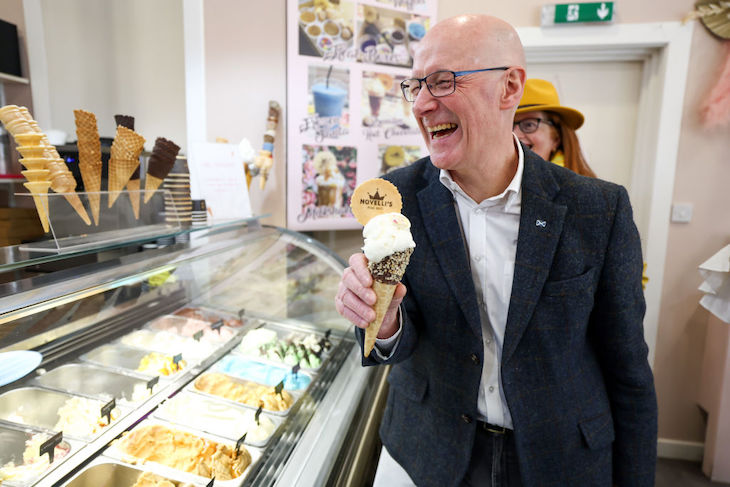
First Minister John Swinney needed a headline-grabbing new policy for the launch of his party’s Holyrood election manifesto yesterday, and it came in the form of a pledge to cap supermarket prices on ‘essential’ foods.

Speaking in Glasgow’s East End, Swinney said that while inflation has come down, people are struggling to afford their groceries to such an extent that ‘for some the cost of food is so high that it is hitting their health and wellbeing’.
He went on: ‘Now, with the current powers of our parliament, I cannot normally set prices at the till. But things have got so tough it is now impacting on our nation’s nutrition. That is a public health issue, and I have public health powers.’
Swinney intends to use his public health powers to set a maximum price for certain food items, such as bread, milk, cheese, eggs, rice and chicken, in large supermarkets. More specifically, supermarkets will be required to cap the cost of at least one variation of those items, such as one particular brand of bread, while leaving the costs of other brands at the regular market price.
Is this achievable? It is questionable. The First Minister thinks he has found a backdoor way to create power levers he doesn’t technically have. But this will likely come into conflict with the UK Internal Market Act (UKIMA), which was put in place after Brexit to ensure a continued level playing field for goods and services across the UK. Under questioning from journalists, Swinney acknowledged this conflict and stated: ‘I am making it clear in the manifesto that the UK government has a dimension [the UKIMA] here that I want to make sure they do not use to undermine the exercise of our properly constituted public health powers.’
The SNP will argue that the food policy is a continuation of public health focused price controls it has previously put in place, namely the introduction of a minimum price on alcohol sold in shops, which was brought in in 2018. But minimum unit pricing for alcohol is effectively exempt from the UKIMA, partly because the regulations were in place before the act came into force at the end of 2020. More recently, the SNP-Green coalition attempted to launch a Scottish deposit return scheme for cans and bottles in 2022, but this fell foul of the UKIMA and was subsequently kicked into the long grass. There is precedent, then, of the UK government enforcing the UKIMA.
There are other potential problems for the plan. How will the food industry react? Minimum unit pricing on alcohol took six years to come into force due to legal challenges from distillers. Will Scotland’s smaller food retailers be happy with large supermarkets being legally mandated to undercut them on pricing? It seems unlikely. And what about the supermarkets themselves? They operate on notoriously slim margins. Will they dutifully fall in line with government plans to put even more pressure on those margins? Again, it seems unlikely.
Already there is pushback from the food industry, with Ewan McDonald-Russell, deputy head of the Scottish Retail Consortium, describing it as a ‘wrong-headed gimmick’.
‘Many of the costs keeping shop prices high are now arising from the muddle of new regulations and taxes coming from government policies,’ he said. ‘Rather than recreating 1970s-style price controls and potty gimmicks, public policy should get serious and focus on cutting retailers’ costs so that resources can be directed to keeping prices as low as possible for consumers.’
Trying to create division between the north and south is the only real motivating factor for the Scottish government
Swinney acknowledged that the introduction of the policy could only happen following ‘consultation with all interested parties’, suggesting if he is returned to power then any drafting of legislation would be some way off. The probability of Scottish consumers seeing government-priced loafs of bread and bags of rice appearing on their local supermarket shelves in the 2020s therefore seems low, even if there were a serious political will to put the policy in place.
Is that will there though? The only reason it might be is because legislation to implement the policy would set a future SNP government up for a constitutional fight with Westminster. It is a sad state of affairs when trying to create division between the north and south of this island is the only real motivating factor behind Scottish government action. But that is where we are.
Swinney’s promise to cap supermarket prices on essential food will garner a few headlines and it might give his party another opportunity to create internal strife in Britain. But as a practical way to address cost-of-living challenges, which is what people really need right now, it will likely fail to have any impact at all.





Comments