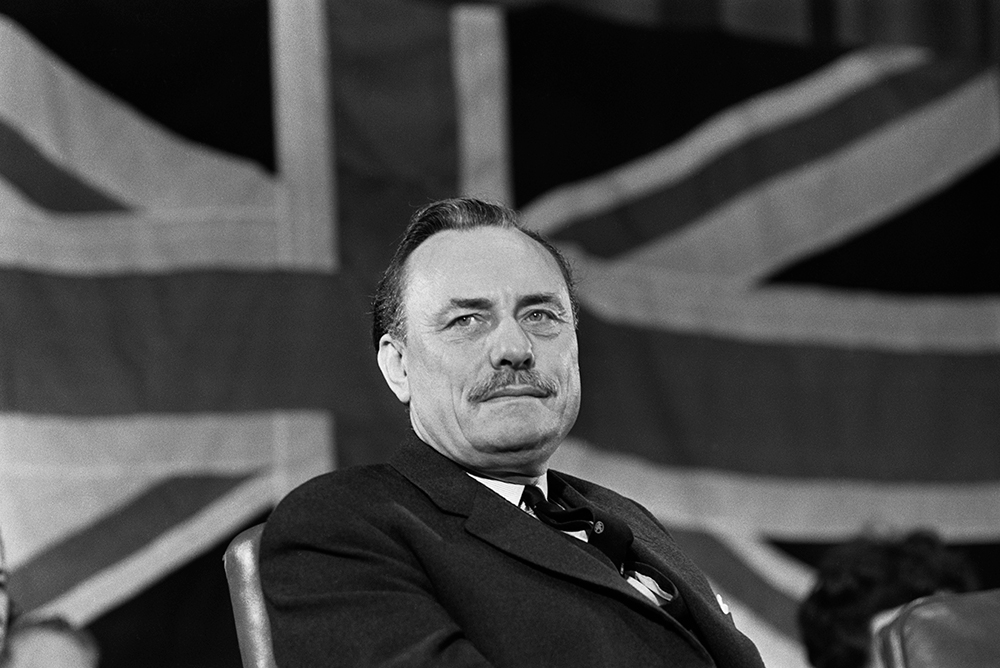
Despite a career of nearly half a century in public life, Enoch Powell is generally remembered for one utterance only: the so-called “Rivers of Blood” speech he made in Birmingham on April 20, 1968, in which he voiced his opposition to the race relations legislation being taken through parliament by the then Labour government. Powell was the Conservative opposition’s defense spokesman. His speech threw the leader of his party, Edward Heath, into a profound panic, and he sacked Powell immediately, initiating decades of assertions that Powell was racially prejudiced.
Powell always said – entirely honestly – that he never made a speech about race: just speeches about immigration policy and his profound disagreement with how it was usually managed. In the Birmingham speech, he had explicitly quoted the words and detailed some experiences of his constituents in Wolverhampton South-West. His argument was not rooted in a racist idea of the inferiority of other cultures – Powell was sufficiently intelligent and experienced to know such thoughts were idiotic – but in an idea of the dangers of imposing upon some communities a culture unlike the one that had always prevailed there. It was a speech, as he clearly said, about the failure to achieve integration across the country. Unfortunately for him, that was a part of the speech to which few chose to listen. What resonated were the hostile remarks of constituents; Powell’s decision to relate them damaged him not just for the rest of his life, but well beyond the grave. To generations of Britons since 1968, including many who have never bothered to read the speech, he was quite simply a rabble-rousing bigot and racist, and no further inquiry was needed.
Powell always said that he never made a speech about race: just speeches about immigration policy
Long after his death he found himself, in contemporary parlance, canceled. For more than 20 years, my biography of Powell, Like the Roman, was readily available on a print-on-demand service. That stopped five years ago when Powell found himself vilified from beyond the grave following the killing of George Floyd thousands of miles away, and the rise of the Black Lives Matter movement. Knowing Powell as well as I did, I am in no doubt that he would have been as appalled by and regretful of Floyd’s death as any other decent human being. There was little point in trying to state that at the time, when he became a serviceable whipping boy for those wanting to exercise their anger against genuine white supremacists and racialists. There can be no question that Floyd’s killing brought necessary attention to unpleasant and ignorant attitudes towards black people in America, with its culture of the legacy of the atrocious practice of enslavement. However, its relevance to Britain – as certain black commentators in this country have observed – is not identically applicable.
For those who enjoy using race relations as a means of grandstanding or virtue-signaling, attacking Powell and rendering him literally unconscionable was a sport that long antedated the killing of Floyd. Nor were these feelings confined to people supposedly on the British political left. David Cameron, for example, made it clear when he ran for the leadership of the Conservatives in 2005 that he wanted to rid his party of any association with Powell. Interestingly, Cameron never seemed to give any indication that he understood what Powell actually stood for, and this did not seem to matter to him. It remained the case throughout his leadership; in 2007 he endorsed the removal of Nigel Hastilow, the Conservative candidate for the parliamentary seat of Halesowen and Rowley Regis, for daring to write in a newspaper column that Powell had been right to warn about the problems of mass immigration. As other commentators said at the time, Powell had, posthumously, become an “unperson.” It was perhaps the most successful exercise of that sort since Stalin’s toadies, both in the Soviet Union and throughout the West, did something similar to Trotsky in the 1930s and into the 1940s and 1950s.
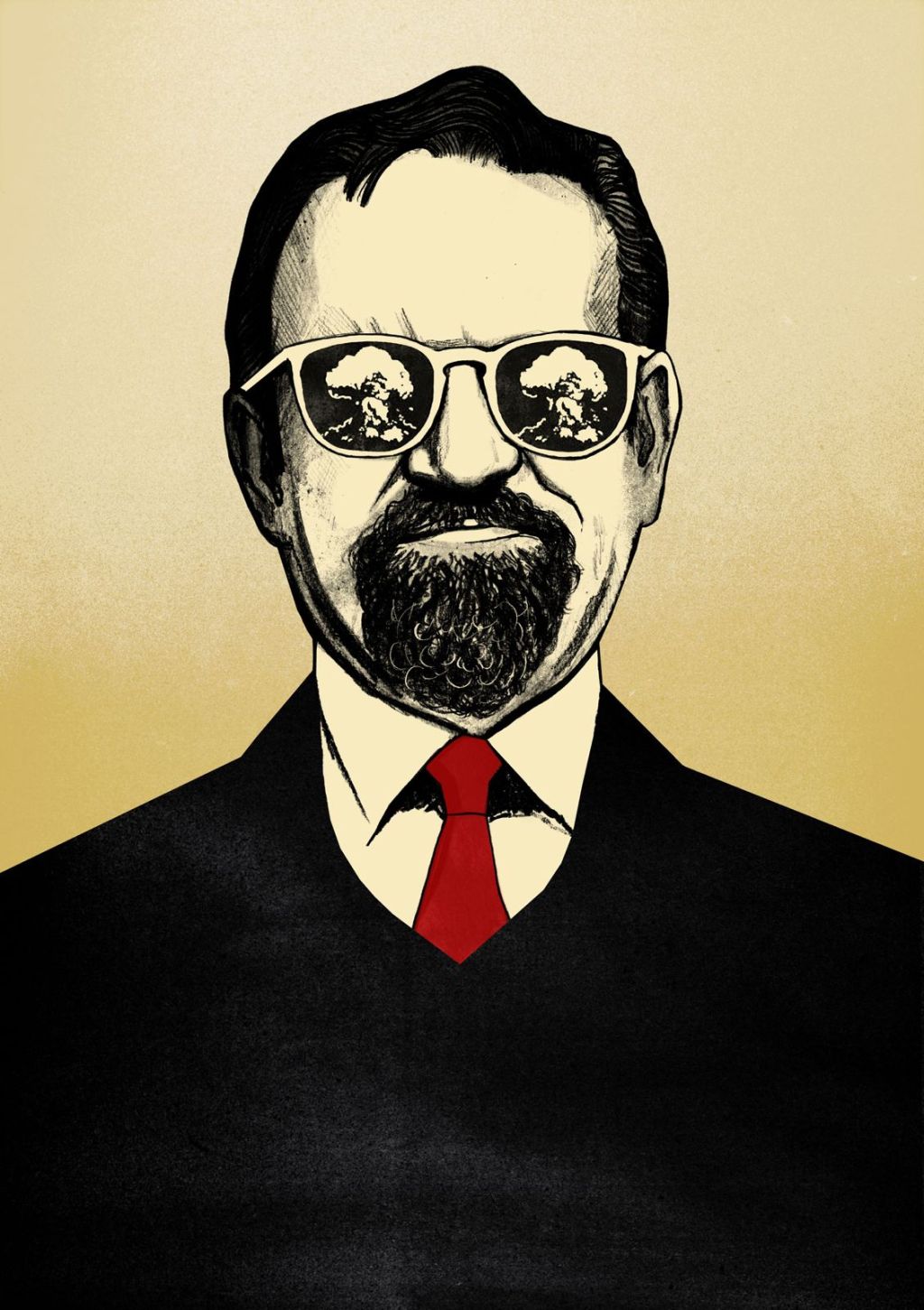
The attempts by Stalin and Stalinists to eliminate any sign of Trotsky’s existence were pinpointed by George Orwell in different ways in both Animal Farm and Nineteen Eighty-Four. Although he eventually found a publisher for the former, for a time it looked as though he might have to publish it himself; and in preparation for that possibility wrote in 1944 a foreword to the novel, not printed until long after his death, damning the publishing trade. His words are relevant to Powell and his legacy. Orwell said that “the chief danger to freedom of thought and speech” came from publishers and editors who, he asserted, were not “frightened of prosecution but… are frightened of public opinion.” This led him to a fundamental point: “In this country intellectual cowardice is the worst enemy a writer or journalist has to face, and that fact does not seem to me to have had the discussion it deserves.”
Little has changed in more than 80 years. In 1944 it was deemed unthinkable among “progressives” to attack Stalin, even though his brutality and persecution of those who dared to disagree with him were well known. T.S. Eliot, then a publishing executive, admitted that rejecting Animal Farm was one of the worst mistakes of his career, but he had felt that public opinion was not ready for an attack on Stalin. Even Orwell’s own publisher, Victor Gollancz, would not touch it. No author should rush to identify himself with a genius such as Orwell; but until the appearance of this edition of Like the Roman I had been struggling for three or four years to find a publisher to put the book back into print. It became quite clear to me, as I and my literary agent tried a number of publishing houses, that fear of public opinion – real or perceived – was largely responsible for our failure to re-issue the book.
Yet Powell was, quite simply, one of the foremost conservative thinkers in living memory, possibly the greatest since Burke. In economics, he arrived at a modern idea of monetarism some years before Milton Friedman. Margaret Thatcher herself identified him as one of the architects of Thatcherism. He made the Brexiteers’ case for leaving the EU from March 1969, four years before Britain even entered what was then called the Common Market. His deep skepticism about the confluence of America’s interests with those of Britain seemed bizarre when he voiced them in the depths of the Cold War in the 1960s; in the era of Donald Trump they seem entirely sensible, and prescient.
He had a view of the British values and way of life with which many Britons to this day feel they identify
But inevitably it was his warnings about the effects of mass migration, about the failure to achieve integration and about the failure to consult the public about the policy that have reignited interest in Powell and his doctrines. It is too simplistic to utter the old mantra that “Enoch was right”: for Powell could not have predicted, and did not predict, the present chaos in Britain’s border controls, or the abdication of decisions about individual migration cases to an extra-territorial court. However, many who reread some of his speeches from the late 1960s and early 1970s – and reread them with the care he would have wished – will notice that his warnings were far from baseless. Their good sense gives him a great relevance, but they are not the only reason why he is relevant.
He had a view of the British polity, values and way of life with which many Britons to this day feel they identify, and that is not least what establishes him as one of the country’s greatest conservative influences. It will guarantee that that reputation endures. The attempt to vilify and to cancel him, coming in a dangerous period where freedom of speech and expression seemed more under threat in Great Britain than at any time since the 17th century, will prove temporary. His true importance will survive.
Tickets for Enoch Powell’s Complicated Legacy, on 2 June, are sold out but you can watch via livestream at spectator.com/livestream on the night at 7 p.m.
The new edition of Simon Heffer’s Like the Roman is out now (wylfings.com/like-the-roman).


Comments