
It is 70 years since Donald McLachlan’s Daily Telegraph leader urged prime minister Sir Anthony Eden to demonstrate ‘the smack of firm government’, and there has always been an element of the British electorate which thrills at the idea. This is a constituency Nigel Farage knows well and has long courted, the same one that looked at the chaos of the mid-1970s and wondered whether activist groups calling for a ‘strong leader’ might have a point.
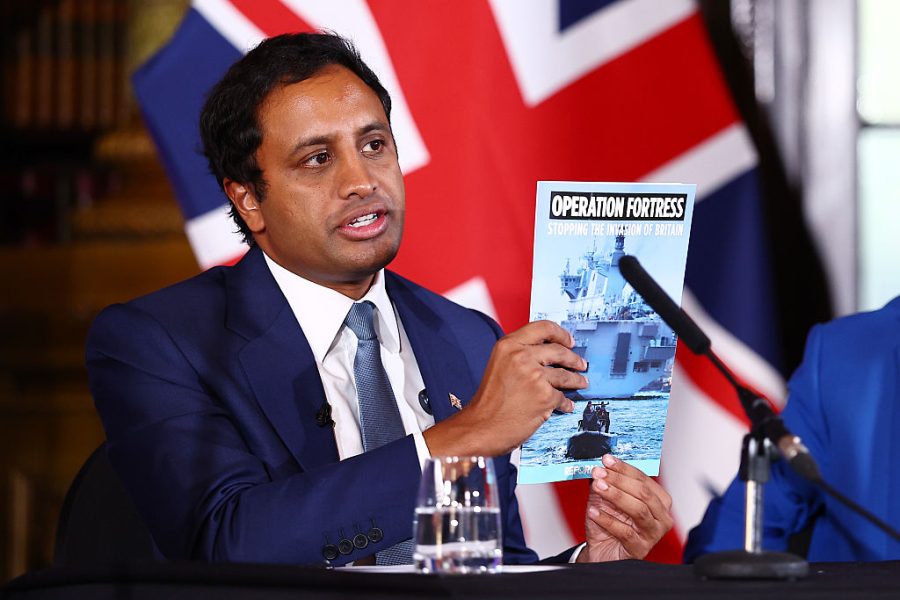
Reform UK has returned to this mood music once again as it sets out new policies on illegal migration. Its home affairs spokesman, Zia Yusuf, has been laying out the basic features of what is posturingly dubbed ‘Operation Fortress’:
Britain is being invaded. Tory and Labour governments responded with a free ferry service and free hotels. Reform UK will respond by launching the largest military operation in the English Channel since world war two.
There are many potential flaws in Reform’s Britain-at-bay, fight-them-on-the-beaches plan
Ready to pass emergency legislation if necessary, a future Reform government will create a joint command drawn from the Royal Navy and Royal Marines, the Army and the Royal Air Force to intercept unauthorised vessels in the Channel, detain the occupants and return them to France or Belgium on Royal Navy warships. Yusuf concedes there may be a ‘diplomatic argument’ but is unfazed by the fact that, under the United Nations Convention on the Laws of the Sea, France and Belgium would have to consent to the plan. He asserts – on an as-yet-obscure legal basis – that those countries have a ‘commitment under international law’ to process migrants.
According to Reform, this policy will make the country’s border ‘impenetrable’, a neon-lit hostage to fortune if ever there was one. It is simple electoral calculus to appeal to enormous, if inchoate, public anger and frustration over illegal migration. On the other hand, Home Office figures show that the numbers attempting to cross the Channel illegally this year have fallen by 43 per cent compared to the corresponding period last year, and the number of so-called ‘small boats’ has been on a downward trend since the peak of 2022.

Few would deny that there is a great deal more to do on controlling illegal migration. Labour’s 2024 election manifesto wisely did not commit to a specific figure for reducing illegal migration, but Reform has upped the ante stratospherically by saying that such action will effectively stop them altogether. Given that 41,472 people crossed the Channel in small boats last year, that is an ambitious target.
No one should underestimate the level of frustration and disenchantment among the public that the Conservatives were elected on manifestos in 2010, 2015 and 2017, which all promised to reduce net migration to ‘tens of thousands’ and abjectly failed to do so. But Reform, essentially a one-man show with a variety of eccentric, ambitious, inexperienced, disillusioned and shallow-thinking support acts, repeatedly falls into the trap of thinking its opponents have failed not because coherent and coordinated policy-making is hard, but because none has possessed the bravery and clarity of vision simply to do what is necessary, to grasp nettles, seize bulls by their horns and get jobs done.
There are many potential flaws in Reform’s Britain-at-bay, fight-them-on-the-beaches plan. If Yusuf’s optimism is misplaced and neither France nor Belgium will accept detained migrants, the whole scheme falls apart at first contact. The UK has little enough leverage with our EU neighbours as we try to gather together some tracings of our former membership without re-applying or accepting any of the costs and disadvantages.
There are also practical and moral considerations. The Royal Navy is impossibly stretched at the moment: six Type 45 destroyers, five Type 23 frigates and eight River-class, 16 Archer-class and two Cutlass-class patrol vessels represent the total potential surface fleet (unless Reform plans to deploy an aircraft carrier or the Nelson-flagship HMS Victory). The Type 45s and Type 23s are only at around 50 per cent availability and needed for other tasks. Former Royal Navy commander Tom Sharpe explained to the BBC that the larger warships ‘are not best used for ferrying people around… you’re better off using an actual ferry’.
It would be negligent to ignore the lingering question: what if migrants refuse to comply with Reform’s new joint command? What if they resist detention or transportation to France or Belgium? International law requires coastal states to help anyone in distress at sea and to get them to a safe place on land as quickly as possible. The only exception to this is if doing so would put the vessel undertaking the rescue or its crew at risk. How will these obligations mesh with Operation Fortress, or are they merely pettifogging regulations compromising our border security?
Reform clearly thinks the current Border Security Command and Border Force are inadequate. It also bats away potential legal issues carelessly, implying all will easily be resolved, even if a ‘diplomatic argument’ is required. Maybe this is not the point. Maybe Operation Fortress is not intended as a serious, detailed policy proposal but a performative flexing of the muscles: this is how far we’re prepared to go. Nigel Farage has enjoyed a successful 30-year career by tossing out brash, sometimes inflammatory soundbites, knowing he will never be held to account for their implementation. But the difficulties, inadequacies and scandals which have beset a number of the local authorities Reform now controls is instructive: with power comes responsibility and accountability.
Loyal Reform voters will feel a shiver of delight at these new plans. Dyed-in-the-wool progressives will have every fear confirmed. It is interesting to speculate how the Royal Navy and the other services feel. But nothing has changed. Reform raises the stakes, but we will have to wait until the electorate turns them away or calls their bluff.






Comments