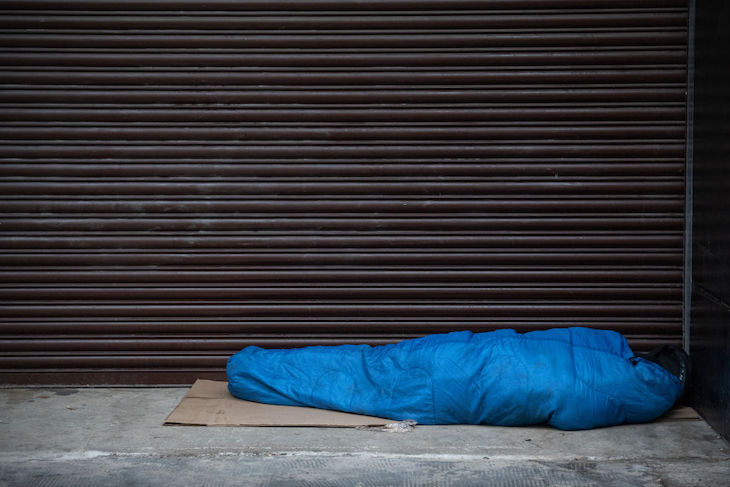
The government’s decision to decriminalise rough sleeping by repealing the Vagrancy Act of 1824 has been met with outrage and wringing hands. For some, the police losing their powers to move rough sleepers on evokes the prospect of tent cities and businesses plagued by people living in doorways.
Yet the change, which will be formally enacted today, is really only a rationalisation which brings the law into line with reality. Last time it was in power, Labour pledged to dramatically reduce the numbers of people on the streets. Set up in 1999, the Rough Sleepers Unit brought together local government, the police, health services and the voluntary sector to, as homelessness tsar Louise Casey said earnestly when I interviewed her, encourage rough sleepers to ‘come in from the cold’.
The homeless sat in Trafalgar Square in their hundreds, with smaller groups settling in the surrounding streets
The numbers of rough sleepers took a dip but rose again post-credit crunch. In 2018, the Conservative government launched a strategy which aimed, by doing something clever with stamp duty receipts, to end rough sleeping in England by 2027.
Lockdown presented the government with a particular challenge: how could you confine the entire population to their homes while some people were visibly living on the streets? A bold initiative seemed to offer the solution. Under the ‘Everyone In’ initiative, local councils were given funding to block book hotel rooms and instructed to disregard the eligibility criteria for accommodation. With concerns about the transmission of Covid circulating, no one would ‘get left behind’, promised the Minister for Rough Sleeping.
A different reality lay behind the rhetoric. An isolated hotel room is the last place most homeless people want to spend the day and there was little provision for food. So the empty capital became host to a new population, a mixture of those who refused to ‘come in’ and those who slept in the hotels but spent the day outside.
In 2020, I joined teams distributing hot meals with an informal organisation called Under One Sky. The big charities were nowhere to be seen and the day centres on which homeless people relied were closed. (Afterwards, a Salvation Army worker told me the decision to shut services had followed a ‘risk assessment’.)
The homeless sat in Trafalgar Square in their hundreds, with smaller groups settling in the surrounding streets. There were rows of tents off the Strand and a jolly community in the Embankment gardens. While shops and businesses were closed, there was a huge police presence: red security vans lined the streets and cars patrolled the area. The police ignored the homeless and for months the two groups co-existed as if the other did not exist. Central London was like the dystopian novel Noughts and Crosses.
As volunteers, our brief was to talk to our beneficiaries as well as hand out food. The conversations confirmed what I’d learnt from previous experience of working with the homeless: the reasons vary hugely and the causes are complex. Losing a home can stem from relationship breakdown and job loss; the inability to maintain one from mental health problems and addiction. Some longterm homeless are so used to living on the street they can’t bear to be in a house. I met a couple of traditional travellers, self-sufficient loners who would accept food but shunned the rowdiness of hostels.
In the wake of Covid, the problem of homelessness is worse than ever. This was entirely foreseeable: printing money and closing businesses have obvious economic consequences and risk tipping people who might otherwise have been all right over the edge. The previous owner of my cat is one such: she lost her job during Covid, took to drink and then had her flat repossessed, leaving the cat to scavenge in local gardens. She, the cat’s former owner, now sleeps on a friend’s sofa a couple of streets away, one of a wider population of hidden homeless.
The truth is that no British government has been genuinely interested in tackling homelessness. The causes are too big, and addressing them would require the kind of social and economic transformation no political party knows how to bring about. In an affluent and stable society, the numbers of rough sleepers would likely dwindle to a tiny number made up of the odd travelling man and person having a life crisis.
But with rising prices and a deteriorating economy, it seems inevitable that the numbers of people sleeping rough will grow. According to a recent survey by the Office for National Statistics, a quarter of British households have less than £2,100 in savings, making them a month or two away from a missed mortgage payment. One count last autumn revealed almost 5,000 people sleeping rough in England, an increase of 96 per cent since 2021 and the highest number ever recorded.
Linked to this is an even more difficult truth: some politicians are wedded to policies – The Spectator‘s readers will have their own examples – which create the conditions for poverty and distress. In this context, rough sleepers are part of the collateral damage.
Meanwhile, I suspect that the visceral reaction to the prospect of people being ‘allowed’ to sleep in public places is more a reflection of fear – it could happen to you – and shame that British society isn’t as civilised as we would like to think.



Comments