
Where’s your nearest bomb shelter? And how long would it take you to get there? What about at work? Have you downloaded an early warning app for alerts when there’s an incoming missile attack?
If you live in Britain, you probably can’t answer most of these questions. I have no idea where my nearest shelter is.
So what will you do when the time comes? All this might be purely theoretical. But it is not impossible
Israelis can answer all these questions and have been able to for years. Of course – they live under the constant threat of missile attack. They’ve had to implement effective monitoring, alerts and shelter provisions. And they’ve invested massively in anti-missile defence systems which despite the two mass casualty strikes they experienced on Saturday in Arad and Dimona, have been 92 per cent successful during an Iranian assault of over 400 ballistic missiles over the last three weeks. Since their current war with Iran started, there have been only four destruction sites in Israel.
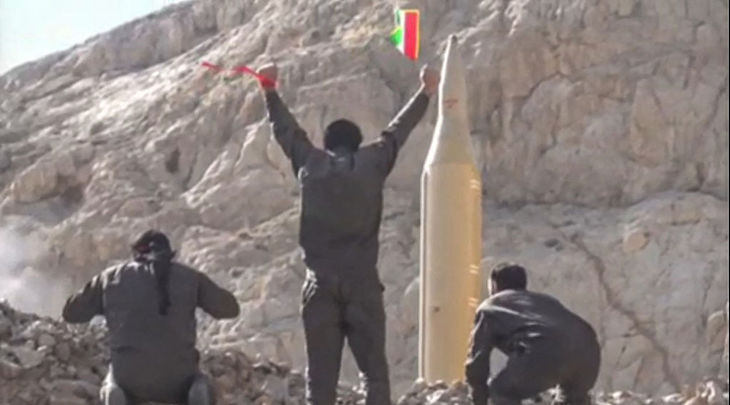
Britain has never had to deal with all that. Not since 1945, anyway. But this week the Islamic Republic of Iran proudly demonstrated its long range ability, aiming its missiles at British territory – Diego Garcia in the Chagos Islands. We now know (as we had suspected before) that Europe is also within range, including London. So what is our government doing to protect us?
Commenting from the southern Israeli city of Arad which was hit over the weekend, Israeli Prime Minister Benjamin Netanyahu spelled it out for us: Iran targets civilians, and Europe should take note, especially after Iran fired an intercontinental ballistic missile on Diego Garcia. “That’s 4,000 kilometres,” he said. “I’ve been warning all the time, they have now the capacity to reach deep into Europe. They already have fired on European countries – Cyprus. They are putting everyone in their sights.”

Perhaps Keir Starmer thinks his appeasement of Iran, Hamas, and the Islamic Republic regime itself will prove to be air defence enough. He shouldn’t: they’ve already attacked gulf states who have been their traditional allies or sought to remain neutral in this conflict. Like Britain, they have not been directly involved in striking Iran, but that didn’t buy them immunity from the theocratic lunatics. Perhaps Starmer thinks his loving caress from the now Palestinian ambassador in Westminster hall, filmed for all to see as the sounds of ‘Allahu akbar’ rung through the historic parliamentary location, will have calmed the mullahs’ ire for us British infidels. Perhaps Sadiq Khan’s Adhan in Trafalgar Square, now seen around the world, will have placated the Islamic Revolutionary regime to act as an inoculation against Islamic fundamentalist missiles. Perhaps not.
Inexplicably, it fell to Housing Secretary Steve Reed to reassure us of the UK’s military abilities. “We have systems and defences in place that keep the United Kingdom safe, and that will continue to happen,” he told Sky News. “We will take necessary defensive action to protect British interests,” he said. I hope you’ll forgive me for not believing him, but I don’t have much faith in this or previous governments having prepared in advance for this threat. Just remember how, when the Covid pandemic broke out, we discovered that successive governments had been all too ready to forfeit expensive forward planning for disasters in favour of saving a bit of money.
If the necessary measures are already in place, they need to tell us, rehearse us, prepare us. Israeli society is well versed in such matters. I’ve sat in restaurants in Israel and had to cross the road to an underground car park to seek shelter before casually returning for desert afterwards. Meetings are planned around the closest shelters. Mobile phones deliver localised warnings and even timings to help you get to a shelter when needed. Neighbours help each other out if they don’t have private shelters at home. But what can we do here in Britain if we have to take shelter, and when will our government decide to tell us about it?
Some might think this alarmist, or over the top, but the Brits and others living in Dubai never thought they would need to take shelter, until Iran attacked them without hesitation or warning. And the regime in Iran is willing to target civilian targets without hesitation. In the strikes over the weekend on Israel, they hit yet more Israeli civilian areas, wounding around 175 people across the two cities. Are we ready for this in Britain?
It’s not that they didn’t know. There has been a real and long standing concern that Iran might launch longer range missiles for years. As early as March 2019, the permanent representatives of France, Germany, and the United Kingdom to the United Nations addressed a letter to the Secretary-General (and circulated to the Security Council), expressing serious concern over Iran’s ballistic missile developments. They highlighted the Khorramshahr missile’s new conical warhead design, which appeared smaller and lighter than previous versions. Such a modification could significantly extend the missile’s range by reducing payload weight while preserving or enhancing propulsion and accuracy, potentially allowing much longer range strikes. Follow-up letters in November 2019 reiterated worries that these advances made Iran’s missiles more capable of delivering nuclear payloads. The Islamic Republic’s actions in recent weeks can only have made those concerns greater.
But our country’s defences have been neglected and degraded for years. We have nothing like Israel’s missile defences. While we officially have six Royal Navy Type 45 destroyers, recent reports confirm that only about three are currently operational or readily deployable, with the others tied up in long-term maintenance and power improvement upgrades that won’t fully conclude until around 2028. One has been sent to the Middle East to defend Cyprus. That leaves us just one to protect us back home. Our defences are not designed to protect against ballistic missiles. Successive governments have allowed this situation to arise.
Our country’s defences have been neglected and degraded for years
We are unprepared for what could happen, and our current government is officially in denial, which only makes it worse. In fact, it was the Americans and the Israelis who told us about the missiles launched at Diego Garcia, not our own Defence Secretary or Prime Minister. It has been left to foreign countries to both warn us of the dangers, and to fight against the adversary potentially posing them, all without our proper willingness to help.
Suitable civilian protection can be done outside Israel. Switzerland stands in stark contrast to Britain’s limited preparations, boasting one of the world’s most comprehensive shelter systems rooted in law since the early 1960s. Following a 1959 referendum and the 1963 Federal Protective Shelter Law, Switzerland mandated that new residential buildings include reinforced shelters or that owners contribute fees to fund nearby public ones, ensuring every resident has access to a protected space. This Cold War-era policy was designed primarily against nuclear fallout, blasts, and weapons of mass destruction, but has endured with updates, including a new civil protection ordinance effective in 2026 that modernises around 200 larger bunkers at significant cost amid renewed global threats like the wars in Ukraine and the Middle East. Today, the country maintains approximately 370,000 shelters – mostly private basement rooms in homes and buildings, plus public facilities – providing over nine million spots. That is more than 100 per cent coverage for its roughly nine million inhabitants. Britain’s public or private bomb shelters were largely dismantled after the Cold War. We have no Swiss or Israeli style plan to offer population-wide protection.
So what will you do when the time comes? All this might be purely theoretical. But it is not impossible. We can hope for the best, absolutely, but that is not a defence strategy. Unless we also prepare for the worst, we might well need to run for shelter, but we’re unlikely to find it.






Comments