
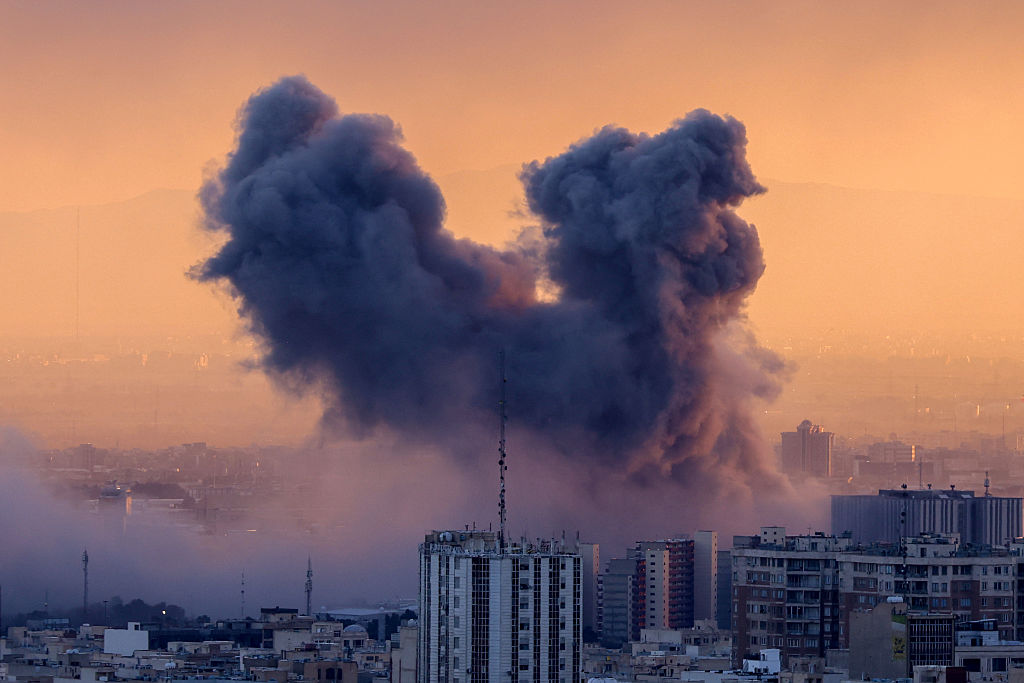
Iran’s president, Masoud Pezeshkian, has announced that the country’s temporary leadership council has approved the suspension of attacks against neighbouring countries unless those countries launch attacks on Iran themselves. He said that the council decided the day before that Iran will stop attacking surrounding states unless attacks on Iran originate from those territories. The statement was delivered publicly as the war in the region continues to intensify, and while Iran continues to launch attacks in the region in response to the US-Israeli strikes on the Islamic Republic.
The Iranian regime is already adjusting its behaviour under pressure, announcing that it will stop attacking neighbouring countries unless those countries attack Iran first
This new Iranian position comes after just one week of intense military action carried out by Israel and the United States against the Islamic regime.
In that single week, a carefully planned and determined campaign has inflicted major damage on Iran’s military infrastructure and leadership networks. Despite implementing its so-called mosaic defence strategy – a decentralised approach which gives individual commanders autonomy to keep fighting when cut off from leadership structures – the speed with which Tehran has now adjusted its posture toward neighbouring states shows the degree of pressure the regime is already under.
At the beginning of the war, the Iranian leadership attempted to widen the conflict across the region. Iranian missiles and drones were launched not only toward Israel but toward surrounding Gulf and Arab countries. With the help of its regional proxies, Iran spread the extent of its attacks from Cyprus all the way to the coast of Sri Lanka, including an attack on Nato member Turkey (which Iran denies), a European Union country, Gulf states, Israel and altogether 12 different nations.
Iran not only targeted military facilities, but also civilian locations. Hotels and other civilian sites have been struck alongside military bases and airports. The regime attempted to expand the battlefield across the region in the hope that neighbouring states would distance themselves from Israel and the United States and pressure them to halt the campaign. Instead, the opposite has happened.

The Iranian attacks on Gulf and Arab countries have reinforced the alignment between those states, Israel and the United States. Israeli planes and other defence mechanisms have actively been protecting Arab countries – something once unimaginable.
This dynamic represents a real-world demonstration of a strategic idea pursued for years by Israeli Prime Minister Benjamin Netanyahu and US President Donald Trump through the Abraham Accords. The central concept was that shared security threats from the Iranian regime would gradually produce deeper cooperation between Israel and Arab states. The events of the past week show that this logic works in practice. These Arab states did not distance themselves from Israel. The Islamic Republic attacks strengthened their alignment with Israel and the United States.
The Iranian leadership now clearly sees this reality. Continuing those strikes would only strengthen the coalition already confronting the regime.
At the same time, Iran is significantly weaker after the first week of the joint American and Israeli campaign. US and Israeli strikes have heavily degraded its military capabilities, with US Central Command reporting that ballistic missile attacks have fallen by about 90 per cent and drone attacks by roughly 83 per cent since the campaign began, after thousands of strikes on Iranian military infrastructure. The operations have also destroyed missile launch sites, underground storage and command facilities, and more than 30 Iranian naval vessels, significantly weakening Iran’s ability to launch attacks and defend its military assets. Under these conditions, the regime is likely to concentrate its remaining capabilities on continued attacks against Israeli civilians which are still deadly and numerous. Today’s announcement is an effort to put a positive spin on this need to streamline their aggression.
By contrast, Israel and the United States are signalling the opposite. Their campaign is continuing and may intensify.
Israeli officials have made clear that the war is still in its earliest stage. The head of Israeli military intelligence said in a briefing: ‘So far we have achieved full success. We are at the beginning of a campaign, and it is too early to estimate its duration or how it will develop.’
The Israeli military has also emphasised that its strikes on Iran are continuing as part of a broader effort to weaken the regime’s ability to attack Israel. In a statement today describing the latest wave of air strikes on Tehran and central Iran, the Israel Defence Forces said that more than 80 Israeli Air Force fighter jets, guided by IDF intelligence, completed an additional wave of strikes targeting infrastructure belonging to the Iranian regime. The statement added that ‘the combined effort to strengthen the impact on the Iranian regime’s firing and defence capabilities is ongoing, alongside continued efforts to degrade the Iranian regime’s production infrastructure.’
Israeli officials have also indicated that strikes on senior leadership infrastructure are continuing. Following the strike on a major underground command bunker beneath the Iranian leadership compound in Tehran yesterday, an IDF spokesperson explained that despite the elimination of the Supreme Leader, the strike on his underground compound was more than symbolic: ‘there were senior officials who thought it was protecting them. The bunker was attacked with about 100 munitions. We are examining the results of the strike.’
The United States is delivering the same message about the scale and direction of the war. US Central Command said American forces struck more than 3,000 targets during the first week of Operation Epic Fury, and emphasised that the pace of operations is ‘not slowing down’. Senior American officials have also signalled that the campaign may escalate further. US Secretary of War Pete Hegseth said that the firepower against Iran and Tehran ‘is about to surge dramatically.’ The United States is also reinforcing its military presence in the region, and is preparing to deploy a third aircraft carrier to the Middle East – the USS George H. W. Bush – as part of the continuing buildup connected to the campaign.
President Trump has also signalled that the United States is preparing the industrial base to sustain the war effort. After meeting with the chief executives of the country’s largest defence manufacturers, he said the companies had agreed to dramatically expand weapons production and accelerate manufacturing schedules.
The President said the firms had committed to quadrupling output of ‘Exquisite Class’ weaponry – sophisticated and costly, advanced, high-end systems. He added that the expansion had already begun months earlier, with new plants and production lines coming online to increase output. At the same time, he emphasised that the United States already possesses enormous stockpiles of conventional munitions. The US military, he said, has a ‘virtually unlimited supply’ of medium and upper-medium grade weapons, the kinds of munitions currently being used in operations against Iran.
All these developments reveal the strategic reality after the first week of war. The Iranian regime is already adjusting its behaviour under pressure, announcing that it will stop attacking neighbouring countries unless those countries attack Iran first. We will wait to see if it truly delivers on this promise. Israel and the United States, by contrast, are signalling continued determination and expanding military capability.
This war is far from over. But after just one week of sustained military action against a regime that kills and tortures its own citizens and sponsors violence against civilians around the world, the shift in Tehran’s posture already marks a potentially important development.
The campaign against the Iranian regime is continuing, and the first week has already produced visible strategic effects.
Is China Trump’s real target? Freddy Gray joins the latest Edition, with Madeline Grant and Labour peer Maurice Glasman, to discuss Iran, Maga – and Trump’s real strategy:

Comments