The week-long funeral ceremony for Ayatollah Ali Khamenei, Iran’s former supreme leader who was killed in a US-Israeli military strikes four months ago, is expected to draw crowds numbering in the millions. The new rulers of the Islamic Republic will make sure of that.
The Tehran hardliners will use every propaganda trick in the book to convey their message
For the regime, this is much more than a funeral ceremony; it is a religious and political spectacle, a chance to present to the world its desired image of a beloved leader mourned by millions of supporters.
The Tehran hardliners will use every propaganda trick in the book to convey their central message that Khamenei may be dead, but the regime lives on.
Iman Attarzadeh, spokesman for the funeral planning committee, had this eve of funeral message: “We view it as the beginning of a new era in the Islamic Republic”.
In other words, the names of those in charge may have changed, but nothing else.
The carefully choreographed display of national mourning, with events held across five cities, gets underway on Saturday (ironically the day that America marks the 250th anniversary of its declaration of independence).
Khamenei’s body will lie in state, alongside the bodies of his relatives at Tehran’s Grand Mosalla mosque. There will be a heavy police and security presence around the mosque complex, which is used to host many state religious ceremonies.
A steady parade of foreign dignitaries have been arriving in Iran this week to pay their respects. Invited guests include Russian and Chinese officials, a symbolic nod to Tehran’s main international allies. It comes as no great surprise that leaders from the US or Europe were not invited to attend.
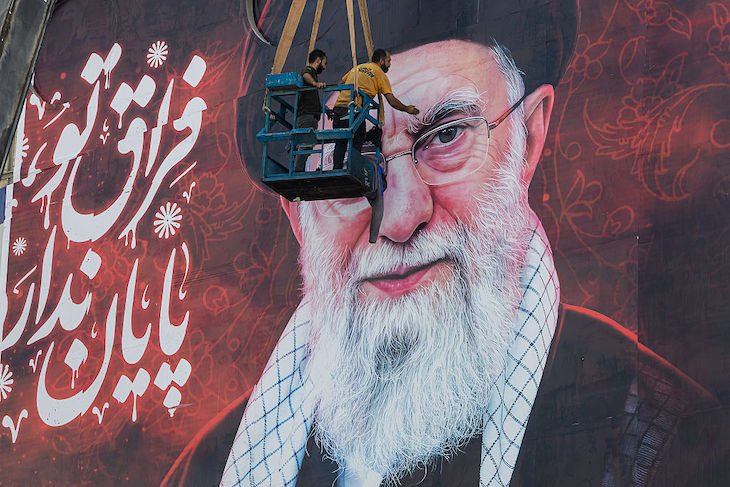
A six-mile procession through Tehran is planned for Monday. The capital has had an expensive makeover, with the streets washed clean and vast car parks created to accommodate mourners. Posters of the former supreme leader loom large everywhere. Government offices have been closed for the weekend, and Tehran’s airspace will be closed on Monday.
Even so, there will be worries about security threats, as well as the practicalities of managing huge crowds of mourners. The burial in 1989 of Khamenei’s predecessor, Ayatollah Ruhollah Khomeini, was marked by scenes of widespread chaos. The crowds lining the roadside swelled to millions, with huge numbers of people trying to rip his funeral shroud into strips to carry away as holy relics. Iran’s rulers will be anxious to avoid any repeat.
The glorification of Khamenei’s life, while millions of ordinary Iranians are struggling to make ends meet, poses its own dangers. It is a lavish expense in a country that is all but bankrupt, and something of an affront to those whose lives are dominated by shortages of food, water and medicine. Any signs of public dissent will be ruthlessly crushed by the strong police and security presence.
On Tuesday, Khamenei’s body will be taken to the holy city of Qom, Iran’s centre of religious scholarship. Every stage of Khamenei’s final journey is replete with symbolism.
After Qom, his body will go to the Iraqi Shia cities of Karbala and Najaf. This serves to highlight Khamenei’s role as a spiritual leader of Shia Muslims, but also allows the regime to nod towards Iran’s regional influence and prominence.
The final stage will be Khamenei’s burial on Thursday in Mashhad, his home town. He will be laid to rest in a shrine devoted to Imam Reza, one of the most important figures in Shia Islam.
One of the biggest unanswered questions concerns Khamenei’s son and successor, Mojtaba. Will he attend? No one really knows but it is unlikely.
This can only fuel fresh speculation about Mojtaba’s health after the military strikes in February that killed his father and many members of his family. All that is really known is that he was severely injured. He has not been seen since then and communicates with the world through written statements.
His non-appearance could also be a sign of ongoing regime worries that his life might be in danger if he is seen in public.
In a broader sense, Mojtaba is merely a figurehead. The prolonged and elaborate farewell orchestrated by Tehran’s ruling clique for his father marks a much more significant moment in the evolution of the country.
The mullahs, godfathers to the 1979 revolution, have been sidelined and no longer call the shots. Those now ruling the roost want the world to know that they have survived the war with America, endured everything thrown their way militarily, and still managed to cling on to power.
The names and faces of Tehran’s new rulers may be different, but their desire for absolute power over the country’s long-suffering people is the same.




Comments